


Step-by-Step: Setting Up Redis Caching for High-Traffic Database Queries
When application traffic spikes, hitting your primary database for repeated, read-heavy data is a quick recipe for high latency and connection pool exhaustion. Implementing a cache-aside pattern with Redis drops your response times from hundreds of milliseconds to under 5ms.
Here is a step-by-step tutorial on implementing the cache-aside pattern correctly:
Identify the Hotspot Query
Locate read-intensive queries where the underlying data doesn't change every second (e.g., user profiles, product catalogs, or system settings).
Implement the Cache-Aside Logic
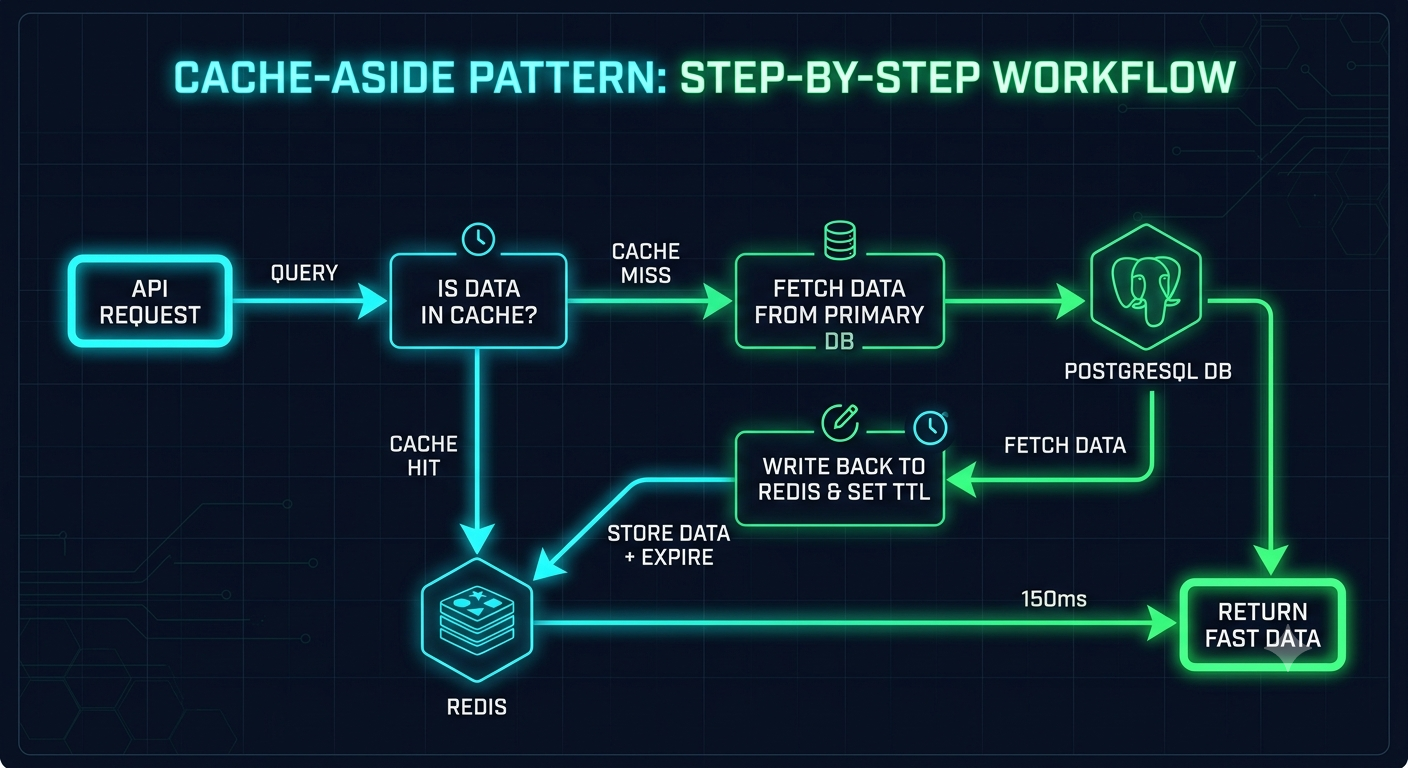
Before querying your primary database, check if the data exists in Redis.
Cache Hit: Return the data directly from Redis.
Cache Miss: Query the primary database, write the result to Redis with a TTL (Time-To-Live), and return the response.
JavaScript
async function getUserProfile(userId) {
const cacheKey = `user:${userId}`;
// Step A: Check Redis
const cachedData = await redis.get(cacheKey);
if (cachedData) {
return JSON.parse(cachedData); // Cache Hit
// Step B: Fetch from Primary DB on Cache Miss
const user = await db.users.findById(userId);
// Step C: Write to Redis with a 1-hour TTL
if (user) {
await redis.setex(cacheKey, 3600, JSON.stringify(user));
return user;
Always Set an Explicit TTL
Never store data indefinitely in Redis without an expiration time unless it is strictly static. Setting a TTL prevents stale data issues and ensures your Redis instance doesn't run out of memory.
Handle Cache Invalidation Strategy
When a user updates their profile data, write to the primary database and immediately delete or update the corresponding key in Redis (redis.del(cacheKey)). This prevents serving outdated records to your users.
Key Takeaways
Cache-aside reads from Redis first, falling back to the main database only on a cache miss.
Expiration (TTL) is non-negotiable to prevent memory bloat and stale data accumulation.
Explicitly invalidate cached keys whenever performing UPDATE or DELETE operations in the primary DB.
CTA (Join Techawks India)
Mastering backend performance requires practical, battle-tested patterns. Join Techawks India today to access more hands-on tutorials, code walkthroughs, and performance optimization guides built for developers.
When application traffic spikes, hitting your primary database for repeated, read-heavy data is a quick recipe for high latency and connection pool exhaustion. Implementing a cache-aside pattern with Redis drops your response times from hundreds of milliseconds to under 5ms.
Here is a step-by-step tutorial on implementing the cache-aside pattern correctly:
Identify the Hotspot Query
Locate read-intensive queries where the underlying data doesn't change every second (e.g., user profiles, product catalogs, or system settings).
Implement the Cache-Aside Logic
Before querying your primary database, check if the data exists in Redis.
Cache Hit: Return the data directly from Redis.
Cache Miss: Query the primary database, write the result to Redis with a TTL (Time-To-Live), and return the response.
JavaScript
async function getUserProfile(userId) {
const cacheKey = `user:${userId}`;
// Step A: Check Redis
const cachedData = await redis.get(cacheKey);
if (cachedData) {
return JSON.parse(cachedData); // Cache Hit
// Step B: Fetch from Primary DB on Cache Miss
const user = await db.users.findById(userId);
// Step C: Write to Redis with a 1-hour TTL
if (user) {
await redis.setex(cacheKey, 3600, JSON.stringify(user));
return user;
Always Set an Explicit TTL
Never store data indefinitely in Redis without an expiration time unless it is strictly static. Setting a TTL prevents stale data issues and ensures your Redis instance doesn't run out of memory.
Handle Cache Invalidation Strategy
When a user updates their profile data, write to the primary database and immediately delete or update the corresponding key in Redis (redis.del(cacheKey)). This prevents serving outdated records to your users.
Key Takeaways
Cache-aside reads from Redis first, falling back to the main database only on a cache miss.
Expiration (TTL) is non-negotiable to prevent memory bloat and stale data accumulation.
Explicitly invalidate cached keys whenever performing UPDATE or DELETE operations in the primary DB.
CTA (Join Techawks India)
Mastering backend performance requires practical, battle-tested patterns. Join Techawks India today to access more hands-on tutorials, code walkthroughs, and performance optimization guides built for developers.
Step-by-Step: Setting Up Redis Caching for High-Traffic Database Queries
When application traffic spikes, hitting your primary database for repeated, read-heavy data is a quick recipe for high latency and connection pool exhaustion. Implementing a cache-aside pattern with Redis drops your response times from hundreds of milliseconds to under 5ms.
Here is a step-by-step tutorial on implementing the cache-aside pattern correctly:
Identify the Hotspot Query
Locate read-intensive queries where the underlying data doesn't change every second (e.g., user profiles, product catalogs, or system settings).
Implement the Cache-Aside Logic
Before querying your primary database, check if the data exists in Redis.
Cache Hit: Return the data directly from Redis.
Cache Miss: Query the primary database, write the result to Redis with a TTL (Time-To-Live), and return the response.
JavaScript
async function getUserProfile(userId) {
const cacheKey = `user:${userId}`;
// Step A: Check Redis
const cachedData = await redis.get(cacheKey);
if (cachedData) {
return JSON.parse(cachedData); // Cache Hit
// Step B: Fetch from Primary DB on Cache Miss
const user = await db.users.findById(userId);
// Step C: Write to Redis with a 1-hour TTL
if (user) {
await redis.setex(cacheKey, 3600, JSON.stringify(user));
return user;
Always Set an Explicit TTL
Never store data indefinitely in Redis without an expiration time unless it is strictly static. Setting a TTL prevents stale data issues and ensures your Redis instance doesn't run out of memory.
Handle Cache Invalidation Strategy
When a user updates their profile data, write to the primary database and immediately delete or update the corresponding key in Redis (redis.del(cacheKey)). This prevents serving outdated records to your users.
Key Takeaways
Cache-aside reads from Redis first, falling back to the main database only on a cache miss.
Expiration (TTL) is non-negotiable to prevent memory bloat and stale data accumulation.
Explicitly invalidate cached keys whenever performing UPDATE or DELETE operations in the primary DB.
CTA (Join Techawks India)
Mastering backend performance requires practical, battle-tested patterns. Join Techawks India today to access more hands-on tutorials, code walkthroughs, and performance optimization guides built for developers.

 English
 Arabic
 French
 Portuguese
 Deutsch
 Turkish
 Dutch
Dutch
 Italiano
 Russian
 Romaian
 Portuguese (Brazil)
 Greek
Greek