


Serverless vs. Kubernetes: When Does the Cloud Migration Strategy Shift?
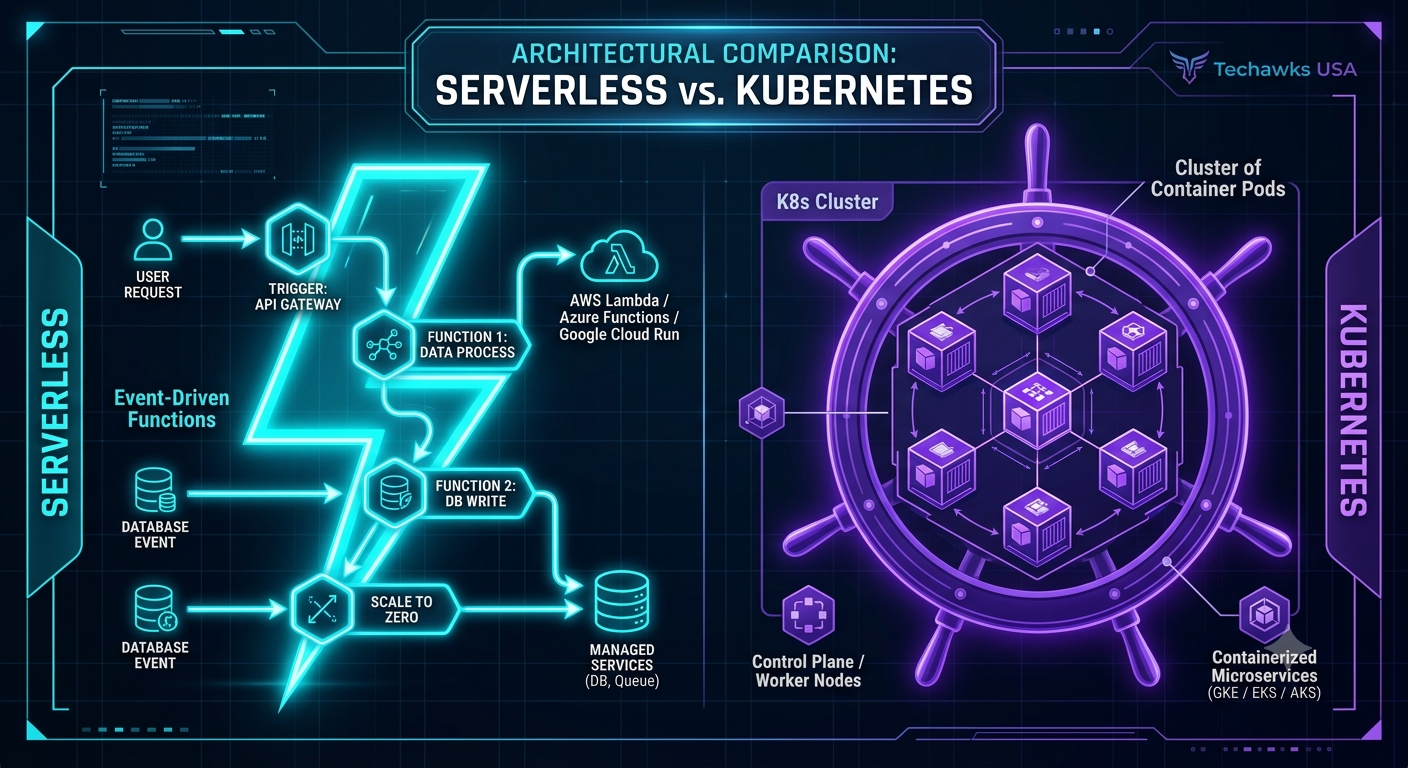
Choosing between Serverless (AWS Lambda, Google Cloud Run) and Managed Kubernetes (EKS, GKE) remains one of the most critical infrastructure decisions for US engineering leaders. While serverless promises zero infrastructure management, its costs and limitations can compound rapidly as execution scale increases.
To determine the optimal architecture for your team's current growth phase, evaluate these three core vectors:
Traffic Patterns and Predictability
Serverless excels with variable, unpredictable, or bursty traffic where scaling to zero saves significant operational costs. However, for baseline workloads with steady, predictable, high-throughput traffic, provisioned Kubernetes nodes yield far higher compute efficiency and lower per-request costs.
Operational Overhead vs. Fine-Grained Control
Kubernetes grants complete control over networking, service meshes, sidecars, and underlying runtime environments, but requires dedicated platform engineering resources to manage ingress, secrets, and cluster upgrades. Serverless shifts that maintenance burden entirely to the cloud provider, freeing your developers to focus purely on application logic.
Cold Starts and Execution Lifetimes
If your workload involves long-running jobs (over 15 minutes), heavy background compute, or strict sub-millisecond response latency, containerized environments on Kubernetes eliminate the cold-start penalty and execution timeouts inherent to function-as-a-service architectures.
Rather than committing dogmatically to one paradigm, modern engineering teams often land on a hybrid approach: using Kubernetes for core microservices and leveraging serverless for event-driven async processing.
Key Takeaways
Serverless reduces time-to-market and operational overhead for variable, event-driven workloads.
Managed Kubernetes provides predictable unit economics and fine-grained control at continuous high scale.
Hybrid patterns allow engineering teams to balance developer velocity with compute cost optimization.
CTA (Join Techawks USA)
How is your organization managing the tradeoff between serverless speed and Kubernetes control? Share your architectural lessons learned in the comments, and Join Techawks USA to engage with cloud architects and tech leaders across the country.
Choosing between Serverless (AWS Lambda, Google Cloud Run) and Managed Kubernetes (EKS, GKE) remains one of the most critical infrastructure decisions for US engineering leaders. While serverless promises zero infrastructure management, its costs and limitations can compound rapidly as execution scale increases.
To determine the optimal architecture for your team's current growth phase, evaluate these three core vectors:
Traffic Patterns and Predictability
Serverless excels with variable, unpredictable, or bursty traffic where scaling to zero saves significant operational costs. However, for baseline workloads with steady, predictable, high-throughput traffic, provisioned Kubernetes nodes yield far higher compute efficiency and lower per-request costs.
Operational Overhead vs. Fine-Grained Control
Kubernetes grants complete control over networking, service meshes, sidecars, and underlying runtime environments, but requires dedicated platform engineering resources to manage ingress, secrets, and cluster upgrades. Serverless shifts that maintenance burden entirely to the cloud provider, freeing your developers to focus purely on application logic.
Cold Starts and Execution Lifetimes
If your workload involves long-running jobs (over 15 minutes), heavy background compute, or strict sub-millisecond response latency, containerized environments on Kubernetes eliminate the cold-start penalty and execution timeouts inherent to function-as-a-service architectures.
Rather than committing dogmatically to one paradigm, modern engineering teams often land on a hybrid approach: using Kubernetes for core microservices and leveraging serverless for event-driven async processing.
Key Takeaways
Serverless reduces time-to-market and operational overhead for variable, event-driven workloads.
Managed Kubernetes provides predictable unit economics and fine-grained control at continuous high scale.
Hybrid patterns allow engineering teams to balance developer velocity with compute cost optimization.
CTA (Join Techawks USA)
How is your organization managing the tradeoff between serverless speed and Kubernetes control? Share your architectural lessons learned in the comments, and Join Techawks USA to engage with cloud architects and tech leaders across the country.
Serverless vs. Kubernetes: When Does the Cloud Migration Strategy Shift?
Choosing between Serverless (AWS Lambda, Google Cloud Run) and Managed Kubernetes (EKS, GKE) remains one of the most critical infrastructure decisions for US engineering leaders. While serverless promises zero infrastructure management, its costs and limitations can compound rapidly as execution scale increases.
To determine the optimal architecture for your team's current growth phase, evaluate these three core vectors:
Traffic Patterns and Predictability
Serverless excels with variable, unpredictable, or bursty traffic where scaling to zero saves significant operational costs. However, for baseline workloads with steady, predictable, high-throughput traffic, provisioned Kubernetes nodes yield far higher compute efficiency and lower per-request costs.
Operational Overhead vs. Fine-Grained Control
Kubernetes grants complete control over networking, service meshes, sidecars, and underlying runtime environments, but requires dedicated platform engineering resources to manage ingress, secrets, and cluster upgrades. Serverless shifts that maintenance burden entirely to the cloud provider, freeing your developers to focus purely on application logic.
Cold Starts and Execution Lifetimes
If your workload involves long-running jobs (over 15 minutes), heavy background compute, or strict sub-millisecond response latency, containerized environments on Kubernetes eliminate the cold-start penalty and execution timeouts inherent to function-as-a-service architectures.
Rather than committing dogmatically to one paradigm, modern engineering teams often land on a hybrid approach: using Kubernetes for core microservices and leveraging serverless for event-driven async processing.
Key Takeaways
Serverless reduces time-to-market and operational overhead for variable, event-driven workloads.
Managed Kubernetes provides predictable unit economics and fine-grained control at continuous high scale.
Hybrid patterns allow engineering teams to balance developer velocity with compute cost optimization.
CTA (Join Techawks USA)
How is your organization managing the tradeoff between serverless speed and Kubernetes control? Share your architectural lessons learned in the comments, and Join Techawks USA to engage with cloud architects and tech leaders across the country.

 English
 Arabic
 French
 Spanish
 Deutsch
 Turkish
 Dutch
Dutch
 Italiano
 Russian
 Romaian
 Portuguese (Brazil)
 Greek
Greek