


Stop Overpaying for Inference: Why Modern AI Architecture Demands Dynamic Test-Time Compute Routing
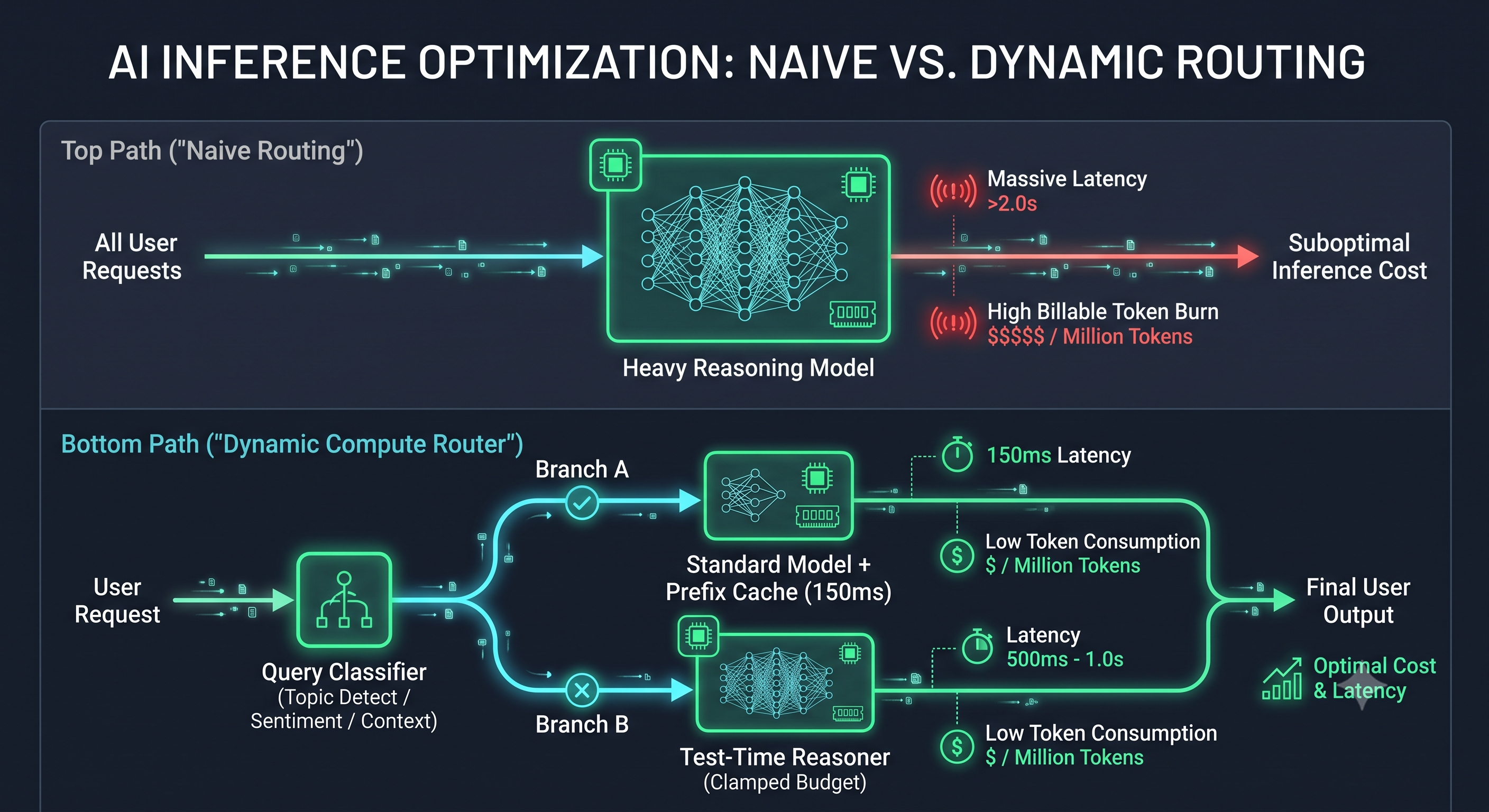
With the rise of reasoning models and test-time compute scaling, developers are encountering a major production bottleneck: the Inference Cost-Latency Paradox.
Test-time compute allows models to generate hidden reasoning traces, self-correct intermediate logic, and explore search trees before emitting a final answer. While this drastically boosts accuracy on complex algorithmic tasks, multi-step math, and refactoring benchmarks, it introduces massive overhead for standard enterprise workflows:
Hidden Token Consumption: Internal chain-of-thought tokens are billable and can expand a simple query's payload exponentially.
GPU Memory Occupancy: Extended inference loops monopolize KV cache resources, reducing total concurrent throughput.
Diminishing Returns: For classification, deterministic transformations, or single-step extraction, reasoning models often yield identical output to standard models while degrading p95 latency.
To build production-grade AI systems, production teams are implementing Adaptive Inference Routing:
Complexity-Based Semantic Classification:
Route inbound prompts through lightweight classifier models or fast embeddings to flag high-ambiguity vs. deterministic tasks before invoking the generation engine.
Dynamic Reasoning Budget Allocation:
Clamp thinking token budgets programmatically based on the detected task profile (e.g., zero thinking tokens for simple JSON normalization; high search depth for multi-file code synthesis).
Hybrid Verification with Speculative Execution:
Use fast draft/small models for standard paths and invoke heavy reasoning models only as an escalation fallback when schema or outcome verifiers fail.
The Architectural Takeaway:
Raw model reasoning capability only creates business value when paired with a routing layer that knows when not to think.
Discussion Question
How are you managing the tradeoff between deep reasoning models and standard latency-sensitive LLMs in your production pipeline? Are you using hardcoded model tiers or dynamic runtime routing?
CTA
Looking to master model routing, inference optimization, and modern LLM application architecture?
👉 Join AI Builders & Enthusiasts at Techawks to learn, build, and scale production systems alongside global engineers.
With the rise of reasoning models and test-time compute scaling, developers are encountering a major production bottleneck: the Inference Cost-Latency Paradox.
Test-time compute allows models to generate hidden reasoning traces, self-correct intermediate logic, and explore search trees before emitting a final answer. While this drastically boosts accuracy on complex algorithmic tasks, multi-step math, and refactoring benchmarks, it introduces massive overhead for standard enterprise workflows:
Hidden Token Consumption: Internal chain-of-thought tokens are billable and can expand a simple query's payload exponentially.
GPU Memory Occupancy: Extended inference loops monopolize KV cache resources, reducing total concurrent throughput.
Diminishing Returns: For classification, deterministic transformations, or single-step extraction, reasoning models often yield identical output to standard models while degrading p95 latency.
To build production-grade AI systems, production teams are implementing Adaptive Inference Routing:
Complexity-Based Semantic Classification:
Route inbound prompts through lightweight classifier models or fast embeddings to flag high-ambiguity vs. deterministic tasks before invoking the generation engine.
Dynamic Reasoning Budget Allocation:
Clamp thinking token budgets programmatically based on the detected task profile (e.g., zero thinking tokens for simple JSON normalization; high search depth for multi-file code synthesis).
Hybrid Verification with Speculative Execution:
Use fast draft/small models for standard paths and invoke heavy reasoning models only as an escalation fallback when schema or outcome verifiers fail.
The Architectural Takeaway:
Raw model reasoning capability only creates business value when paired with a routing layer that knows when not to think.
Discussion Question
How are you managing the tradeoff between deep reasoning models and standard latency-sensitive LLMs in your production pipeline? Are you using hardcoded model tiers or dynamic runtime routing?
CTA
Looking to master model routing, inference optimization, and modern LLM application architecture?
👉 Join AI Builders & Enthusiasts at Techawks to learn, build, and scale production systems alongside global engineers.
Stop Overpaying for Inference: Why Modern AI Architecture Demands Dynamic Test-Time Compute Routing
With the rise of reasoning models and test-time compute scaling, developers are encountering a major production bottleneck: the Inference Cost-Latency Paradox.
Test-time compute allows models to generate hidden reasoning traces, self-correct intermediate logic, and explore search trees before emitting a final answer. While this drastically boosts accuracy on complex algorithmic tasks, multi-step math, and refactoring benchmarks, it introduces massive overhead for standard enterprise workflows:
Hidden Token Consumption: Internal chain-of-thought tokens are billable and can expand a simple query's payload exponentially.
GPU Memory Occupancy: Extended inference loops monopolize KV cache resources, reducing total concurrent throughput.
Diminishing Returns: For classification, deterministic transformations, or single-step extraction, reasoning models often yield identical output to standard models while degrading p95 latency.
To build production-grade AI systems, production teams are implementing Adaptive Inference Routing:
Complexity-Based Semantic Classification:
Route inbound prompts through lightweight classifier models or fast embeddings to flag high-ambiguity vs. deterministic tasks before invoking the generation engine.
Dynamic Reasoning Budget Allocation:
Clamp thinking token budgets programmatically based on the detected task profile (e.g., zero thinking tokens for simple JSON normalization; high search depth for multi-file code synthesis).
Hybrid Verification with Speculative Execution:
Use fast draft/small models for standard paths and invoke heavy reasoning models only as an escalation fallback when schema or outcome verifiers fail.
The Architectural Takeaway:
Raw model reasoning capability only creates business value when paired with a routing layer that knows when not to think.
Discussion Question
How are you managing the tradeoff between deep reasoning models and standard latency-sensitive LLMs in your production pipeline? Are you using hardcoded model tiers or dynamic runtime routing?
CTA
Looking to master model routing, inference optimization, and modern LLM application architecture?
👉 Join AI Builders & Enthusiasts at Techawks to learn, build, and scale production systems alongside global engineers.

 English
 Arabic
 French
 Spanish
 Portuguese
 Deutsch
 Turkish
 Dutch
Dutch
 Russian
 Romaian
 Portuguese (Brazil)
 Greek
Greek