


Stop Writing Naive Retries: Why Distributed Systems Need Idempotent Outbox Transactions
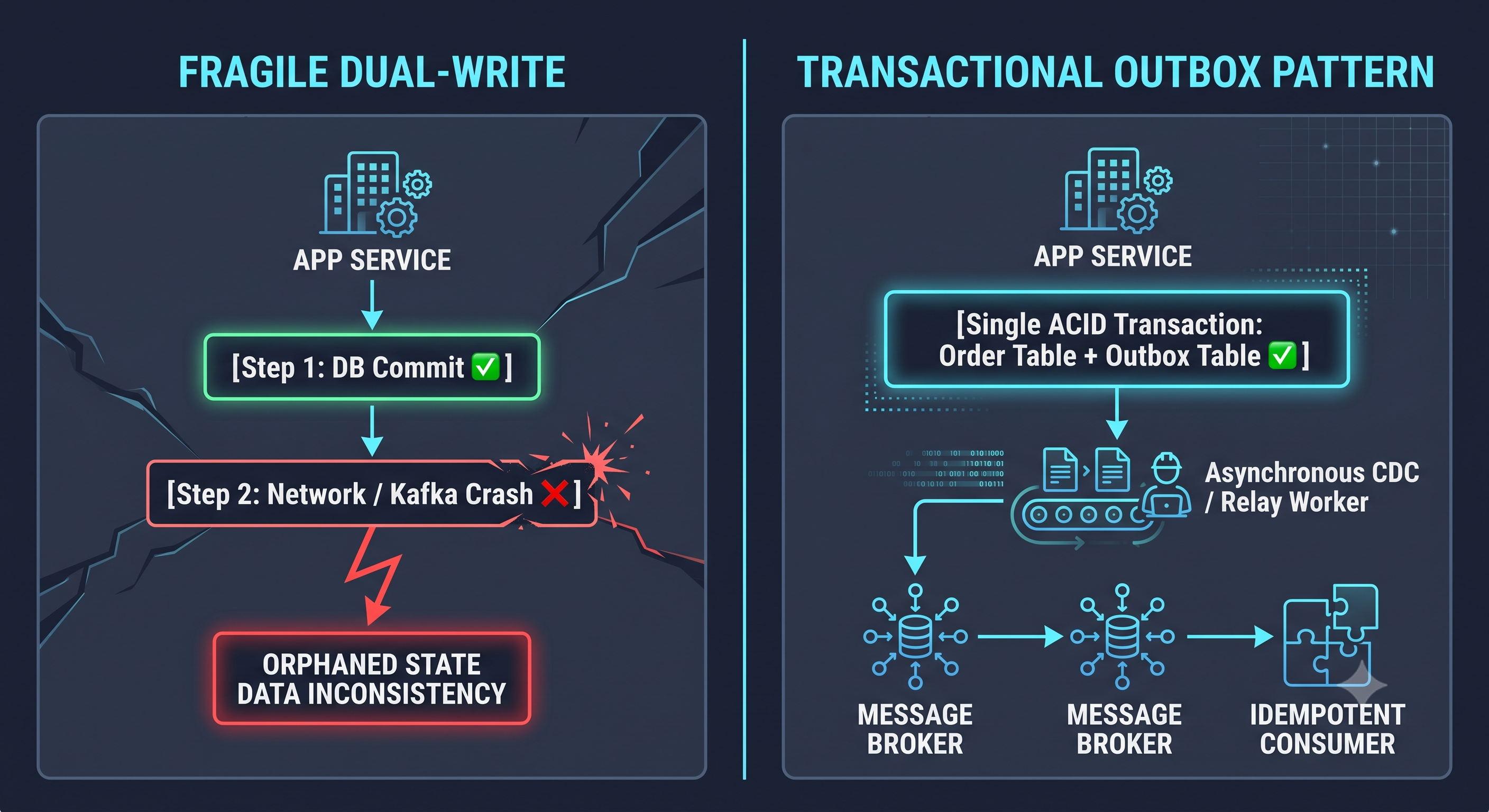
Most backend engineers implement asynchronous event delivery using a standard "dual-write" pattern:
TypeScript
// The Anti-Pattern (Dual Write)
await db.orders.create({ data: orderPayload });
await messageBroker.publish("order.created", orderPayload);
This creates an irreconcilable distributed state problem:
If the database commit succeeds but the message broker call crashes or times out, downstream consumers never receive the event (silent data loss).
If you flip the order and emit the event first, a failed DB write means downstream services act on phantom records.
If you wrap the broker publish in a naive retry loop, network jitter causes cascading retry storms and duplicated side-effects.
To build zero-data-loss event streaming, modern backend architectures rely on the Transactional Outbox Pattern paired with Idempotent Consumer Keys:
Atomic Dual-Write via Single DB Transaction:
Write your domain state change and your outbound event payload into an outbox_events table within the same local database transaction. Both succeed or both roll back together.
Decoupled Asynchronous Polling / CDC:
Use a dedicated background worker or a Change Data Capture (CDC) stream (e.g., Debezium) to tail the outbox_events table and push records to your message broker with at-least-once delivery guarantees.
Consumer-Side Idempotency Keys:
Enforce deterministic idempotency on consumers by storing a unique event_id or transaction hash in a fast cache (like Redis) or database unique constraint before executing business logic.
The Engineering Takeaway:
Network boundaries are inherently unreliable. Never cross an external network boundary inside a critical database lifecycle; decouple persistence from propagation.
Discussion Question
How does your team handle the dual-write problem across distributed microservices? Are you using CDC-driven Transactional Outbox, two-phase commits, or relying on consumer-side reconciliation scripts?
CTA
Looking to master high-throughput backend patterns, distributed systems, and clean architecture?
👉 Join Developers & Coding at Techawks to level up your engineering skills with developers worldwide.
Most backend engineers implement asynchronous event delivery using a standard "dual-write" pattern:
TypeScript
// The Anti-Pattern (Dual Write)
await db.orders.create({ data: orderPayload });
await messageBroker.publish("order.created", orderPayload);
This creates an irreconcilable distributed state problem:
If the database commit succeeds but the message broker call crashes or times out, downstream consumers never receive the event (silent data loss).
If you flip the order and emit the event first, a failed DB write means downstream services act on phantom records.
If you wrap the broker publish in a naive retry loop, network jitter causes cascading retry storms and duplicated side-effects.
To build zero-data-loss event streaming, modern backend architectures rely on the Transactional Outbox Pattern paired with Idempotent Consumer Keys:
Atomic Dual-Write via Single DB Transaction:
Write your domain state change and your outbound event payload into an outbox_events table within the same local database transaction. Both succeed or both roll back together.
Decoupled Asynchronous Polling / CDC:
Use a dedicated background worker or a Change Data Capture (CDC) stream (e.g., Debezium) to tail the outbox_events table and push records to your message broker with at-least-once delivery guarantees.
Consumer-Side Idempotency Keys:
Enforce deterministic idempotency on consumers by storing a unique event_id or transaction hash in a fast cache (like Redis) or database unique constraint before executing business logic.
The Engineering Takeaway:
Network boundaries are inherently unreliable. Never cross an external network boundary inside a critical database lifecycle; decouple persistence from propagation.
Discussion Question
How does your team handle the dual-write problem across distributed microservices? Are you using CDC-driven Transactional Outbox, two-phase commits, or relying on consumer-side reconciliation scripts?
CTA
Looking to master high-throughput backend patterns, distributed systems, and clean architecture?
👉 Join Developers & Coding at Techawks to level up your engineering skills with developers worldwide.
Stop Writing Naive Retries: Why Distributed Systems Need Idempotent Outbox Transactions
Most backend engineers implement asynchronous event delivery using a standard "dual-write" pattern:
TypeScript
// The Anti-Pattern (Dual Write)
await db.orders.create({ data: orderPayload });
await messageBroker.publish("order.created", orderPayload);
This creates an irreconcilable distributed state problem:
If the database commit succeeds but the message broker call crashes or times out, downstream consumers never receive the event (silent data loss).
If you flip the order and emit the event first, a failed DB write means downstream services act on phantom records.
If you wrap the broker publish in a naive retry loop, network jitter causes cascading retry storms and duplicated side-effects.
To build zero-data-loss event streaming, modern backend architectures rely on the Transactional Outbox Pattern paired with Idempotent Consumer Keys:
Atomic Dual-Write via Single DB Transaction:
Write your domain state change and your outbound event payload into an outbox_events table within the same local database transaction. Both succeed or both roll back together.
Decoupled Asynchronous Polling / CDC:
Use a dedicated background worker or a Change Data Capture (CDC) stream (e.g., Debezium) to tail the outbox_events table and push records to your message broker with at-least-once delivery guarantees.
Consumer-Side Idempotency Keys:
Enforce deterministic idempotency on consumers by storing a unique event_id or transaction hash in a fast cache (like Redis) or database unique constraint before executing business logic.
The Engineering Takeaway:
Network boundaries are inherently unreliable. Never cross an external network boundary inside a critical database lifecycle; decouple persistence from propagation.
Discussion Question
How does your team handle the dual-write problem across distributed microservices? Are you using CDC-driven Transactional Outbox, two-phase commits, or relying on consumer-side reconciliation scripts?
CTA
Looking to master high-throughput backend patterns, distributed systems, and clean architecture?
👉 Join Developers & Coding at Techawks to level up your engineering skills with developers worldwide.

 English
 Arabic
 French
 Spanish
 Portuguese
 Deutsch
 Turkish
 Italiano
 Russian
 Romaian
 Portuguese (Brazil)
 Greek
Greek