


The 2026 Engineering Interview Shift: Why "Code Generation" Gets Filtered and "Code Auditability" Gets Hired
The industry-wide adoption of AI development tools has broken the traditional hiring filter. Take-home assignments and blind syntax tests no longer provide signal—because producing working code takes seconds.
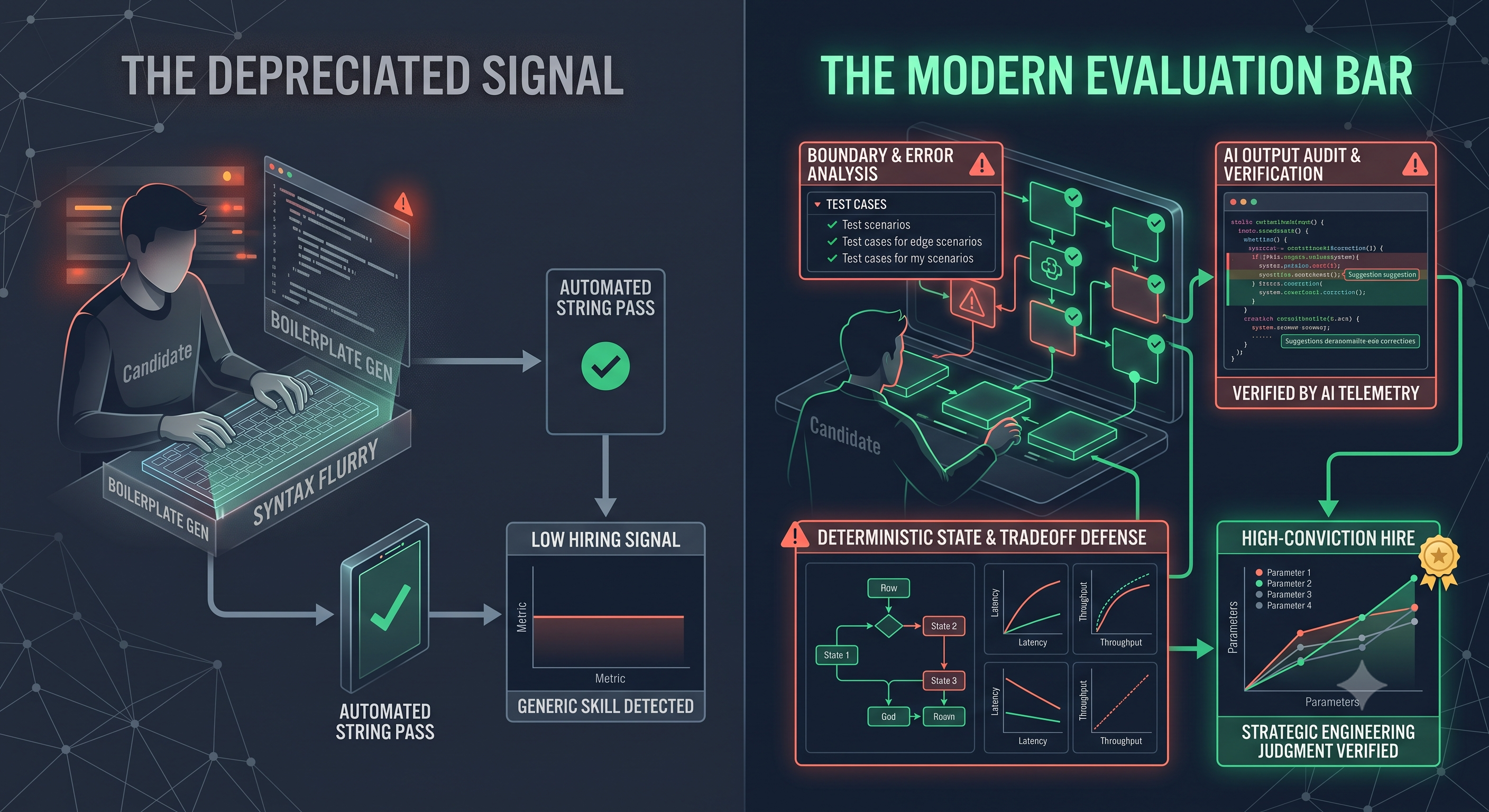
As a result, top engineering teams are changing their evaluation rubrics. The hiring bar has shifted from generation speed to system auditability, architectural taste, and error surface intuition:
Failure Mode Reasoning Over Happy Paths:
Interviewers don't just want to see a functioning microservice or API route. They look for how candidates proactively defend boundaries—handling network timeouts, connection pool exhaustion, schema drift, and silent partial failures.
AI Telemetry & Verification Judgment:
In live collaborative rounds, candidates are evaluated on how they navigate tool output. Blindly accepting boilerplate is an immediate red flag. Pinpointing edge cases, catching subtle hallucinated parameters, and designing deterministic unit test suites demonstrates real engineering depth.
Tradeoff Articulation in System Design:
Memorized architectures (e.g., standard "URL shortener" diagrams) fall flat. Strong candidates explicitly weigh trade-offs: vertical vs. horizontal bottlenecks, consistency models under network partitions, and the operational overhead of introduced dependencies.
The Career Takeaway:
Syntax is a commodity. Your competitive advantage is engineering judgment—the ability to verify, debug, harden, and communicate complex architectural decisions.
Discussion Question
What is the biggest shift you have observed in recent technical interviews? Are companies challenging your architectural trade-offs more than your raw coding speed?
CTA
Ready to navigate the evolving hiring landscape, refine your technical storytelling, and land high-impact engineering roles?
👉 Join Tech Jobs & Opportunities at Techawks to connect with mentors, hiring managers, and candidates worldwide.
The industry-wide adoption of AI development tools has broken the traditional hiring filter. Take-home assignments and blind syntax tests no longer provide signal—because producing working code takes seconds.
As a result, top engineering teams are changing their evaluation rubrics. The hiring bar has shifted from generation speed to system auditability, architectural taste, and error surface intuition:
Failure Mode Reasoning Over Happy Paths:
Interviewers don't just want to see a functioning microservice or API route. They look for how candidates proactively defend boundaries—handling network timeouts, connection pool exhaustion, schema drift, and silent partial failures.
AI Telemetry & Verification Judgment:
In live collaborative rounds, candidates are evaluated on how they navigate tool output. Blindly accepting boilerplate is an immediate red flag. Pinpointing edge cases, catching subtle hallucinated parameters, and designing deterministic unit test suites demonstrates real engineering depth.
Tradeoff Articulation in System Design:
Memorized architectures (e.g., standard "URL shortener" diagrams) fall flat. Strong candidates explicitly weigh trade-offs: vertical vs. horizontal bottlenecks, consistency models under network partitions, and the operational overhead of introduced dependencies.
The Career Takeaway:
Syntax is a commodity. Your competitive advantage is engineering judgment—the ability to verify, debug, harden, and communicate complex architectural decisions.
Discussion Question
What is the biggest shift you have observed in recent technical interviews? Are companies challenging your architectural trade-offs more than your raw coding speed?
CTA
Ready to navigate the evolving hiring landscape, refine your technical storytelling, and land high-impact engineering roles?
👉 Join Tech Jobs & Opportunities at Techawks to connect with mentors, hiring managers, and candidates worldwide.
The 2026 Engineering Interview Shift: Why "Code Generation" Gets Filtered and "Code Auditability" Gets Hired
The industry-wide adoption of AI development tools has broken the traditional hiring filter. Take-home assignments and blind syntax tests no longer provide signal—because producing working code takes seconds.
As a result, top engineering teams are changing their evaluation rubrics. The hiring bar has shifted from generation speed to system auditability, architectural taste, and error surface intuition:
Failure Mode Reasoning Over Happy Paths:
Interviewers don't just want to see a functioning microservice or API route. They look for how candidates proactively defend boundaries—handling network timeouts, connection pool exhaustion, schema drift, and silent partial failures.
AI Telemetry & Verification Judgment:
In live collaborative rounds, candidates are evaluated on how they navigate tool output. Blindly accepting boilerplate is an immediate red flag. Pinpointing edge cases, catching subtle hallucinated parameters, and designing deterministic unit test suites demonstrates real engineering depth.
Tradeoff Articulation in System Design:
Memorized architectures (e.g., standard "URL shortener" diagrams) fall flat. Strong candidates explicitly weigh trade-offs: vertical vs. horizontal bottlenecks, consistency models under network partitions, and the operational overhead of introduced dependencies.
The Career Takeaway:
Syntax is a commodity. Your competitive advantage is engineering judgment—the ability to verify, debug, harden, and communicate complex architectural decisions.
Discussion Question
What is the biggest shift you have observed in recent technical interviews? Are companies challenging your architectural trade-offs more than your raw coding speed?
CTA
Ready to navigate the evolving hiring landscape, refine your technical storytelling, and land high-impact engineering roles?
👉 Join Tech Jobs & Opportunities at Techawks to connect with mentors, hiring managers, and candidates worldwide.

 Arabic
 French
 Spanish
 Portuguese
 Deutsch
 Turkish
 Dutch
Dutch
 Italiano
 Russian
 Romaian
 Portuguese (Brazil)
 Greek
Greek