


Step-by-Step: Implementing Zero-Downtime Database Schema Migrations in Production
Renaming a database column or altering a schema constraint is one of the highest-risk operations in backend engineering. Executing a standard ALTER TABLE statement in SQL often acquires an exclusive write lock, queueing incoming transactions until the operation times out or causes cascading failure.
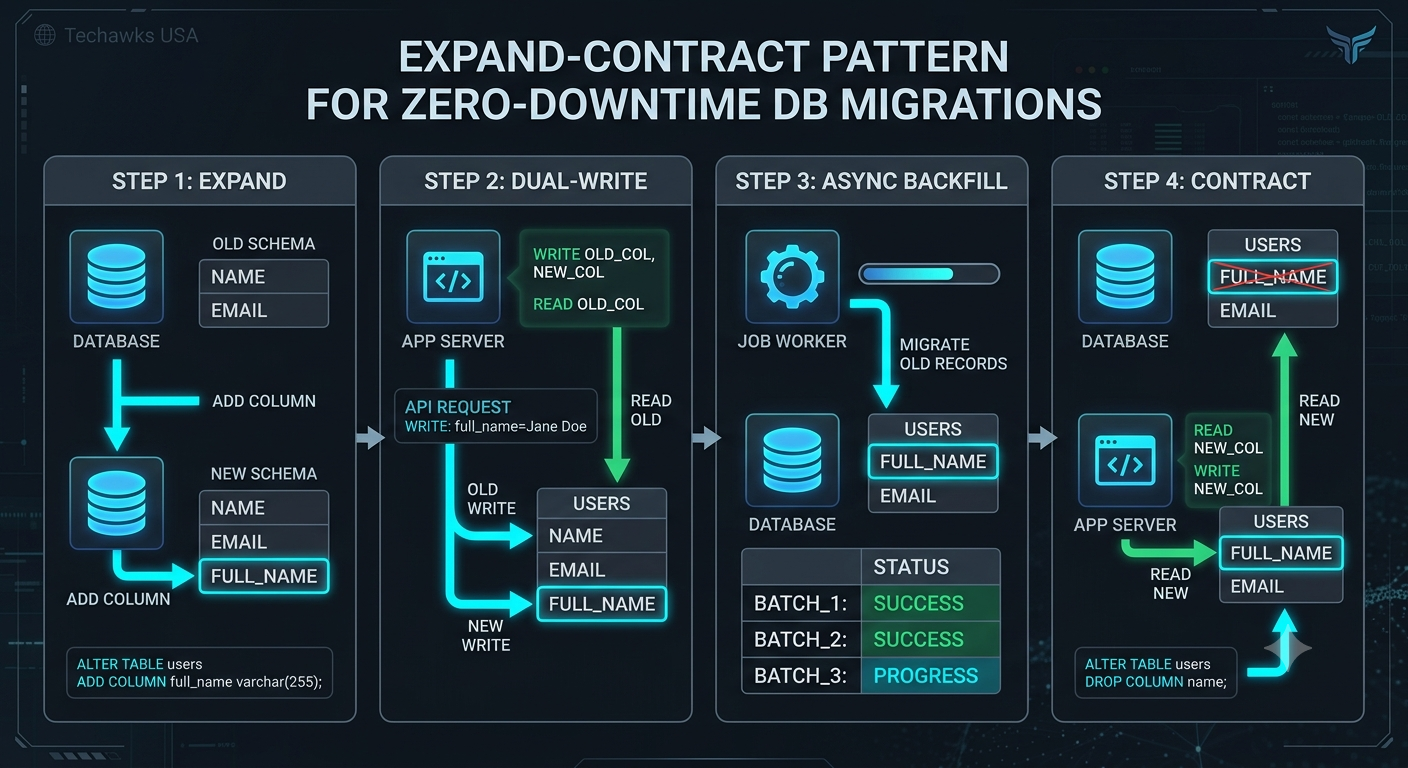
To roll out schema changes safely without downtime, use the Expand-Contract (Parallel Change) Pattern. Here is a 4-step tutorial on implementing it:
Step 1: Expand (Add the New Column alongside the Old One)
Never rename or modify an existing column in place. First, deploy a migration that adds the new column as nullable, keeping the original column intact.
SQL
Step 1: Add new column without blocking existing writes
ALTER TABLE users ADD COLUMN full_name VARCHAR(255) NULL;
Step 2: Dual-Write (Update Application Code)
Deploy application code that writes to both the old and new columns simultaneously (name and full_name), while reading strictly from the old column. This ensures all incoming updates populate both fields without breaking existing reads
.
Step 3: Backfill Historical Data
Run a background script or asynchronous batch job to migrate existing records from the old column to the new column in small, controlled batches (e.g., 1,000 rows at a time) to prevent table locks and high I/O utilization.
Step 4: Contract (Cut Over Reads and Drop the Old Column)
4A: Deploy code that switches reads to the new full_name column.
4B: Deploy code that stops writing to the old name column.
4C: Execute a final cleanup migration to drop the legacy column.
SQL
Step 4C: Safe cleanup after full application cutover
ALTER TABLE users DROP COLUMN name;
Key Takeaways
Direct schema mutations on live databases risk table locks and application downtime.
The Expand-Contract pattern decouples database migrations from code deployments.
Batching backfills prevents high I/O consumption and memory exhaustion during data migration.
CTA (Join Techawks USA)
Building zero-downtime, high-availability architecture is a essential skill for backend engineers. Join Techawks USA today to access practical guides, architectural deep dives, and system design insights built for US tech professionals.
Renaming a database column or altering a schema constraint is one of the highest-risk operations in backend engineering. Executing a standard ALTER TABLE statement in SQL often acquires an exclusive write lock, queueing incoming transactions until the operation times out or causes cascading failure.
To roll out schema changes safely without downtime, use the Expand-Contract (Parallel Change) Pattern. Here is a 4-step tutorial on implementing it:
Step 1: Expand (Add the New Column alongside the Old One)
Never rename or modify an existing column in place. First, deploy a migration that adds the new column as nullable, keeping the original column intact.
SQL
Step 1: Add new column without blocking existing writes
ALTER TABLE users ADD COLUMN full_name VARCHAR(255) NULL;
Step 2: Dual-Write (Update Application Code)
Deploy application code that writes to both the old and new columns simultaneously (name and full_name), while reading strictly from the old column. This ensures all incoming updates populate both fields without breaking existing reads
.
Step 3: Backfill Historical Data
Run a background script or asynchronous batch job to migrate existing records from the old column to the new column in small, controlled batches (e.g., 1,000 rows at a time) to prevent table locks and high I/O utilization.
Step 4: Contract (Cut Over Reads and Drop the Old Column)
4A: Deploy code that switches reads to the new full_name column.
4B: Deploy code that stops writing to the old name column.
4C: Execute a final cleanup migration to drop the legacy column.
SQL
Step 4C: Safe cleanup after full application cutover
ALTER TABLE users DROP COLUMN name;
Key Takeaways
Direct schema mutations on live databases risk table locks and application downtime.
The Expand-Contract pattern decouples database migrations from code deployments.
Batching backfills prevents high I/O consumption and memory exhaustion during data migration.
CTA (Join Techawks USA)
Building zero-downtime, high-availability architecture is a essential skill for backend engineers. Join Techawks USA today to access practical guides, architectural deep dives, and system design insights built for US tech professionals.
Step-by-Step: Implementing Zero-Downtime Database Schema Migrations in Production
Renaming a database column or altering a schema constraint is one of the highest-risk operations in backend engineering. Executing a standard ALTER TABLE statement in SQL often acquires an exclusive write lock, queueing incoming transactions until the operation times out or causes cascading failure.
To roll out schema changes safely without downtime, use the Expand-Contract (Parallel Change) Pattern. Here is a 4-step tutorial on implementing it:
Step 1: Expand (Add the New Column alongside the Old One)
Never rename or modify an existing column in place. First, deploy a migration that adds the new column as nullable, keeping the original column intact.
SQL
Step 1: Add new column without blocking existing writes
ALTER TABLE users ADD COLUMN full_name VARCHAR(255) NULL;
Step 2: Dual-Write (Update Application Code)
Deploy application code that writes to both the old and new columns simultaneously (name and full_name), while reading strictly from the old column. This ensures all incoming updates populate both fields without breaking existing reads
.
Step 3: Backfill Historical Data
Run a background script or asynchronous batch job to migrate existing records from the old column to the new column in small, controlled batches (e.g., 1,000 rows at a time) to prevent table locks and high I/O utilization.
Step 4: Contract (Cut Over Reads and Drop the Old Column)
4A: Deploy code that switches reads to the new full_name column.
4B: Deploy code that stops writing to the old name column.
4C: Execute a final cleanup migration to drop the legacy column.
SQL
Step 4C: Safe cleanup after full application cutover
ALTER TABLE users DROP COLUMN name;
Key Takeaways
Direct schema mutations on live databases risk table locks and application downtime.
The Expand-Contract pattern decouples database migrations from code deployments.
Batching backfills prevents high I/O consumption and memory exhaustion during data migration.
CTA (Join Techawks USA)
Building zero-downtime, high-availability architecture is a essential skill for backend engineers. Join Techawks USA today to access practical guides, architectural deep dives, and system design insights built for US tech professionals.

 English
 Arabic
 French
 Spanish
 Portuguese
 Deutsch
 Dutch
Dutch
 Italiano
 Russian
 Romaian
 Portuguese (Brazil)
 Greek
Greek