


Designing GDPR-Compliant Data Retention Pipelines: 4 Engineering Standards.
Complying with the Right to Erasure (Article 17 under UK GDPR) is not just a legal requirement; it is a backend engineering challenge. Naive deletion strategies often lead to broken foreign key constraints, incomplete data purges across microservices, and compromised analytics pipelines.
To build an automated, auditable, and reliable data retention architecture, implement these four technical standards:
Adopt Soft Deletes with Automated Purge Schedules
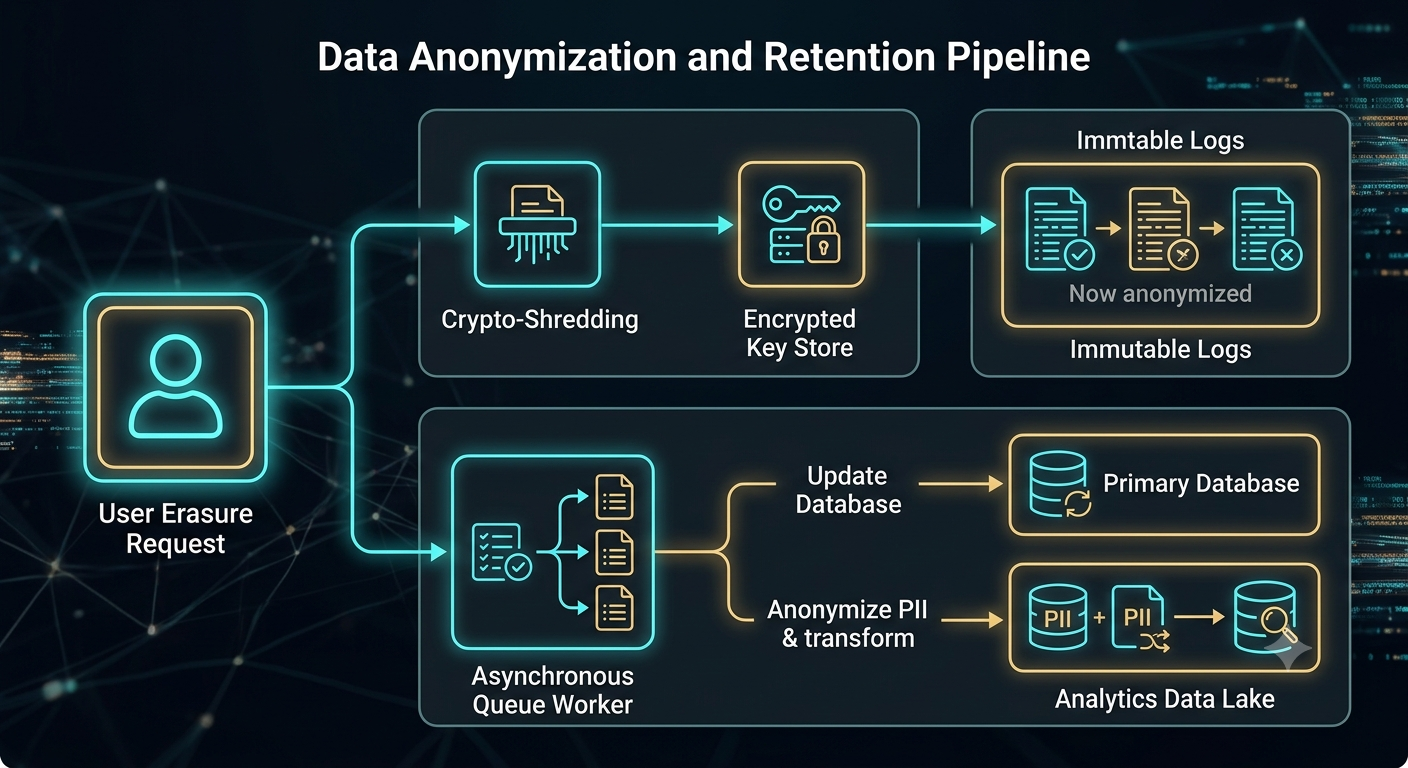
Avoid performing instant DELETE queries upon user request. Flag records with a deleted_at timestamp and transition user status to pending_purge. Schedule an asynchronous worker (e.g., via Celery or Temporal) to run batch purges during low-traffic windows, enforcing a hard retention deadline (such as 30 days).
Decouple Personally Identifiable Information (PII) from Transactional Records
Instead of deleting non-identifying transaction history needed for financial audits, isolate PII (names, emails, phone numbers) into a dedicated User Identity Service. When an erasure request executes, replace the user's PII with cryptographic hashes or anonymous UUIDs while preserving system logs and aggregated reporting.
Handle Event Stream and Log Anonymization
Logs written to Kafka, Elasticsearch, or cloud storage (AWS S3, Azure Blob) should never contain raw PII. Use pseudonymous identifiers in log payloads and maintain a separate, encrypted key-value mapping for PII. Purging a user's data then becomes a simple act of deleting their encryption key ("Crypto-Shredding"), rendering all historical log entries unreadable instantly.
Automate Backup Expiration Compliance
Database backups do not need to be modified instantly upon a deletion request—doing so risks backup corruption. Instead, set clear backup TTL (Time-to-Live) retention policies (e.g., 14 to 30 days) ensuring that overwritten or restored backups naturally drop deleted user records within an acceptable compliance window.
Key Takeaways
Crypto-shredding key management simplifies data erasure across immutable event logs and backups.
Anonymizing transactional data preserves business intelligence while fulfilling privacy obligations.
Asynchronous batch purges prevent database lockups caused by synchronous CASCADE deletions.
CTA (Join Techawks UK)
Architecting compliant, high-scale infrastructure requires sharing battle-tested strategies. Join Techawks UK today to connect with lead engineers, security architects, and CTOs across the UK tech ecosystem.
Complying with the Right to Erasure (Article 17 under UK GDPR) is not just a legal requirement; it is a backend engineering challenge. Naive deletion strategies often lead to broken foreign key constraints, incomplete data purges across microservices, and compromised analytics pipelines.
To build an automated, auditable, and reliable data retention architecture, implement these four technical standards:
Adopt Soft Deletes with Automated Purge Schedules
Avoid performing instant DELETE queries upon user request. Flag records with a deleted_at timestamp and transition user status to pending_purge. Schedule an asynchronous worker (e.g., via Celery or Temporal) to run batch purges during low-traffic windows, enforcing a hard retention deadline (such as 30 days).
Decouple Personally Identifiable Information (PII) from Transactional Records
Instead of deleting non-identifying transaction history needed for financial audits, isolate PII (names, emails, phone numbers) into a dedicated User Identity Service. When an erasure request executes, replace the user's PII with cryptographic hashes or anonymous UUIDs while preserving system logs and aggregated reporting.
Handle Event Stream and Log Anonymization
Logs written to Kafka, Elasticsearch, or cloud storage (AWS S3, Azure Blob) should never contain raw PII. Use pseudonymous identifiers in log payloads and maintain a separate, encrypted key-value mapping for PII. Purging a user's data then becomes a simple act of deleting their encryption key ("Crypto-Shredding"), rendering all historical log entries unreadable instantly.
Automate Backup Expiration Compliance
Database backups do not need to be modified instantly upon a deletion request—doing so risks backup corruption. Instead, set clear backup TTL (Time-to-Live) retention policies (e.g., 14 to 30 days) ensuring that overwritten or restored backups naturally drop deleted user records within an acceptable compliance window.
Key Takeaways
Crypto-shredding key management simplifies data erasure across immutable event logs and backups.
Anonymizing transactional data preserves business intelligence while fulfilling privacy obligations.
Asynchronous batch purges prevent database lockups caused by synchronous CASCADE deletions.
CTA (Join Techawks UK)
Architecting compliant, high-scale infrastructure requires sharing battle-tested strategies. Join Techawks UK today to connect with lead engineers, security architects, and CTOs across the UK tech ecosystem.
Designing GDPR-Compliant Data Retention Pipelines: 4 Engineering Standards.
Complying with the Right to Erasure (Article 17 under UK GDPR) is not just a legal requirement; it is a backend engineering challenge. Naive deletion strategies often lead to broken foreign key constraints, incomplete data purges across microservices, and compromised analytics pipelines.
To build an automated, auditable, and reliable data retention architecture, implement these four technical standards:
Adopt Soft Deletes with Automated Purge Schedules
Avoid performing instant DELETE queries upon user request. Flag records with a deleted_at timestamp and transition user status to pending_purge. Schedule an asynchronous worker (e.g., via Celery or Temporal) to run batch purges during low-traffic windows, enforcing a hard retention deadline (such as 30 days).
Decouple Personally Identifiable Information (PII) from Transactional Records
Instead of deleting non-identifying transaction history needed for financial audits, isolate PII (names, emails, phone numbers) into a dedicated User Identity Service. When an erasure request executes, replace the user's PII with cryptographic hashes or anonymous UUIDs while preserving system logs and aggregated reporting.
Handle Event Stream and Log Anonymization
Logs written to Kafka, Elasticsearch, or cloud storage (AWS S3, Azure Blob) should never contain raw PII. Use pseudonymous identifiers in log payloads and maintain a separate, encrypted key-value mapping for PII. Purging a user's data then becomes a simple act of deleting their encryption key ("Crypto-Shredding"), rendering all historical log entries unreadable instantly.
Automate Backup Expiration Compliance
Database backups do not need to be modified instantly upon a deletion request—doing so risks backup corruption. Instead, set clear backup TTL (Time-to-Live) retention policies (e.g., 14 to 30 days) ensuring that overwritten or restored backups naturally drop deleted user records within an acceptable compliance window.
Key Takeaways
Crypto-shredding key management simplifies data erasure across immutable event logs and backups.
Anonymizing transactional data preserves business intelligence while fulfilling privacy obligations.
Asynchronous batch purges prevent database lockups caused by synchronous CASCADE deletions.
CTA (Join Techawks UK)
Architecting compliant, high-scale infrastructure requires sharing battle-tested strategies. Join Techawks UK today to connect with lead engineers, security architects, and CTOs across the UK tech ecosystem.

 English
 Arabic
 French
 Portuguese
 Deutsch
 Turkish
 Dutch
Dutch
 Italiano
 Russian
 Romaian
 Portuguese (Brazil)
 Greek
Greek