


Centralised Platform Teams vs. Embedded DevOps: What Works for Scaling UK Tech Teams?
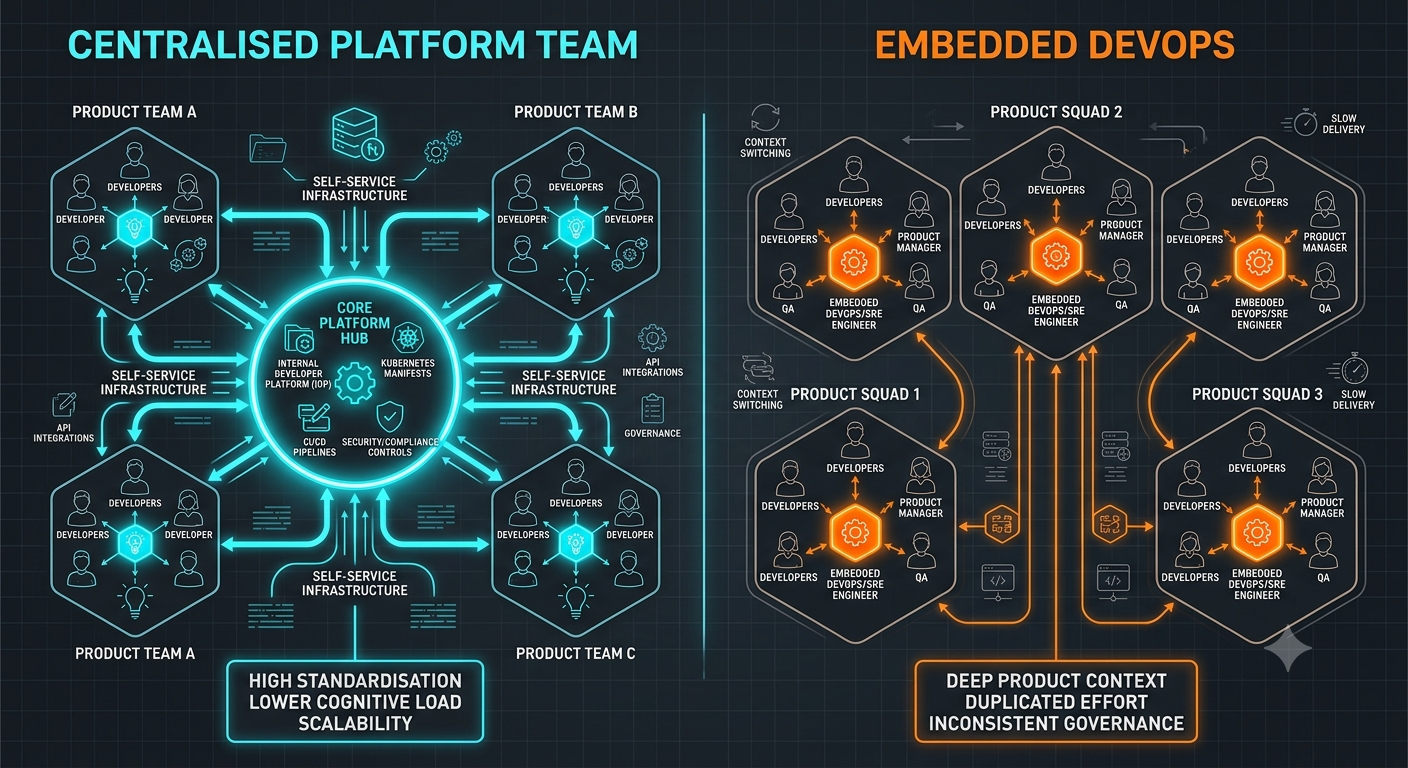
As UK tech scale-ups grow beyond 30+ engineers, the traditional "everyone does DevOps" approach rapidly hits a wall. Developers get bogged down by Kubernetes manifests, IAM permission headaches, and deployment scripts, leading to context switching and slower feature delivery.
To solve this, engineering leaders generally pivot toward one of two operational models:
The Centralised Platform Engineering Model
In this approach, a dedicated platform team builds an Internal Developer Platform (IDP) that abstracts cloud complexity away. Developers interact with self-service APIs or internal portals (like Backstage) to spin up environments, databases, and pipelines instantly.
Pros: High standardization, centralized security/compliance controls, lower cognitive load on product developers.
Cons: Risk of creating an isolated "ivory tower" team that builds tools nobody actually wants to use.
The Embedded DevOps Model
Here, specialized DevOps or Site Reliability Engineers (SREs) are embedded directly into cross-functional product squads.
Pros: Deep context on product requirements, tight alignment with feature delivery goals, faster immediate feedback loops.
Cons: Inconsistent infrastructure choices across squads, duplicated operational effort, and difficulty maintaining company-wide governance.
Finding the Right Balance
The most effective UK engineering teams often start with embedded engineers to establish initial patterns, then transition to a centralized platform team once common infrastructure bottlenecks are clearly identified across multiple squads.
Key Takeaways
Embedded DevOps speeds up early-stage feature delivery but risks infrastructure fragmentation at scale.
Centralized Platform Engineering reduces cognitive load, provided the platform is treated as a product built for internal developers.
The transition between models should be driven by measurable developer friction, not organizational trends.
CTA (Join Techawks UK)
How is your engineering organization structuring its platform and DevOps capabilities? Are you building a dedicated platform team or embedding operational specialists into squads? Share your experiences below, and Join Techawks UK to connect with CTOs, principal engineers, and tech leaders driving software delivery across the UK.
As UK tech scale-ups grow beyond 30+ engineers, the traditional "everyone does DevOps" approach rapidly hits a wall. Developers get bogged down by Kubernetes manifests, IAM permission headaches, and deployment scripts, leading to context switching and slower feature delivery.
To solve this, engineering leaders generally pivot toward one of two operational models:
The Centralised Platform Engineering Model
In this approach, a dedicated platform team builds an Internal Developer Platform (IDP) that abstracts cloud complexity away. Developers interact with self-service APIs or internal portals (like Backstage) to spin up environments, databases, and pipelines instantly.
Pros: High standardization, centralized security/compliance controls, lower cognitive load on product developers.
Cons: Risk of creating an isolated "ivory tower" team that builds tools nobody actually wants to use.
The Embedded DevOps Model
Here, specialized DevOps or Site Reliability Engineers (SREs) are embedded directly into cross-functional product squads.
Pros: Deep context on product requirements, tight alignment with feature delivery goals, faster immediate feedback loops.
Cons: Inconsistent infrastructure choices across squads, duplicated operational effort, and difficulty maintaining company-wide governance.
Finding the Right Balance
The most effective UK engineering teams often start with embedded engineers to establish initial patterns, then transition to a centralized platform team once common infrastructure bottlenecks are clearly identified across multiple squads.
Key Takeaways
Embedded DevOps speeds up early-stage feature delivery but risks infrastructure fragmentation at scale.
Centralized Platform Engineering reduces cognitive load, provided the platform is treated as a product built for internal developers.
The transition between models should be driven by measurable developer friction, not organizational trends.
CTA (Join Techawks UK)
How is your engineering organization structuring its platform and DevOps capabilities? Are you building a dedicated platform team or embedding operational specialists into squads? Share your experiences below, and Join Techawks UK to connect with CTOs, principal engineers, and tech leaders driving software delivery across the UK.
Centralised Platform Teams vs. Embedded DevOps: What Works for Scaling UK Tech Teams?
As UK tech scale-ups grow beyond 30+ engineers, the traditional "everyone does DevOps" approach rapidly hits a wall. Developers get bogged down by Kubernetes manifests, IAM permission headaches, and deployment scripts, leading to context switching and slower feature delivery.
To solve this, engineering leaders generally pivot toward one of two operational models:
The Centralised Platform Engineering Model
In this approach, a dedicated platform team builds an Internal Developer Platform (IDP) that abstracts cloud complexity away. Developers interact with self-service APIs or internal portals (like Backstage) to spin up environments, databases, and pipelines instantly.
Pros: High standardization, centralized security/compliance controls, lower cognitive load on product developers.
Cons: Risk of creating an isolated "ivory tower" team that builds tools nobody actually wants to use.
The Embedded DevOps Model
Here, specialized DevOps or Site Reliability Engineers (SREs) are embedded directly into cross-functional product squads.
Pros: Deep context on product requirements, tight alignment with feature delivery goals, faster immediate feedback loops.
Cons: Inconsistent infrastructure choices across squads, duplicated operational effort, and difficulty maintaining company-wide governance.
Finding the Right Balance
The most effective UK engineering teams often start with embedded engineers to establish initial patterns, then transition to a centralized platform team once common infrastructure bottlenecks are clearly identified across multiple squads.
Key Takeaways
Embedded DevOps speeds up early-stage feature delivery but risks infrastructure fragmentation at scale.
Centralized Platform Engineering reduces cognitive load, provided the platform is treated as a product built for internal developers.
The transition between models should be driven by measurable developer friction, not organizational trends.
CTA (Join Techawks UK)
How is your engineering organization structuring its platform and DevOps capabilities? Are you building a dedicated platform team or embedding operational specialists into squads? Share your experiences below, and Join Techawks UK to connect with CTOs, principal engineers, and tech leaders driving software delivery across the UK.

 English
 Arabic
 French
 Spanish
 Deutsch
 Turkish
 Dutch
Dutch
 Italiano
 Russian
 Romaian
 Portuguese (Brazil)
 Greek
Greek