


Step-by-Step: Implementing Zero-Trust Authentication in Microservices
Traditional perimeter security assumes that everything inside the internal network is trustworthy. Zero-Trust Architecture replaces this passive trust model with explicit, continuous verification for every inter-service request.
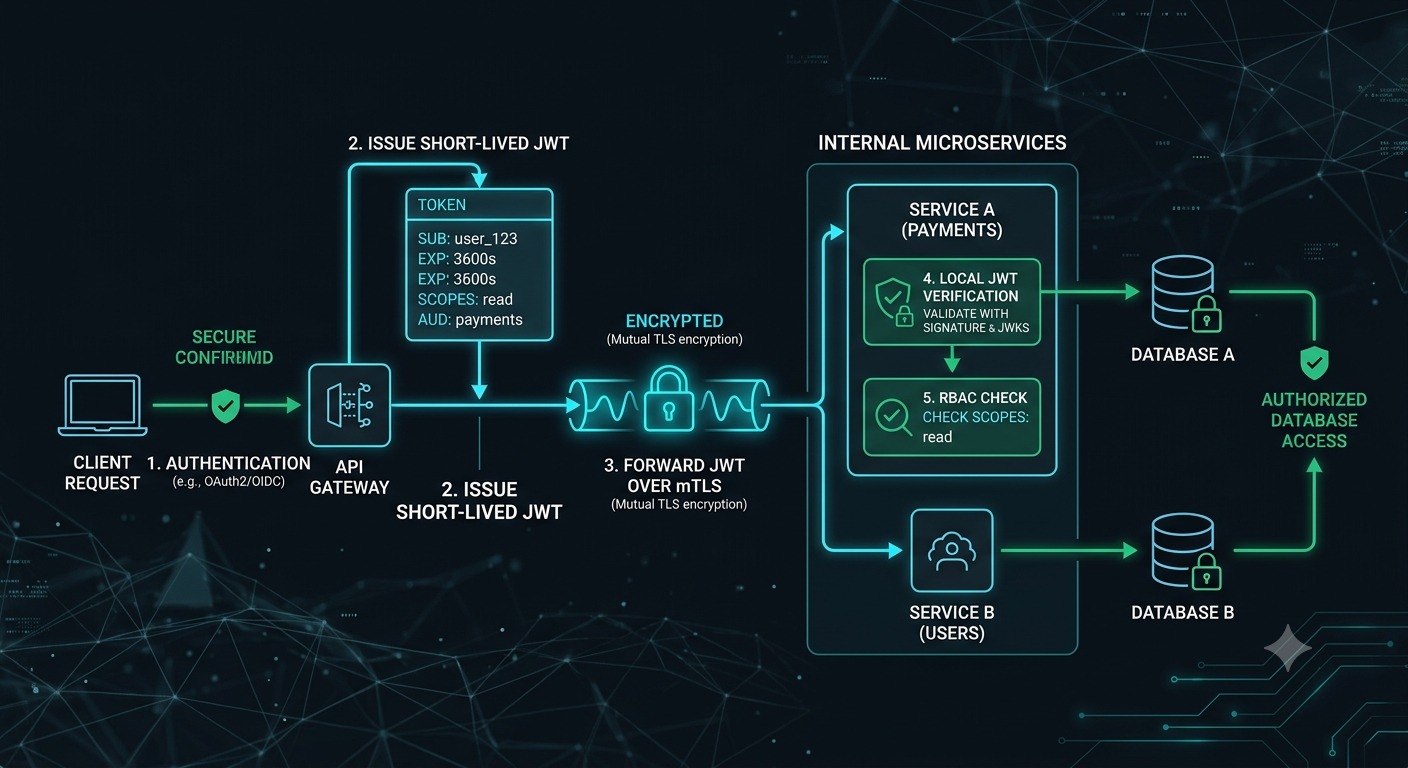
Here is a step-by-step tutorial for implementing Zero-Trust authentication between microservices using mTLS (Mutual TLS) and short-lived JWTs:
Enforce Mutual TLS (mTLS) at the Transport Layer
Configure your service mesh (such as Istio or Linkerd) or reverse proxies (Envoy/Nginx) to mandate mTLS for all internal communication.
Mechanism: Every microservice presents an X.509 certificate to authenticate its identity.
Result: Traffic between services is fully encrypted in transit, and unauthorized services cannot establish TCP connections.
Issue Short-Lived User Context Tokens (JWTs) at the Edge
When a client request hits your API Gateway, authenticate the user and issue a cryptographically signed, short-lived JSON Web Token (JWT) containing the user’s identity, roles, and scope.
JSON
{
"sub": "usr_987654321",
"iss": "https://auth.techawks.co.uk",
"aud": "order-service",
"exp": 1785787200,
"roles": ["customer"]
}
Pass and Validate Context Across Service Boundaries
Forward the user token in the HTTP Authorization header for all downstream service calls. Every downstream service must independently verify:
Signature: Validated using the Public Key Set (JWKS) fetched from the Identity Provider.
Expiration: Reject any tokens where exp has passed.
Audience/Scope: Ensure the target service is authorized to perform the action on behalf of that user.
Implement Fine-Grained Role-Based Access Control (RBAC)
Do not delegate access control solely to the API Gateway. Enforce authorization checks locally inside each microservice endpoint (e.g., verifying roles or specific permission claims before executing database reads or writes).
Key Takeaways
mTLS authenticates service identity and encrypts internal network traffic.
Downstream services must explicitly validate user tokens rather than trusting upstream calls implicitly.
Local authorization checks at the service level prevent lateral movement during a perimeter breach.
CTA (Join Techawks UK)
Security and resilience are core pillars of modern backend engineering. Join Techawks UK today to access practical security tutorials, architecture blueprints, and insights shared by UK tech professionals
Traditional perimeter security assumes that everything inside the internal network is trustworthy. Zero-Trust Architecture replaces this passive trust model with explicit, continuous verification for every inter-service request.
Here is a step-by-step tutorial for implementing Zero-Trust authentication between microservices using mTLS (Mutual TLS) and short-lived JWTs:
Enforce Mutual TLS (mTLS) at the Transport Layer
Configure your service mesh (such as Istio or Linkerd) or reverse proxies (Envoy/Nginx) to mandate mTLS for all internal communication.
Mechanism: Every microservice presents an X.509 certificate to authenticate its identity.
Result: Traffic between services is fully encrypted in transit, and unauthorized services cannot establish TCP connections.
Issue Short-Lived User Context Tokens (JWTs) at the Edge
When a client request hits your API Gateway, authenticate the user and issue a cryptographically signed, short-lived JSON Web Token (JWT) containing the user’s identity, roles, and scope.
JSON
{
"sub": "usr_987654321",
"iss": "https://auth.techawks.co.uk",
"aud": "order-service",
"exp": 1785787200,
"roles": ["customer"]
}
Pass and Validate Context Across Service Boundaries
Forward the user token in the HTTP Authorization header for all downstream service calls. Every downstream service must independently verify:
Signature: Validated using the Public Key Set (JWKS) fetched from the Identity Provider.
Expiration: Reject any tokens where exp has passed.
Audience/Scope: Ensure the target service is authorized to perform the action on behalf of that user.
Implement Fine-Grained Role-Based Access Control (RBAC)
Do not delegate access control solely to the API Gateway. Enforce authorization checks locally inside each microservice endpoint (e.g., verifying roles or specific permission claims before executing database reads or writes).
Key Takeaways
mTLS authenticates service identity and encrypts internal network traffic.
Downstream services must explicitly validate user tokens rather than trusting upstream calls implicitly.
Local authorization checks at the service level prevent lateral movement during a perimeter breach.
CTA (Join Techawks UK)
Security and resilience are core pillars of modern backend engineering. Join Techawks UK today to access practical security tutorials, architecture blueprints, and insights shared by UK tech professionals
Step-by-Step: Implementing Zero-Trust Authentication in Microservices
Traditional perimeter security assumes that everything inside the internal network is trustworthy. Zero-Trust Architecture replaces this passive trust model with explicit, continuous verification for every inter-service request.
Here is a step-by-step tutorial for implementing Zero-Trust authentication between microservices using mTLS (Mutual TLS) and short-lived JWTs:
Enforce Mutual TLS (mTLS) at the Transport Layer
Configure your service mesh (such as Istio or Linkerd) or reverse proxies (Envoy/Nginx) to mandate mTLS for all internal communication.
Mechanism: Every microservice presents an X.509 certificate to authenticate its identity.
Result: Traffic between services is fully encrypted in transit, and unauthorized services cannot establish TCP connections.
Issue Short-Lived User Context Tokens (JWTs) at the Edge
When a client request hits your API Gateway, authenticate the user and issue a cryptographically signed, short-lived JSON Web Token (JWT) containing the user’s identity, roles, and scope.
JSON
{
"sub": "usr_987654321",
"iss": "https://auth.techawks.co.uk",
"aud": "order-service",
"exp": 1785787200,
"roles": ["customer"]
}
Pass and Validate Context Across Service Boundaries
Forward the user token in the HTTP Authorization header for all downstream service calls. Every downstream service must independently verify:
Signature: Validated using the Public Key Set (JWKS) fetched from the Identity Provider.
Expiration: Reject any tokens where exp has passed.
Audience/Scope: Ensure the target service is authorized to perform the action on behalf of that user.
Implement Fine-Grained Role-Based Access Control (RBAC)
Do not delegate access control solely to the API Gateway. Enforce authorization checks locally inside each microservice endpoint (e.g., verifying roles or specific permission claims before executing database reads or writes).
Key Takeaways
mTLS authenticates service identity and encrypts internal network traffic.
Downstream services must explicitly validate user tokens rather than trusting upstream calls implicitly.
Local authorization checks at the service level prevent lateral movement during a perimeter breach.
CTA (Join Techawks UK)
Security and resilience are core pillars of modern backend engineering. Join Techawks UK today to access practical security tutorials, architecture blueprints, and insights shared by UK tech professionals

 Arabic
 French
 Spanish
 Portuguese
 Deutsch
 Turkish
 Dutch
Dutch
 Italiano
 Russian
 Romaian
 Portuguese (Brazil)
 Greek
Greek