


The Multi-Region Trap: Why Over-Engineering Your US Cloud Footprint Is Costing You Millions
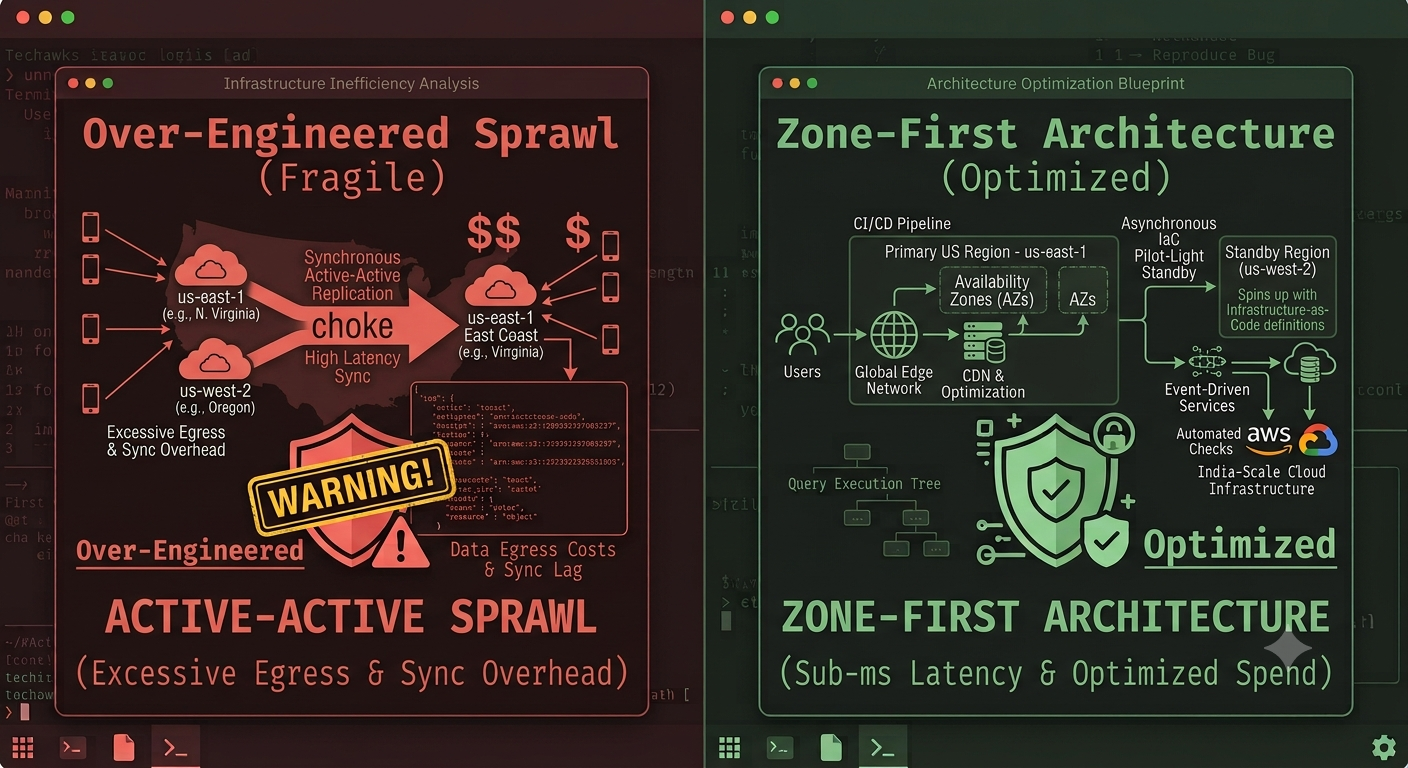
In the US enterprise and startup landscape, high availability is often treated as synonymous with active-active multi-region infrastructure. Teams duplicate clusters, replicate databases across coasts, and build distributed synchronization logic long before their product market fit or traffic patterns demand it.
The result isn't bulletproof uptime; it is distributed state drift, cross-region network latency, and compounding data egress expenses.
To build cost-conscious, high-availability architecture tailored to the US cloud landscape, follow the Zone-First Resilience Blueprint:
Maximize Multi-AZ Before Expanding Multi-Region: Major US cloud regions consist of physically separated data centers with single-digit millisecond latency between availability zones. Exhaust multi-AZ redundancy, regional auto-scaling, and managed failover pools first. For 95% of applications, three independent availability zones within a single region provide the required SLA without cross-region egress penalties.
Treat Secondary Regions as Asynchronous Disaster Recovery (Pilot Light): If compliance or catastrophic risk requires a secondary region, avoid active-active synchronous data replication. Instead, implement a "pilot light" or warm standby model using asynchronous backups and Infrastructure-as-Code definitions that can spin up capacity in minutes during a total regional outage.
Audit Cross-Region Data Egress Paths: Keep high-throughput microservices, caching tiers, and database primary replicas co-located within the same region. Route cross-country read traffic through edge points of presence (PoPs) using local caching to terminate user requests close to home without backhauling raw data across coasts.
Let’s talk system design and cloud economics: How does your engineering team decide between single-region multi-AZ and true active-active multi-region deployments?
What is the biggest hidden cost or networking headache you’ve encountered running systems across US regions? Drop your experiences below.
Key Takeaways
Availability zones solve most downtime: Multi-AZ configurations provide resilient fault tolerance without the complexity of cross-country replication.
Egress is an architectural metric: Design data flows to minimize unmetered cross-region chatter and expensive synchronous links.
Standby beats over-engineering: Use automated IaC to spin up standby disaster recovery regions on demand rather than paying 2x operational overhead 24/7.
CTA
Navigating cloud architecture, enterprise scaling, or engineering trade-offs across the US tech landscape? Join Techawks USA to connect with local architects, exchange production playbooks, and build scalable, cost-efficient infrastructure together. Link in the bio/comments!
In the US enterprise and startup landscape, high availability is often treated as synonymous with active-active multi-region infrastructure. Teams duplicate clusters, replicate databases across coasts, and build distributed synchronization logic long before their product market fit or traffic patterns demand it.
The result isn't bulletproof uptime; it is distributed state drift, cross-region network latency, and compounding data egress expenses.
To build cost-conscious, high-availability architecture tailored to the US cloud landscape, follow the Zone-First Resilience Blueprint:
Maximize Multi-AZ Before Expanding Multi-Region: Major US cloud regions consist of physically separated data centers with single-digit millisecond latency between availability zones. Exhaust multi-AZ redundancy, regional auto-scaling, and managed failover pools first. For 95% of applications, three independent availability zones within a single region provide the required SLA without cross-region egress penalties.
Treat Secondary Regions as Asynchronous Disaster Recovery (Pilot Light): If compliance or catastrophic risk requires a secondary region, avoid active-active synchronous data replication. Instead, implement a "pilot light" or warm standby model using asynchronous backups and Infrastructure-as-Code definitions that can spin up capacity in minutes during a total regional outage.
Audit Cross-Region Data Egress Paths: Keep high-throughput microservices, caching tiers, and database primary replicas co-located within the same region. Route cross-country read traffic through edge points of presence (PoPs) using local caching to terminate user requests close to home without backhauling raw data across coasts.
Let’s talk system design and cloud economics: How does your engineering team decide between single-region multi-AZ and true active-active multi-region deployments?
What is the biggest hidden cost or networking headache you’ve encountered running systems across US regions? Drop your experiences below.
Key Takeaways
Availability zones solve most downtime: Multi-AZ configurations provide resilient fault tolerance without the complexity of cross-country replication.
Egress is an architectural metric: Design data flows to minimize unmetered cross-region chatter and expensive synchronous links.
Standby beats over-engineering: Use automated IaC to spin up standby disaster recovery regions on demand rather than paying 2x operational overhead 24/7.
CTA
Navigating cloud architecture, enterprise scaling, or engineering trade-offs across the US tech landscape? Join Techawks USA to connect with local architects, exchange production playbooks, and build scalable, cost-efficient infrastructure together. Link in the bio/comments!
The Multi-Region Trap: Why Over-Engineering Your US Cloud Footprint Is Costing You Millions
In the US enterprise and startup landscape, high availability is often treated as synonymous with active-active multi-region infrastructure. Teams duplicate clusters, replicate databases across coasts, and build distributed synchronization logic long before their product market fit or traffic patterns demand it.
The result isn't bulletproof uptime; it is distributed state drift, cross-region network latency, and compounding data egress expenses.
To build cost-conscious, high-availability architecture tailored to the US cloud landscape, follow the Zone-First Resilience Blueprint:
Maximize Multi-AZ Before Expanding Multi-Region: Major US cloud regions consist of physically separated data centers with single-digit millisecond latency between availability zones. Exhaust multi-AZ redundancy, regional auto-scaling, and managed failover pools first. For 95% of applications, three independent availability zones within a single region provide the required SLA without cross-region egress penalties.
Treat Secondary Regions as Asynchronous Disaster Recovery (Pilot Light): If compliance or catastrophic risk requires a secondary region, avoid active-active synchronous data replication. Instead, implement a "pilot light" or warm standby model using asynchronous backups and Infrastructure-as-Code definitions that can spin up capacity in minutes during a total regional outage.
Audit Cross-Region Data Egress Paths: Keep high-throughput microservices, caching tiers, and database primary replicas co-located within the same region. Route cross-country read traffic through edge points of presence (PoPs) using local caching to terminate user requests close to home without backhauling raw data across coasts.
Let’s talk system design and cloud economics: How does your engineering team decide between single-region multi-AZ and true active-active multi-region deployments?
What is the biggest hidden cost or networking headache you’ve encountered running systems across US regions? Drop your experiences below.
Key Takeaways
Availability zones solve most downtime: Multi-AZ configurations provide resilient fault tolerance without the complexity of cross-country replication.
Egress is an architectural metric: Design data flows to minimize unmetered cross-region chatter and expensive synchronous links.
Standby beats over-engineering: Use automated IaC to spin up standby disaster recovery regions on demand rather than paying 2x operational overhead 24/7.
CTA
Navigating cloud architecture, enterprise scaling, or engineering trade-offs across the US tech landscape? Join Techawks USA to connect with local architects, exchange production playbooks, and build scalable, cost-efficient infrastructure together. Link in the bio/comments!

 English
 French
 Spanish
 Portuguese
 Deutsch
 Turkish
 Dutch
Dutch
 Italiano
 Russian
 Romaian
 Portuguese (Brazil)
 Greek
Greek