


Architecting for the Gulf: Why Local Data In-Country Isn't Just Good Practice—It's Architectural Law
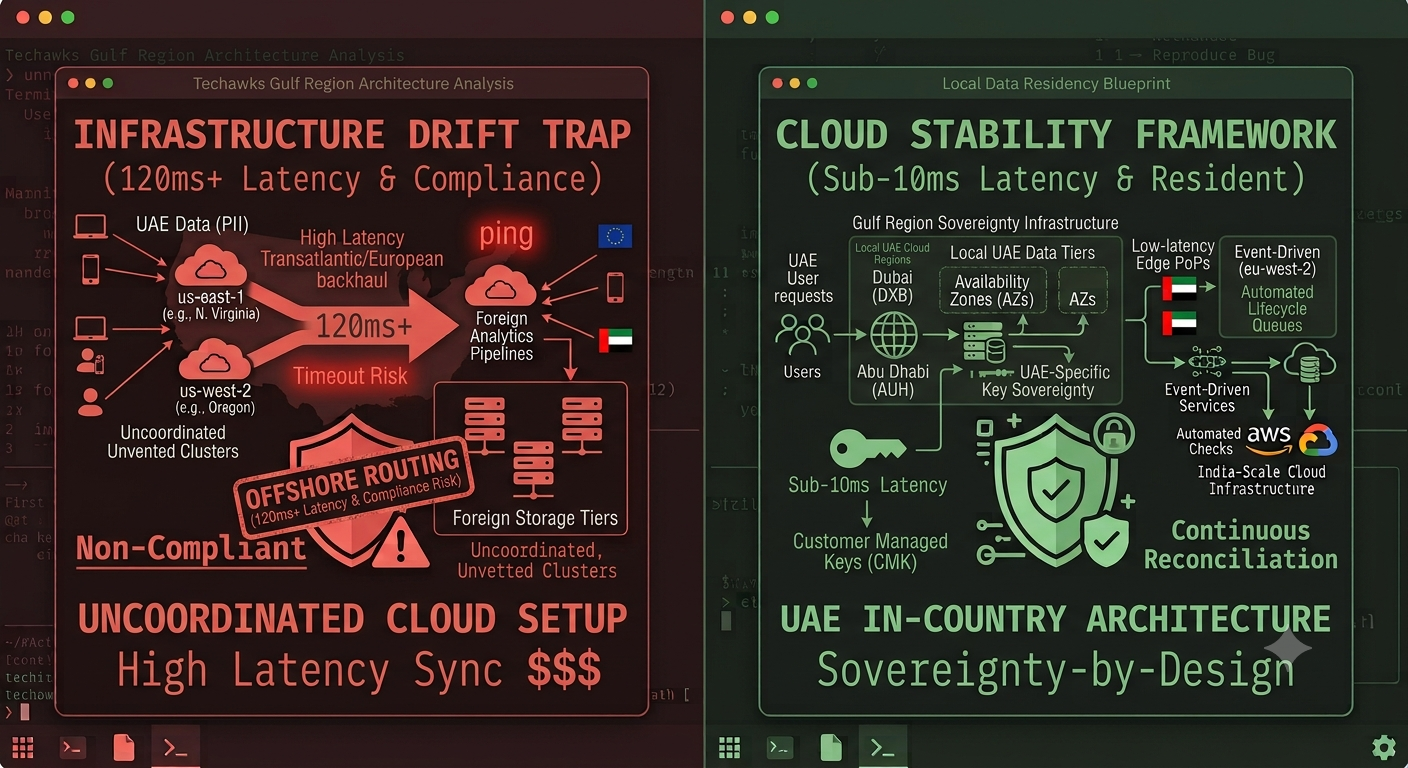
Engineering systems in the UAE and wider GCC market comes with distinct operational requirements. With comprehensive personal data protection laws (Federal Decree-Law No. 45) and strict industry regulations across fintech and healthcare, hosting sensitive customer records offshore creates significant legal exposure.
Beyond compliance, backhauling database queries to Europe degrades the real-time user experiences that local mobile-first consumers expect.
To build an architecture that stays fast, resilient, and compliant within the UAE ecosystem, implement the Gulf In-Country Blueprint:
Leverage Local Cloud Regions as Primary Tiers: Both AWS (Middle East / UAE) and Microsoft Azure (UAE North / Central) provide mature regional zones in Abu Dhabi and Dubai. Keep transactional databases, customer profiles, and session data anchored within these local zones to guarantee single-digit millisecond latency and clear data residency boundaries.
Implement Dual-Tier Encryption & Key Sovereignty: Never rely solely on generic vendor-managed keys for sensitive workloads. Use localized Hardware Security Modules (HSMs) or Customer Managed Keys (CMK) configured to restrict key derivation and access exclusively to local identity principals.
Decouple Edge Ingress from Core Compliance Storage: Route public media assets, static frontends, and non-PII caches through local Middle Eastern edge points of presence (PoPs) to optimize delivery speeds across the GCC, while locking database write queries down to strict in-country VPC endpoints.
Let’s talk architecture in the region: What has been your biggest design challenge when ensuring local UAE data residency alongside global microservice dependencies?
How does your team handle hybrid on-prem and local cloud infrastructure across Dubai and Abu Dhabi? Share your technical setup below.
Key Takeaways
Residency by default: Anchor databases and user tables in local UAE cloud regions to meet compliance without performance trade-offs.
Retain encryption custody: Use Customer Managed Keys and localized access policies to enforce strict cryptographic boundaries.
Optimize via local edge nodes: Use GCC-based PoPs to accelerate delivery while isolating sensitive transactional pipelines within sovereign VPCs.
CTA
Navigating local cloud architecture, enterprise scalability, and tech infrastructure across the Emirates? Join Techawks UAE to connect with local systems architects, debate operational playbooks, and build high-performance systems for the region. Link in the bio/comments!
Engineering systems in the UAE and wider GCC market comes with distinct operational requirements. With comprehensive personal data protection laws (Federal Decree-Law No. 45) and strict industry regulations across fintech and healthcare, hosting sensitive customer records offshore creates significant legal exposure.
Beyond compliance, backhauling database queries to Europe degrades the real-time user experiences that local mobile-first consumers expect.
To build an architecture that stays fast, resilient, and compliant within the UAE ecosystem, implement the Gulf In-Country Blueprint:
Leverage Local Cloud Regions as Primary Tiers: Both AWS (Middle East / UAE) and Microsoft Azure (UAE North / Central) provide mature regional zones in Abu Dhabi and Dubai. Keep transactional databases, customer profiles, and session data anchored within these local zones to guarantee single-digit millisecond latency and clear data residency boundaries.
Implement Dual-Tier Encryption & Key Sovereignty: Never rely solely on generic vendor-managed keys for sensitive workloads. Use localized Hardware Security Modules (HSMs) or Customer Managed Keys (CMK) configured to restrict key derivation and access exclusively to local identity principals.
Decouple Edge Ingress from Core Compliance Storage: Route public media assets, static frontends, and non-PII caches through local Middle Eastern edge points of presence (PoPs) to optimize delivery speeds across the GCC, while locking database write queries down to strict in-country VPC endpoints.
Let’s talk architecture in the region: What has been your biggest design challenge when ensuring local UAE data residency alongside global microservice dependencies?
How does your team handle hybrid on-prem and local cloud infrastructure across Dubai and Abu Dhabi? Share your technical setup below.
Key Takeaways
Residency by default: Anchor databases and user tables in local UAE cloud regions to meet compliance without performance trade-offs.
Retain encryption custody: Use Customer Managed Keys and localized access policies to enforce strict cryptographic boundaries.
Optimize via local edge nodes: Use GCC-based PoPs to accelerate delivery while isolating sensitive transactional pipelines within sovereign VPCs.
CTA
Navigating local cloud architecture, enterprise scalability, and tech infrastructure across the Emirates? Join Techawks UAE to connect with local systems architects, debate operational playbooks, and build high-performance systems for the region. Link in the bio/comments!
Architecting for the Gulf: Why Local Data In-Country Isn't Just Good Practice—It's Architectural Law
Engineering systems in the UAE and wider GCC market comes with distinct operational requirements. With comprehensive personal data protection laws (Federal Decree-Law No. 45) and strict industry regulations across fintech and healthcare, hosting sensitive customer records offshore creates significant legal exposure.
Beyond compliance, backhauling database queries to Europe degrades the real-time user experiences that local mobile-first consumers expect.
To build an architecture that stays fast, resilient, and compliant within the UAE ecosystem, implement the Gulf In-Country Blueprint:
Leverage Local Cloud Regions as Primary Tiers: Both AWS (Middle East / UAE) and Microsoft Azure (UAE North / Central) provide mature regional zones in Abu Dhabi and Dubai. Keep transactional databases, customer profiles, and session data anchored within these local zones to guarantee single-digit millisecond latency and clear data residency boundaries.
Implement Dual-Tier Encryption & Key Sovereignty: Never rely solely on generic vendor-managed keys for sensitive workloads. Use localized Hardware Security Modules (HSMs) or Customer Managed Keys (CMK) configured to restrict key derivation and access exclusively to local identity principals.
Decouple Edge Ingress from Core Compliance Storage: Route public media assets, static frontends, and non-PII caches through local Middle Eastern edge points of presence (PoPs) to optimize delivery speeds across the GCC, while locking database write queries down to strict in-country VPC endpoints.
Let’s talk architecture in the region: What has been your biggest design challenge when ensuring local UAE data residency alongside global microservice dependencies?
How does your team handle hybrid on-prem and local cloud infrastructure across Dubai and Abu Dhabi? Share your technical setup below.
Key Takeaways
Residency by default: Anchor databases and user tables in local UAE cloud regions to meet compliance without performance trade-offs.
Retain encryption custody: Use Customer Managed Keys and localized access policies to enforce strict cryptographic boundaries.
Optimize via local edge nodes: Use GCC-based PoPs to accelerate delivery while isolating sensitive transactional pipelines within sovereign VPCs.
CTA
Navigating local cloud architecture, enterprise scalability, and tech infrastructure across the Emirates? Join Techawks UAE to connect with local systems architects, debate operational playbooks, and build high-performance systems for the region. Link in the bio/comments!

 English
 Arabic
 French
 Spanish
 Portuguese
 Deutsch
 Turkish
 Dutch
Dutch
 Italiano
 Russian
 Romaian
 Greek
Greek