


The Cross-Border Cloud Illusion: Why Canadian Data Residency Is More Than Just Picking a Local Region
Building systems in Canada means navigating a layered regulatory landscape. Between federal PIPEDA accountability, provincial mandates like Quebec’s Law 25, and strict public/healthcare sector requirements (such as Ontario's PHIPA), data residency isn't a single checkbox at initial cloud setup.
Too often, teams point their primary application database to ca-central-1 (Montreal) or Azure Canada Central (Toronto) and assume their residency obligations are met.
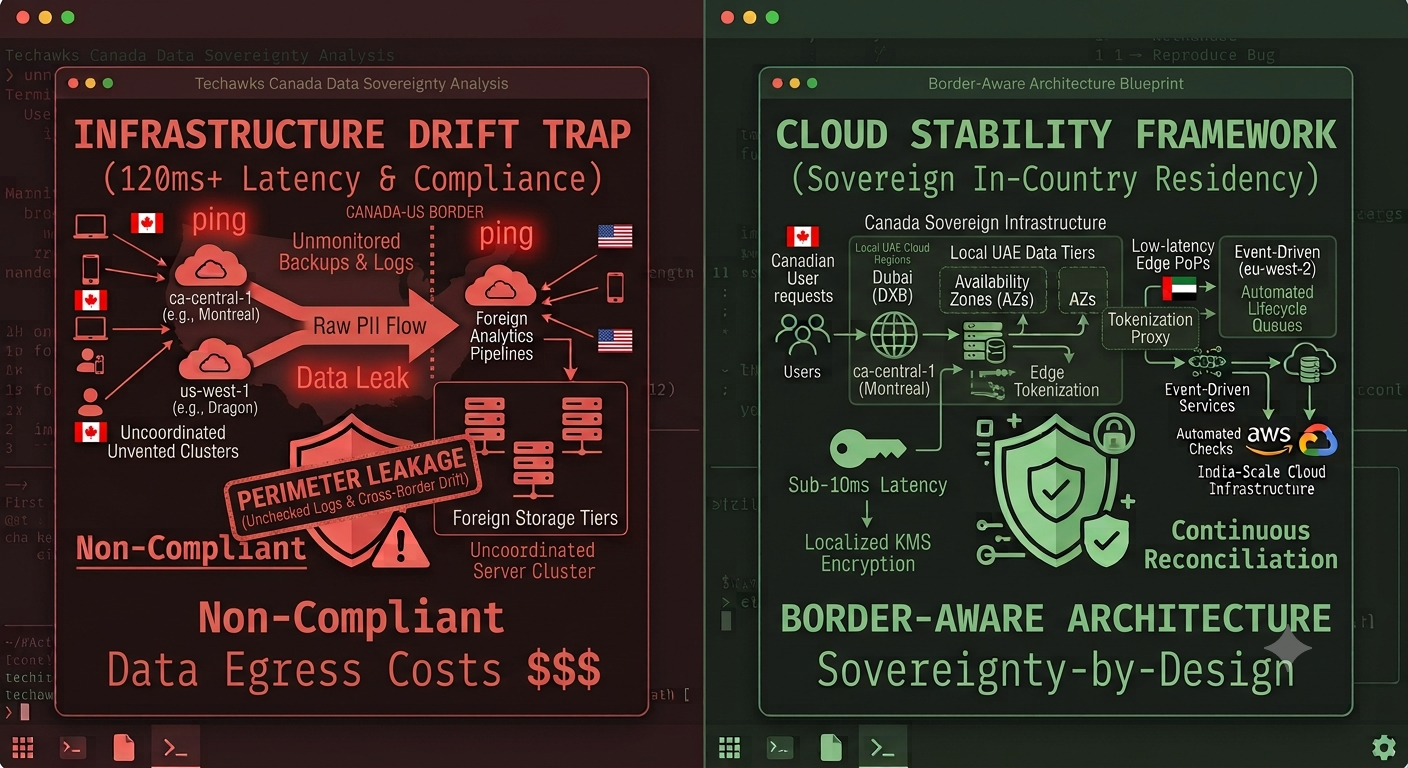
The breakdown happens in the periphery: unvetted telemetry streaming to US-based observability SaaS, unencrypted disaster recovery buckets replicating cross-border, or shared AI API calls sending sensitive customer context outside Canadian borders.
To establish defensible, audit-ready data residency within the Canadian tech landscape, implement the Border-Aware Cloud Framework:
Audit Peripheral Egress (Backups, Telemetry, and Queues): Your primary database might sit in Canada, but where do your database snapshots, dead-letter queues, and debug logs go? Ensure that all S3/blob lifecycle policies, cross-region replication rules, and log sinks strictly specify in-country destinations (e.g., pairing Canada Central with Canada West / Calgary for in-country disaster recovery).
Proxy and Scrub Third-Party SaaS Calls: When integrating third-party monitoring, CRM tools, or AI inference models, client-side identifiers (IP addresses, names, session tokens) often stream directly to US servers. Terminate third-party telemetry at a Canadian API proxy, strip or tokenize personal identifiable information (PII), and enforce client-side masking before payloads leave the perimeter.
Automate Residency Guardrails via Service Control Policies: Prevent engineers from accidentally spinning up non-compliant infrastructure during midnight fixes. Use AWS Service Control Policies (SCPs) or Azure Policies to explicitly deny resource creation in any cloud region outside designated Canadian zones.
Let’s talk architecture in the Great White North: How does your team handle data residency when third-party SaaS vendors or managed services only host their infrastructure in US regions?
What is your playbook for balancing Quebec's Law 25 privacy assessments with rapid cloud deployments? Drop your thoughts below.
Key Takeaways
Audit the periphery: Primary databases are rarely the source of cross-border leaks; secondary backups, log streams, and monitoring tools are.
Keep disaster recovery domestic: Pair Canadian east and west availability hubs (e.g., Montreal and Calgary/Toronto) for failover without triggering foreign legal jurisdiction.
Codify boundaries: Use organization-level cloud policy guardrails to make out-of-region resource provisioning impossible by default.
CTA
Navigating Canadian cloud governance, data privacy compliance, and distributed architecture across the Canadian ecosystem? Join Techawks Canada to connect with local cloud engineers, share architectural patterns, and build resilient infrastructure together. Link in the bio/comments!
Building systems in Canada means navigating a layered regulatory landscape. Between federal PIPEDA accountability, provincial mandates like Quebec’s Law 25, and strict public/healthcare sector requirements (such as Ontario's PHIPA), data residency isn't a single checkbox at initial cloud setup.
Too often, teams point their primary application database to ca-central-1 (Montreal) or Azure Canada Central (Toronto) and assume their residency obligations are met.
The breakdown happens in the periphery: unvetted telemetry streaming to US-based observability SaaS, unencrypted disaster recovery buckets replicating cross-border, or shared AI API calls sending sensitive customer context outside Canadian borders.
To establish defensible, audit-ready data residency within the Canadian tech landscape, implement the Border-Aware Cloud Framework:
Audit Peripheral Egress (Backups, Telemetry, and Queues): Your primary database might sit in Canada, but where do your database snapshots, dead-letter queues, and debug logs go? Ensure that all S3/blob lifecycle policies, cross-region replication rules, and log sinks strictly specify in-country destinations (e.g., pairing Canada Central with Canada West / Calgary for in-country disaster recovery).
Proxy and Scrub Third-Party SaaS Calls: When integrating third-party monitoring, CRM tools, or AI inference models, client-side identifiers (IP addresses, names, session tokens) often stream directly to US servers. Terminate third-party telemetry at a Canadian API proxy, strip or tokenize personal identifiable information (PII), and enforce client-side masking before payloads leave the perimeter.
Automate Residency Guardrails via Service Control Policies: Prevent engineers from accidentally spinning up non-compliant infrastructure during midnight fixes. Use AWS Service Control Policies (SCPs) or Azure Policies to explicitly deny resource creation in any cloud region outside designated Canadian zones.
Let’s talk architecture in the Great White North: How does your team handle data residency when third-party SaaS vendors or managed services only host their infrastructure in US regions?
What is your playbook for balancing Quebec's Law 25 privacy assessments with rapid cloud deployments? Drop your thoughts below.
Key Takeaways
Audit the periphery: Primary databases are rarely the source of cross-border leaks; secondary backups, log streams, and monitoring tools are.
Keep disaster recovery domestic: Pair Canadian east and west availability hubs (e.g., Montreal and Calgary/Toronto) for failover without triggering foreign legal jurisdiction.
Codify boundaries: Use organization-level cloud policy guardrails to make out-of-region resource provisioning impossible by default.
CTA
Navigating Canadian cloud governance, data privacy compliance, and distributed architecture across the Canadian ecosystem? Join Techawks Canada to connect with local cloud engineers, share architectural patterns, and build resilient infrastructure together. Link in the bio/comments!
The Cross-Border Cloud Illusion: Why Canadian Data Residency Is More Than Just Picking a Local Region
Building systems in Canada means navigating a layered regulatory landscape. Between federal PIPEDA accountability, provincial mandates like Quebec’s Law 25, and strict public/healthcare sector requirements (such as Ontario's PHIPA), data residency isn't a single checkbox at initial cloud setup.
Too often, teams point their primary application database to ca-central-1 (Montreal) or Azure Canada Central (Toronto) and assume their residency obligations are met.
The breakdown happens in the periphery: unvetted telemetry streaming to US-based observability SaaS, unencrypted disaster recovery buckets replicating cross-border, or shared AI API calls sending sensitive customer context outside Canadian borders.
To establish defensible, audit-ready data residency within the Canadian tech landscape, implement the Border-Aware Cloud Framework:
Audit Peripheral Egress (Backups, Telemetry, and Queues): Your primary database might sit in Canada, but where do your database snapshots, dead-letter queues, and debug logs go? Ensure that all S3/blob lifecycle policies, cross-region replication rules, and log sinks strictly specify in-country destinations (e.g., pairing Canada Central with Canada West / Calgary for in-country disaster recovery).
Proxy and Scrub Third-Party SaaS Calls: When integrating third-party monitoring, CRM tools, or AI inference models, client-side identifiers (IP addresses, names, session tokens) often stream directly to US servers. Terminate third-party telemetry at a Canadian API proxy, strip or tokenize personal identifiable information (PII), and enforce client-side masking before payloads leave the perimeter.
Automate Residency Guardrails via Service Control Policies: Prevent engineers from accidentally spinning up non-compliant infrastructure during midnight fixes. Use AWS Service Control Policies (SCPs) or Azure Policies to explicitly deny resource creation in any cloud region outside designated Canadian zones.
Let’s talk architecture in the Great White North: How does your team handle data residency when third-party SaaS vendors or managed services only host their infrastructure in US regions?
What is your playbook for balancing Quebec's Law 25 privacy assessments with rapid cloud deployments? Drop your thoughts below.
Key Takeaways
Audit the periphery: Primary databases are rarely the source of cross-border leaks; secondary backups, log streams, and monitoring tools are.
Keep disaster recovery domestic: Pair Canadian east and west availability hubs (e.g., Montreal and Calgary/Toronto) for failover without triggering foreign legal jurisdiction.
Codify boundaries: Use organization-level cloud policy guardrails to make out-of-region resource provisioning impossible by default.
CTA
Navigating Canadian cloud governance, data privacy compliance, and distributed architecture across the Canadian ecosystem? Join Techawks Canada to connect with local cloud engineers, share architectural patterns, and build resilient infrastructure together. Link in the bio/comments!

 English
 Arabic
 French
 Spanish
 Portuguese
 Deutsch
 Turkish
 Italiano
 Russian
 Romaian
 Portuguese (Brazil)
 Greek
Greek