


Multi-Region Cloud vs. Local Data Sovereignty: How Are UAE Tech Leaders Balancing both?
As the UAE tech ecosystem matures into a global digital hub, engineering leaders face a unique infrastructure dilemma: meeting strict local data residency regulations while maintaining high availability and rapid response times for international users.
Designing system architecture to satisfy both demands requires moving beyond simple multi-region deployments toward strategic data segregation:
The Regional Data Pinning Strategy
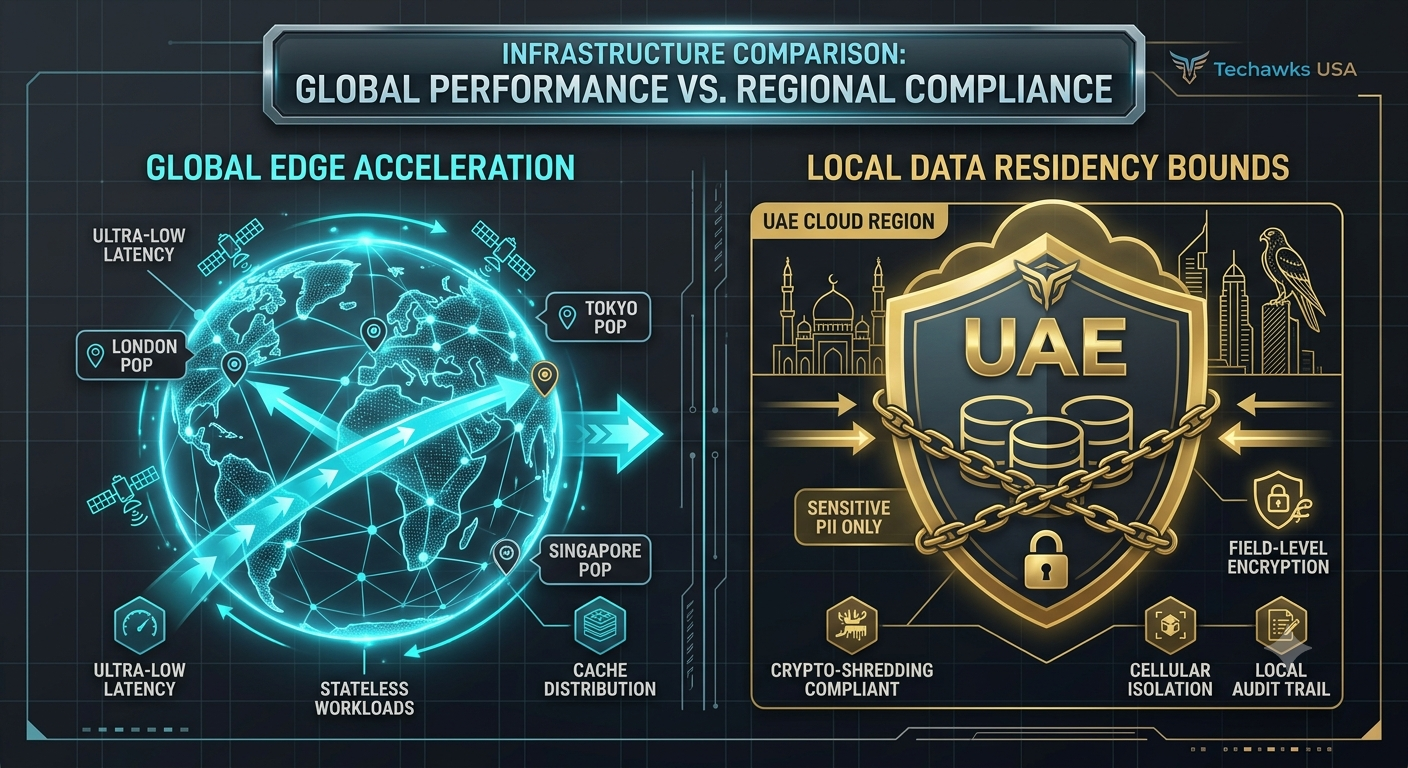
Instead of replicating entire databases across global cloud regions, structure your data model to isolate Personally Identifiable Information (PII) and localized records to UAE cloud regions (me-central-1 / me-south-1). Non-sensitive, stateless workloads or globally cached assets can be distributed via global edge networks.
Decoupled Event Streaming Across Borders
Use event brokers (like Apache Kafka or AWS EventBridge) configured with strict payload filtering. Ensure events cross-regionally contain only anonymized event IDs or operational metadata, leaving the actual customer payloads securely stored within local data boundaries.
Managing the Cost of Multi-Region Operational Complexity
Running active-active multi-region clusters can quickly double or triple your cloud spend. Many UAE scale-ups opt for an Active-Passive (Warm Standby) or Cellular Architecture approach, where each country or region operates as an independent, self-contained cell, minimizing blast radiuses and lowering cross-region networking fees.
Finding the optimal trade-off between strict local compliance, latency performance, and cloud expenditure is an ongoing challenge for regional CTOs and principal architects.
Key Takeaways
Isolate PII to local cloud regions while serving stateless workloads via global edge locations.
Filter cross-border event streams to ensure no sensitive customer data leaves local jurisdictions.
Cellular architecture provides strong isolation and compliance bounds without the high cost of active-active cross-region setups.
CTA (Join Techawks UAE)
How is your team handling data sovereignty alongside multi-region performance requirements in the Gulf region? Share your technical strategy in the comments below, and Join Techawks UAE to connect with engineering leaders, architects, and CTOs shaping technology in the Middle East.
As the UAE tech ecosystem matures into a global digital hub, engineering leaders face a unique infrastructure dilemma: meeting strict local data residency regulations while maintaining high availability and rapid response times for international users.
Designing system architecture to satisfy both demands requires moving beyond simple multi-region deployments toward strategic data segregation:
The Regional Data Pinning Strategy
Instead of replicating entire databases across global cloud regions, structure your data model to isolate Personally Identifiable Information (PII) and localized records to UAE cloud regions (me-central-1 / me-south-1). Non-sensitive, stateless workloads or globally cached assets can be distributed via global edge networks.
Decoupled Event Streaming Across Borders
Use event brokers (like Apache Kafka or AWS EventBridge) configured with strict payload filtering. Ensure events cross-regionally contain only anonymized event IDs or operational metadata, leaving the actual customer payloads securely stored within local data boundaries.
Managing the Cost of Multi-Region Operational Complexity
Running active-active multi-region clusters can quickly double or triple your cloud spend. Many UAE scale-ups opt for an Active-Passive (Warm Standby) or Cellular Architecture approach, where each country or region operates as an independent, self-contained cell, minimizing blast radiuses and lowering cross-region networking fees.
Finding the optimal trade-off between strict local compliance, latency performance, and cloud expenditure is an ongoing challenge for regional CTOs and principal architects.
Key Takeaways
Isolate PII to local cloud regions while serving stateless workloads via global edge locations.
Filter cross-border event streams to ensure no sensitive customer data leaves local jurisdictions.
Cellular architecture provides strong isolation and compliance bounds without the high cost of active-active cross-region setups.
CTA (Join Techawks UAE)
How is your team handling data sovereignty alongside multi-region performance requirements in the Gulf region? Share your technical strategy in the comments below, and Join Techawks UAE to connect with engineering leaders, architects, and CTOs shaping technology in the Middle East.
Multi-Region Cloud vs. Local Data Sovereignty: How Are UAE Tech Leaders Balancing both?
As the UAE tech ecosystem matures into a global digital hub, engineering leaders face a unique infrastructure dilemma: meeting strict local data residency regulations while maintaining high availability and rapid response times for international users.
Designing system architecture to satisfy both demands requires moving beyond simple multi-region deployments toward strategic data segregation:
The Regional Data Pinning Strategy
Instead of replicating entire databases across global cloud regions, structure your data model to isolate Personally Identifiable Information (PII) and localized records to UAE cloud regions (me-central-1 / me-south-1). Non-sensitive, stateless workloads or globally cached assets can be distributed via global edge networks.
Decoupled Event Streaming Across Borders
Use event brokers (like Apache Kafka or AWS EventBridge) configured with strict payload filtering. Ensure events cross-regionally contain only anonymized event IDs or operational metadata, leaving the actual customer payloads securely stored within local data boundaries.
Managing the Cost of Multi-Region Operational Complexity
Running active-active multi-region clusters can quickly double or triple your cloud spend. Many UAE scale-ups opt for an Active-Passive (Warm Standby) or Cellular Architecture approach, where each country or region operates as an independent, self-contained cell, minimizing blast radiuses and lowering cross-region networking fees.
Finding the optimal trade-off between strict local compliance, latency performance, and cloud expenditure is an ongoing challenge for regional CTOs and principal architects.
Key Takeaways
Isolate PII to local cloud regions while serving stateless workloads via global edge locations.
Filter cross-border event streams to ensure no sensitive customer data leaves local jurisdictions.
Cellular architecture provides strong isolation and compliance bounds without the high cost of active-active cross-region setups.
CTA (Join Techawks UAE)
How is your team handling data sovereignty alongside multi-region performance requirements in the Gulf region? Share your technical strategy in the comments below, and Join Techawks UAE to connect with engineering leaders, architects, and CTOs shaping technology in the Middle East.

 English
 Arabic
 French
 Spanish
 Portuguese
 Deutsch
 Dutch
Dutch
 Italiano
 Russian
 Romaian
 Portuguese (Brazil)
 Greek
Greek