


Beyond the White House Post-Quantum Cryptography Mandates: How to Implement Hybrid TLS in Your Stack
Adversaries do not need a functional cryptographically relevant quantum computer today to compromise your enterprise data; they only need to intercept and archive encrypted traffic now and crack it once hardware catches up.
With the Office of Management and Budget (OMB) and CISA enforcing aggressive migration milestones—and major cloud edge networks already serving post-quantum traffic by default—US platform and security engineering teams must shift to crypto-agility.
The standard operational approach isn't an overnight rip-and-replace of RSA or ECC. It is deploying hybrid post-quantum key exchange (X25519 + ML-KEM).
Here is the three-step pattern to introduce post-quantum resilience to your ingress and microservice boundaries today:
1. Enable Hybrid Key Encapsulation (ML-KEM) at the Ingress Edge
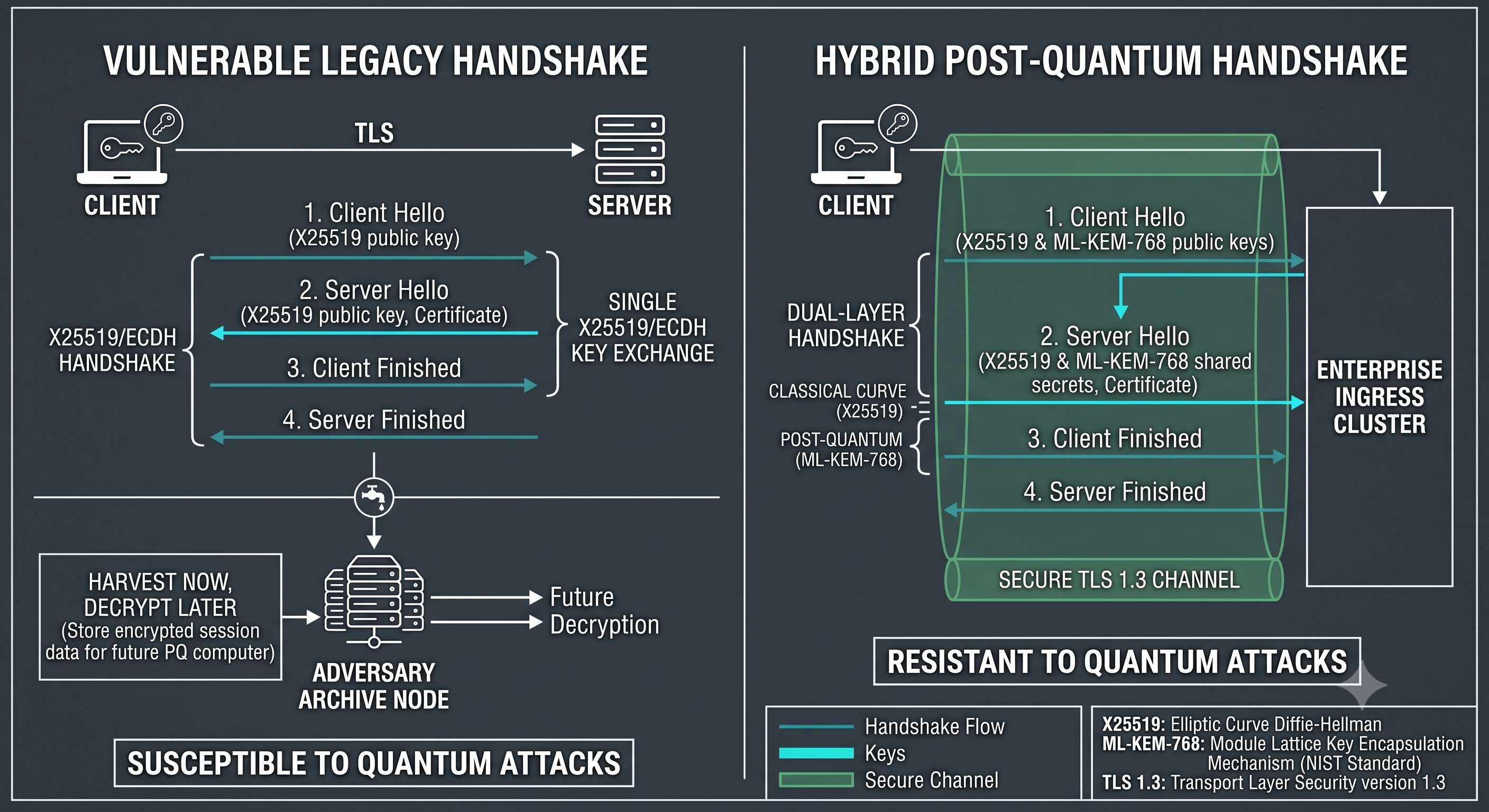
Modern TLS 1.3 supports hybrid key establishment. A hybrid handshake binds a classical algorithm (like X25519) with a post-quantum algorithm (like ML-KEM-768):
The connection remains fully secure even if the post-quantum primitive has unexpected implementation vulnerabilities.
The session key is protected against future quantum decryption even if the classical key exchange is eventually broken.
Configure your reverse proxy, CDN, or gateway (e.g., Envoy, Cloudflare, AWS CloudFront) to prioritize post-quantum hybrid cipher groups (X25519MLKEM768) in the ClientHello negotiation.
2. Audit MTU Sizes and Packet Fragmentation Limits
Post-quantum cryptographic artifacts (keys, ciphertexts, and signatures) are significantly larger than traditional elliptic-curve parameters:
ML-KEM keys and ciphertexts expand the initial TLS handshake size, which can push TCP payloads past standard 1500-byte MTUs.
Benchmark internal service-to-service gRPC or mTLS meshes under post-quantum cipher suites. If middleboxes, legacy firewalls, or load balancers drop fragmented initial packets, your connections will experience silent handshake timeouts.
3. Build a Software Inventory of Cryptographic Primitives (CBOM)
You cannot migrate what you cannot see. Replace hardcoded cryptographic libraries across your codebase:
Generate a Cryptography Bill of Materials (CBOM) using automated code scanners to identify every instance of hardcoded RSA-2048, ECDH, or legacy TLS configurations.
Wrap cryptographic operations behind policy-driven service abstractions so algorithm upgrades require configuration changes rather than code rewrites.
Discussion Question
Has your engineering team begun testing hybrid post-quantum cipher suites on your edge reverse proxies, or is cryptographic migration still isolated to security compliance reviews?
CTA
Ready to build resilient, future-proof cloud infrastructure and navigate US security compliance standards?
👉 Join the Techawks USA Community to collaborate with senior infrastructure architects, access security migration playbooks, and participate in peer-led engineering teardowns.
Adversaries do not need a functional cryptographically relevant quantum computer today to compromise your enterprise data; they only need to intercept and archive encrypted traffic now and crack it once hardware catches up.
With the Office of Management and Budget (OMB) and CISA enforcing aggressive migration milestones—and major cloud edge networks already serving post-quantum traffic by default—US platform and security engineering teams must shift to crypto-agility.
The standard operational approach isn't an overnight rip-and-replace of RSA or ECC. It is deploying hybrid post-quantum key exchange (X25519 + ML-KEM).
Here is the three-step pattern to introduce post-quantum resilience to your ingress and microservice boundaries today:
1. Enable Hybrid Key Encapsulation (ML-KEM) at the Ingress Edge
Modern TLS 1.3 supports hybrid key establishment. A hybrid handshake binds a classical algorithm (like X25519) with a post-quantum algorithm (like ML-KEM-768):
The connection remains fully secure even if the post-quantum primitive has unexpected implementation vulnerabilities.
The session key is protected against future quantum decryption even if the classical key exchange is eventually broken.
Configure your reverse proxy, CDN, or gateway (e.g., Envoy, Cloudflare, AWS CloudFront) to prioritize post-quantum hybrid cipher groups (X25519MLKEM768) in the ClientHello negotiation.
2. Audit MTU Sizes and Packet Fragmentation Limits
Post-quantum cryptographic artifacts (keys, ciphertexts, and signatures) are significantly larger than traditional elliptic-curve parameters:
ML-KEM keys and ciphertexts expand the initial TLS handshake size, which can push TCP payloads past standard 1500-byte MTUs.
Benchmark internal service-to-service gRPC or mTLS meshes under post-quantum cipher suites. If middleboxes, legacy firewalls, or load balancers drop fragmented initial packets, your connections will experience silent handshake timeouts.
3. Build a Software Inventory of Cryptographic Primitives (CBOM)
You cannot migrate what you cannot see. Replace hardcoded cryptographic libraries across your codebase:
Generate a Cryptography Bill of Materials (CBOM) using automated code scanners to identify every instance of hardcoded RSA-2048, ECDH, or legacy TLS configurations.
Wrap cryptographic operations behind policy-driven service abstractions so algorithm upgrades require configuration changes rather than code rewrites.
Discussion Question
Has your engineering team begun testing hybrid post-quantum cipher suites on your edge reverse proxies, or is cryptographic migration still isolated to security compliance reviews?
CTA
Ready to build resilient, future-proof cloud infrastructure and navigate US security compliance standards?
👉 Join the Techawks USA Community to collaborate with senior infrastructure architects, access security migration playbooks, and participate in peer-led engineering teardowns.
Beyond the White House Post-Quantum Cryptography Mandates: How to Implement Hybrid TLS in Your Stack
Adversaries do not need a functional cryptographically relevant quantum computer today to compromise your enterprise data; they only need to intercept and archive encrypted traffic now and crack it once hardware catches up.
With the Office of Management and Budget (OMB) and CISA enforcing aggressive migration milestones—and major cloud edge networks already serving post-quantum traffic by default—US platform and security engineering teams must shift to crypto-agility.
The standard operational approach isn't an overnight rip-and-replace of RSA or ECC. It is deploying hybrid post-quantum key exchange (X25519 + ML-KEM).
Here is the three-step pattern to introduce post-quantum resilience to your ingress and microservice boundaries today:
1. Enable Hybrid Key Encapsulation (ML-KEM) at the Ingress Edge
Modern TLS 1.3 supports hybrid key establishment. A hybrid handshake binds a classical algorithm (like X25519) with a post-quantum algorithm (like ML-KEM-768):
The connection remains fully secure even if the post-quantum primitive has unexpected implementation vulnerabilities.
The session key is protected against future quantum decryption even if the classical key exchange is eventually broken.
Configure your reverse proxy, CDN, or gateway (e.g., Envoy, Cloudflare, AWS CloudFront) to prioritize post-quantum hybrid cipher groups (X25519MLKEM768) in the ClientHello negotiation.
2. Audit MTU Sizes and Packet Fragmentation Limits
Post-quantum cryptographic artifacts (keys, ciphertexts, and signatures) are significantly larger than traditional elliptic-curve parameters:
ML-KEM keys and ciphertexts expand the initial TLS handshake size, which can push TCP payloads past standard 1500-byte MTUs.
Benchmark internal service-to-service gRPC or mTLS meshes under post-quantum cipher suites. If middleboxes, legacy firewalls, or load balancers drop fragmented initial packets, your connections will experience silent handshake timeouts.
3. Build a Software Inventory of Cryptographic Primitives (CBOM)
You cannot migrate what you cannot see. Replace hardcoded cryptographic libraries across your codebase:
Generate a Cryptography Bill of Materials (CBOM) using automated code scanners to identify every instance of hardcoded RSA-2048, ECDH, or legacy TLS configurations.
Wrap cryptographic operations behind policy-driven service abstractions so algorithm upgrades require configuration changes rather than code rewrites.
Discussion Question
Has your engineering team begun testing hybrid post-quantum cipher suites on your edge reverse proxies, or is cryptographic migration still isolated to security compliance reviews?
CTA
Ready to build resilient, future-proof cloud infrastructure and navigate US security compliance standards?
👉 Join the Techawks USA Community to collaborate with senior infrastructure architects, access security migration playbooks, and participate in peer-led engineering teardowns.

 Arabic
 French
 Spanish
 Portuguese
 Deutsch
 Turkish
 Dutch
Dutch
 Italiano
 Russian
 Romaian
 Portuguese (Brazil)
 Greek
Greek