


Architecting Zero-Egress RAG for UAE Sovereign AI Compliance
With UAE regulatory enforcement intensifying around cross-border telemetry and data residency, enterprise engineering teams in Dubai and Abu Dhabi face a hard constraint: critical citizen data, corporate IP, and regulated customer records cannot leave national borders.
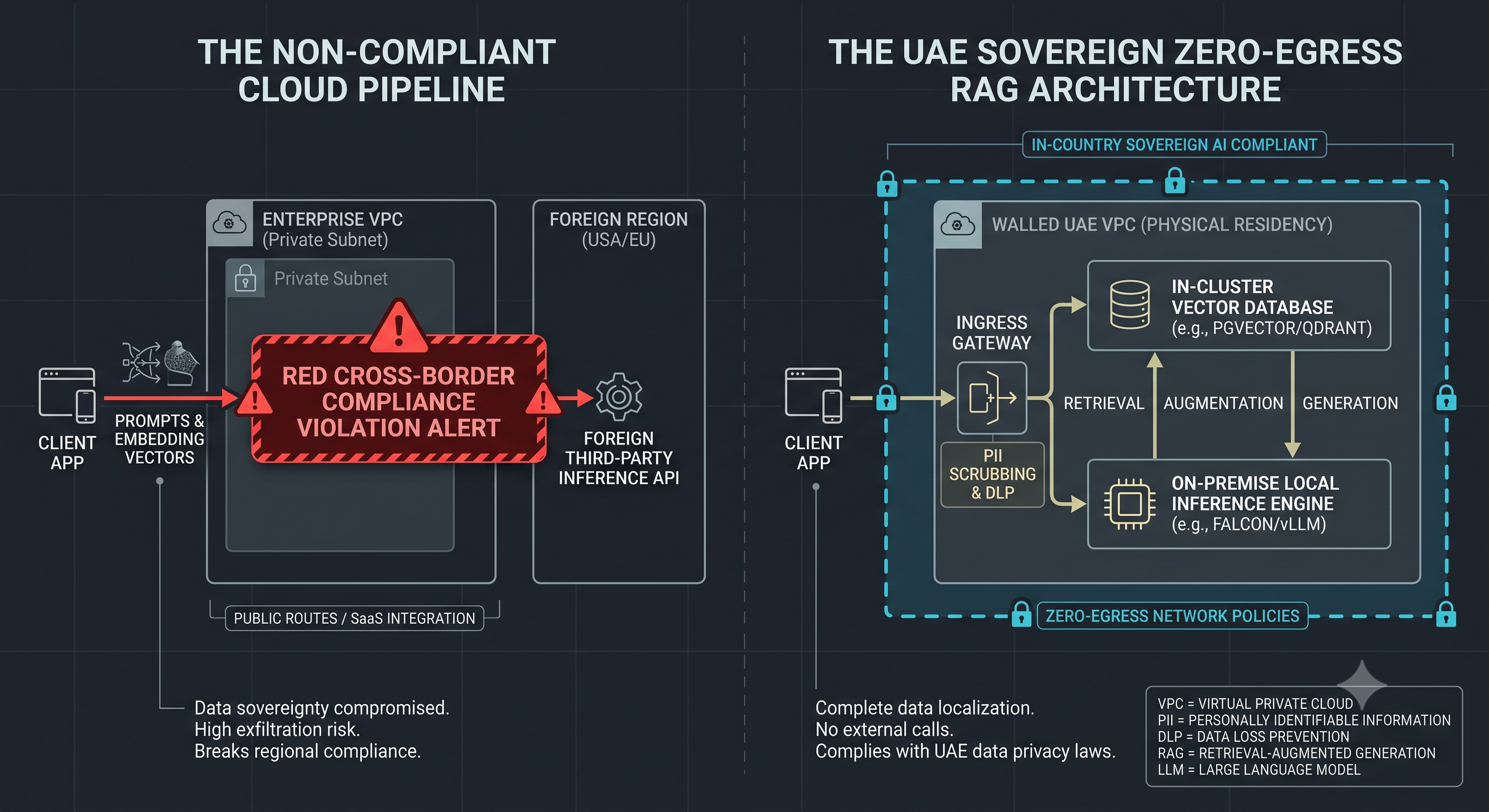
Sending vector embeddings, raw prompt contexts, or fine-tuning datasets to public SaaS inference endpoints outside the country breaks compliance by design. Sovereign AI is not just about choosing an open-weight base model—it is about enforcing strict, zero-egress data planes.
Here is an architectural blueprint to build an in-country, zero-egress RAG pipeline using open-weight models (such as Falcon or Jais) running entirely on sovereign UAE compute.
1. Isolate the Compute and Model Tier
Deploy your foundational model within local boundaries (e.g., Azure UAE Central/North regions, sovereign GPU providers like Core42, or air-gapped on-premise infrastructure).
Pull open-weight checkpoints (e.g., Falcon-2 or Jais-13b-chat) and run inference through high-throughput engines like vLLM or TGI (Text Generation Inference) isolated inside your private VPC.
Disable all outbound public internet routing on your model worker nodes:
Bash
# Verify no default outbound route exists on the inference subnet
ip route show | grep default
# Ensure traffic to external endpoints drops immediately
curl --connect-timeout 3 https://api.openai.com || echo "Egress blocked: Verified."
2. Deploy Local Vector Stores with Hardware-Isolated Tenants
Avoid managed multi-tenant vector clouds hosted outside the GCC. Host an internal instance of Qdrant, pgvector, or Milvus within your secure cluster:
Enforce TLS 1.3 encryption for in-flight embedding ingestion.
Generate embeddings in-VPC using open embedding models (such as bge-m3 or local multilingual BERT variants) so that raw documents are tokenized and vectorized without exposing plaintext payloads to external networks.
3. Implement Ingress Sanitization and Redaction
Before enterprise context enters your retrieval pipeline:
Run a local Named Entity Recognition (NER) model at your ingress gateway to detect Emirates IDs, payment data, and sensitive PII.
Enforce prompt scrubbing and strict Data Loss Prevention (DLP) rules prior to context injection.
4. Audit VPC Telemetry and DNS Leaks
Even if inference is local, client SDKs often default to sending background usage analytics or crash metrics to overseas SaaS telemetry endpoints.
Route cluster DNS queries through an internal, logging DNS resolver (e.g., CoreDNS).
Configure network security groups to explicitly drop UDP/TCP port 53 traffic aimed at public resolvers (8.8.8.8, 1.1.1.1), terminating all internal name resolution within your UAE private network.
Building sovereign AI infrastructure shifts data protection from an operational policy document into an immutable infrastructure constraint.
Discussion Question
When deploying local generative models across UAE enterprise workloads, are you containerizing self-hosted open-weight models in private VPCs, or relying on dedicated, UAE-domiciled sovereign cloud managed endpoints?
CTA (Join Techawks UAE)
Join the Techawks UAE community to exchange architectural patterns, deployment playbooks, and systems engineering benchmarks with developers and cloud architects across the Emirates.
With UAE regulatory enforcement intensifying around cross-border telemetry and data residency, enterprise engineering teams in Dubai and Abu Dhabi face a hard constraint: critical citizen data, corporate IP, and regulated customer records cannot leave national borders.
Sending vector embeddings, raw prompt contexts, or fine-tuning datasets to public SaaS inference endpoints outside the country breaks compliance by design. Sovereign AI is not just about choosing an open-weight base model—it is about enforcing strict, zero-egress data planes.
Here is an architectural blueprint to build an in-country, zero-egress RAG pipeline using open-weight models (such as Falcon or Jais) running entirely on sovereign UAE compute.
1. Isolate the Compute and Model Tier
Deploy your foundational model within local boundaries (e.g., Azure UAE Central/North regions, sovereign GPU providers like Core42, or air-gapped on-premise infrastructure).
Pull open-weight checkpoints (e.g., Falcon-2 or Jais-13b-chat) and run inference through high-throughput engines like vLLM or TGI (Text Generation Inference) isolated inside your private VPC.
Disable all outbound public internet routing on your model worker nodes:
Bash
# Verify no default outbound route exists on the inference subnet
ip route show | grep default
# Ensure traffic to external endpoints drops immediately
curl --connect-timeout 3 https://api.openai.com || echo "Egress blocked: Verified."
2. Deploy Local Vector Stores with Hardware-Isolated Tenants
Avoid managed multi-tenant vector clouds hosted outside the GCC. Host an internal instance of Qdrant, pgvector, or Milvus within your secure cluster:
Enforce TLS 1.3 encryption for in-flight embedding ingestion.
Generate embeddings in-VPC using open embedding models (such as bge-m3 or local multilingual BERT variants) so that raw documents are tokenized and vectorized without exposing plaintext payloads to external networks.
3. Implement Ingress Sanitization and Redaction
Before enterprise context enters your retrieval pipeline:
Run a local Named Entity Recognition (NER) model at your ingress gateway to detect Emirates IDs, payment data, and sensitive PII.
Enforce prompt scrubbing and strict Data Loss Prevention (DLP) rules prior to context injection.
4. Audit VPC Telemetry and DNS Leaks
Even if inference is local, client SDKs often default to sending background usage analytics or crash metrics to overseas SaaS telemetry endpoints.
Route cluster DNS queries through an internal, logging DNS resolver (e.g., CoreDNS).
Configure network security groups to explicitly drop UDP/TCP port 53 traffic aimed at public resolvers (8.8.8.8, 1.1.1.1), terminating all internal name resolution within your UAE private network.
Building sovereign AI infrastructure shifts data protection from an operational policy document into an immutable infrastructure constraint.
Discussion Question
When deploying local generative models across UAE enterprise workloads, are you containerizing self-hosted open-weight models in private VPCs, or relying on dedicated, UAE-domiciled sovereign cloud managed endpoints?
CTA (Join Techawks UAE)
Join the Techawks UAE community to exchange architectural patterns, deployment playbooks, and systems engineering benchmarks with developers and cloud architects across the Emirates.
Architecting Zero-Egress RAG for UAE Sovereign AI Compliance
With UAE regulatory enforcement intensifying around cross-border telemetry and data residency, enterprise engineering teams in Dubai and Abu Dhabi face a hard constraint: critical citizen data, corporate IP, and regulated customer records cannot leave national borders.
Sending vector embeddings, raw prompt contexts, or fine-tuning datasets to public SaaS inference endpoints outside the country breaks compliance by design. Sovereign AI is not just about choosing an open-weight base model—it is about enforcing strict, zero-egress data planes.
Here is an architectural blueprint to build an in-country, zero-egress RAG pipeline using open-weight models (such as Falcon or Jais) running entirely on sovereign UAE compute.
1. Isolate the Compute and Model Tier
Deploy your foundational model within local boundaries (e.g., Azure UAE Central/North regions, sovereign GPU providers like Core42, or air-gapped on-premise infrastructure).
Pull open-weight checkpoints (e.g., Falcon-2 or Jais-13b-chat) and run inference through high-throughput engines like vLLM or TGI (Text Generation Inference) isolated inside your private VPC.
Disable all outbound public internet routing on your model worker nodes:
Bash
# Verify no default outbound route exists on the inference subnet
ip route show | grep default
# Ensure traffic to external endpoints drops immediately
curl --connect-timeout 3 https://api.openai.com || echo "Egress blocked: Verified."
2. Deploy Local Vector Stores with Hardware-Isolated Tenants
Avoid managed multi-tenant vector clouds hosted outside the GCC. Host an internal instance of Qdrant, pgvector, or Milvus within your secure cluster:
Enforce TLS 1.3 encryption for in-flight embedding ingestion.
Generate embeddings in-VPC using open embedding models (such as bge-m3 or local multilingual BERT variants) so that raw documents are tokenized and vectorized without exposing plaintext payloads to external networks.
3. Implement Ingress Sanitization and Redaction
Before enterprise context enters your retrieval pipeline:
Run a local Named Entity Recognition (NER) model at your ingress gateway to detect Emirates IDs, payment data, and sensitive PII.
Enforce prompt scrubbing and strict Data Loss Prevention (DLP) rules prior to context injection.
4. Audit VPC Telemetry and DNS Leaks
Even if inference is local, client SDKs often default to sending background usage analytics or crash metrics to overseas SaaS telemetry endpoints.
Route cluster DNS queries through an internal, logging DNS resolver (e.g., CoreDNS).
Configure network security groups to explicitly drop UDP/TCP port 53 traffic aimed at public resolvers (8.8.8.8, 1.1.1.1), terminating all internal name resolution within your UAE private network.
Building sovereign AI infrastructure shifts data protection from an operational policy document into an immutable infrastructure constraint.
Discussion Question
When deploying local generative models across UAE enterprise workloads, are you containerizing self-hosted open-weight models in private VPCs, or relying on dedicated, UAE-domiciled sovereign cloud managed endpoints?
CTA (Join Techawks UAE)
Join the Techawks UAE community to exchange architectural patterns, deployment playbooks, and systems engineering benchmarks with developers and cloud architects across the Emirates.

 Arabic
 French
 Spanish
 Portuguese
 Deutsch
 Turkish
 Dutch
Dutch
 Italiano
 Russian
 Romaian
 Portuguese (Brazil)
 Greek
Greek