


The 5-Layer Production Agent Evaluation Checklist
Most builders test AI agents with "vibe checks": run 5 prompts, review the output, and declare it production-ready.
Then it touches live users. Costs spiral from runaway agent loops, schema validations fail silently downstream, and model drift causes subtle tool-selection regressions.
To ship autonomous agents that survive real-world workloads, you need deterministic verification wrapped around probabilistic models.
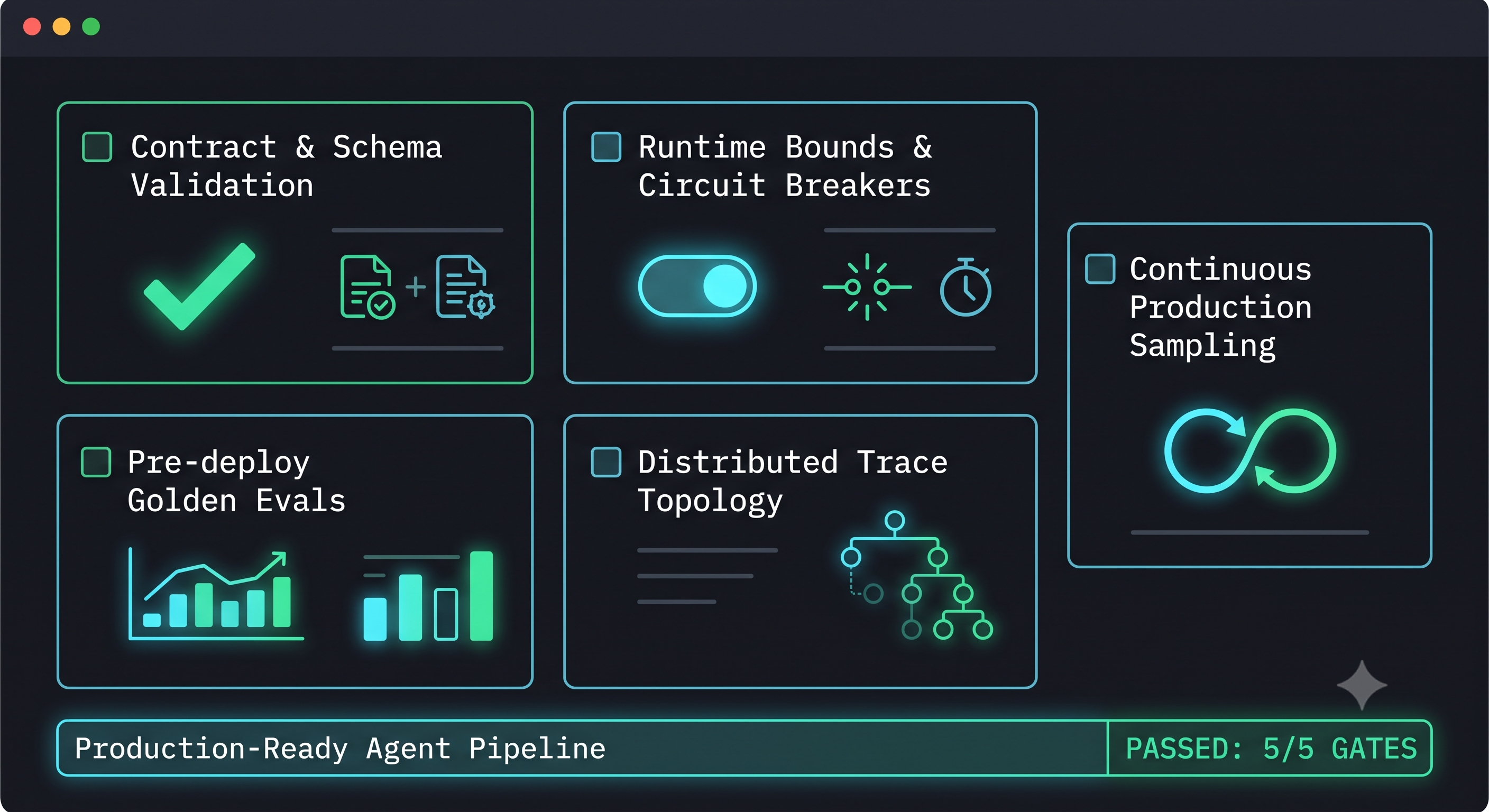
Save this 5-Layer Production Agent Checklist before pushing your next agent workflow to production:
Markdown
[ ] LAYER 1: DETERMINISTIC CONTRACT VALIDATION
- [ ] Structured Output Enforcement: Enforce strict JSON Schema or Pydantic validation on all terminal model outputs.
- [ ] Silent Failure Trap: Ensure a JSON parsing error triggers an automatic structured re-prompt rather than bubbling up a 500 error.
- [ ] Tool Call Schema Matching: Assert exact parameter typing before forwarding tool inputs to your backend APIs.
[ ] LAYER 2: BOUNDED AGENT RUNTIMES (GUARDRAILS)
- [ ] Max Hop Circuit-Breaker: Hardcode a deterministic cap on multi-step reasoning steps (e.g., max 6 turns per session) to halt infinite agentic loops.
- [ ] Token Spend Limit: Set per-session token budgets; gracefully fallback to a human operator when approaching threshold.
- [ ] Idempotency Check: Verify mutating tool calls (e.g., database writes, payment APIs) have idempotent keys to prevent duplicate execution during retries.
[ ] LAYER 3: EVALUATION & REGRESSION GATES (PRE-DEPLOY)
- [ ] Golden Trace Dataset: Run automated CI/CD sweeps against at least 50+ hand-curated multi-turn traces.
- [ ] Tool Selection Accuracy: Benchmark whether the agent invokes the exact expected API schema across edge-case user prompts.
- [ ] Scope Refusal Check: Deliberately test adversarial out-of-domain queries to assert boundary enforcement without over-refusal.
[ ] LAYER 4: OBSERVABILITY & TRACE TOPOLOGY
- [ ] Causal Span Tracing: Instrument OpenTelemetry semantic conventions for AI across nested model calls, retrievals, and tool executions.
- [ ] Tool Latency P99: Measure individual tool-call latency separate from LLM Time-to-First-Token (TTFT).
- [ ] Payload Redaction: Hash and redact sensitive enterprise/PII data before exporting traces to your logging backend.
[ ] LAYER 5: ONLINE TRAFFIC SAMPLING (POST-DEPLOY)
- [ ] LLM-as-a-Judge Auditing: Run offline asynchronous evaluators across 5–10% of production traces to evaluate groundedness and safety.
- [ ] Failure-First Ingestion: Automatically route user "thumbs-down" or aborted interactions directly into your golden regression dataset.
Rule of Thumb: If your evaluation strategy can't run on every pull request, your agent is unmaintainable.
Discussion Question
Which layer is currently the most difficult bottleneck in your agent stack: bounded runtime loops (Layer 2) or automated CI/CD regression suites (Layer 3)?
CTA (Join AI Builders & Enthusiasts)
Ready to build, benchmark, and deploy enterprise-grade AI systems? Join AI Builders & Enthusiasts by Techawks to get hands-on architectures, production templates, and technical deep dives with active engineers. [Link in Bio]
Most builders test AI agents with "vibe checks": run 5 prompts, review the output, and declare it production-ready.
Then it touches live users. Costs spiral from runaway agent loops, schema validations fail silently downstream, and model drift causes subtle tool-selection regressions.
To ship autonomous agents that survive real-world workloads, you need deterministic verification wrapped around probabilistic models.
Save this 5-Layer Production Agent Checklist before pushing your next agent workflow to production:
Markdown
[ ] LAYER 1: DETERMINISTIC CONTRACT VALIDATION
- [ ] Structured Output Enforcement: Enforce strict JSON Schema or Pydantic validation on all terminal model outputs.
- [ ] Silent Failure Trap: Ensure a JSON parsing error triggers an automatic structured re-prompt rather than bubbling up a 500 error.
- [ ] Tool Call Schema Matching: Assert exact parameter typing before forwarding tool inputs to your backend APIs.
[ ] LAYER 2: BOUNDED AGENT RUNTIMES (GUARDRAILS)
- [ ] Max Hop Circuit-Breaker: Hardcode a deterministic cap on multi-step reasoning steps (e.g., max 6 turns per session) to halt infinite agentic loops.
- [ ] Token Spend Limit: Set per-session token budgets; gracefully fallback to a human operator when approaching threshold.
- [ ] Idempotency Check: Verify mutating tool calls (e.g., database writes, payment APIs) have idempotent keys to prevent duplicate execution during retries.
[ ] LAYER 3: EVALUATION & REGRESSION GATES (PRE-DEPLOY)
- [ ] Golden Trace Dataset: Run automated CI/CD sweeps against at least 50+ hand-curated multi-turn traces.
- [ ] Tool Selection Accuracy: Benchmark whether the agent invokes the exact expected API schema across edge-case user prompts.
- [ ] Scope Refusal Check: Deliberately test adversarial out-of-domain queries to assert boundary enforcement without over-refusal.
[ ] LAYER 4: OBSERVABILITY & TRACE TOPOLOGY
- [ ] Causal Span Tracing: Instrument OpenTelemetry semantic conventions for AI across nested model calls, retrievals, and tool executions.
- [ ] Tool Latency P99: Measure individual tool-call latency separate from LLM Time-to-First-Token (TTFT).
- [ ] Payload Redaction: Hash and redact sensitive enterprise/PII data before exporting traces to your logging backend.
[ ] LAYER 5: ONLINE TRAFFIC SAMPLING (POST-DEPLOY)
- [ ] LLM-as-a-Judge Auditing: Run offline asynchronous evaluators across 5–10% of production traces to evaluate groundedness and safety.
- [ ] Failure-First Ingestion: Automatically route user "thumbs-down" or aborted interactions directly into your golden regression dataset.
Rule of Thumb: If your evaluation strategy can't run on every pull request, your agent is unmaintainable.
Discussion Question
Which layer is currently the most difficult bottleneck in your agent stack: bounded runtime loops (Layer 2) or automated CI/CD regression suites (Layer 3)?
CTA (Join AI Builders & Enthusiasts)
Ready to build, benchmark, and deploy enterprise-grade AI systems? Join AI Builders & Enthusiasts by Techawks to get hands-on architectures, production templates, and technical deep dives with active engineers. [Link in Bio]
The 5-Layer Production Agent Evaluation Checklist
Most builders test AI agents with "vibe checks": run 5 prompts, review the output, and declare it production-ready.
Then it touches live users. Costs spiral from runaway agent loops, schema validations fail silently downstream, and model drift causes subtle tool-selection regressions.
To ship autonomous agents that survive real-world workloads, you need deterministic verification wrapped around probabilistic models.
Save this 5-Layer Production Agent Checklist before pushing your next agent workflow to production:
Markdown
[ ] LAYER 1: DETERMINISTIC CONTRACT VALIDATION
- [ ] Structured Output Enforcement: Enforce strict JSON Schema or Pydantic validation on all terminal model outputs.
- [ ] Silent Failure Trap: Ensure a JSON parsing error triggers an automatic structured re-prompt rather than bubbling up a 500 error.
- [ ] Tool Call Schema Matching: Assert exact parameter typing before forwarding tool inputs to your backend APIs.
[ ] LAYER 2: BOUNDED AGENT RUNTIMES (GUARDRAILS)
- [ ] Max Hop Circuit-Breaker: Hardcode a deterministic cap on multi-step reasoning steps (e.g., max 6 turns per session) to halt infinite agentic loops.
- [ ] Token Spend Limit: Set per-session token budgets; gracefully fallback to a human operator when approaching threshold.
- [ ] Idempotency Check: Verify mutating tool calls (e.g., database writes, payment APIs) have idempotent keys to prevent duplicate execution during retries.
[ ] LAYER 3: EVALUATION & REGRESSION GATES (PRE-DEPLOY)
- [ ] Golden Trace Dataset: Run automated CI/CD sweeps against at least 50+ hand-curated multi-turn traces.
- [ ] Tool Selection Accuracy: Benchmark whether the agent invokes the exact expected API schema across edge-case user prompts.
- [ ] Scope Refusal Check: Deliberately test adversarial out-of-domain queries to assert boundary enforcement without over-refusal.
[ ] LAYER 4: OBSERVABILITY & TRACE TOPOLOGY
- [ ] Causal Span Tracing: Instrument OpenTelemetry semantic conventions for AI across nested model calls, retrievals, and tool executions.
- [ ] Tool Latency P99: Measure individual tool-call latency separate from LLM Time-to-First-Token (TTFT).
- [ ] Payload Redaction: Hash and redact sensitive enterprise/PII data before exporting traces to your logging backend.
[ ] LAYER 5: ONLINE TRAFFIC SAMPLING (POST-DEPLOY)
- [ ] LLM-as-a-Judge Auditing: Run offline asynchronous evaluators across 5–10% of production traces to evaluate groundedness and safety.
- [ ] Failure-First Ingestion: Automatically route user "thumbs-down" or aborted interactions directly into your golden regression dataset.
Rule of Thumb: If your evaluation strategy can't run on every pull request, your agent is unmaintainable.
Discussion Question
Which layer is currently the most difficult bottleneck in your agent stack: bounded runtime loops (Layer 2) or automated CI/CD regression suites (Layer 3)?
CTA (Join AI Builders & Enthusiasts)
Ready to build, benchmark, and deploy enterprise-grade AI systems? Join AI Builders & Enthusiasts by Techawks to get hands-on architectures, production templates, and technical deep dives with active engineers. [Link in Bio]

 English
 Arabic
 French
 Spanish
 Portuguese
 Deutsch
 Dutch
Dutch
 Italiano
 Russian
 Romaian
 Portuguese (Brazil)
 Greek
Greek