


The Concurrent Code Review Checklist: How to Prevent Race Conditions Before Merge
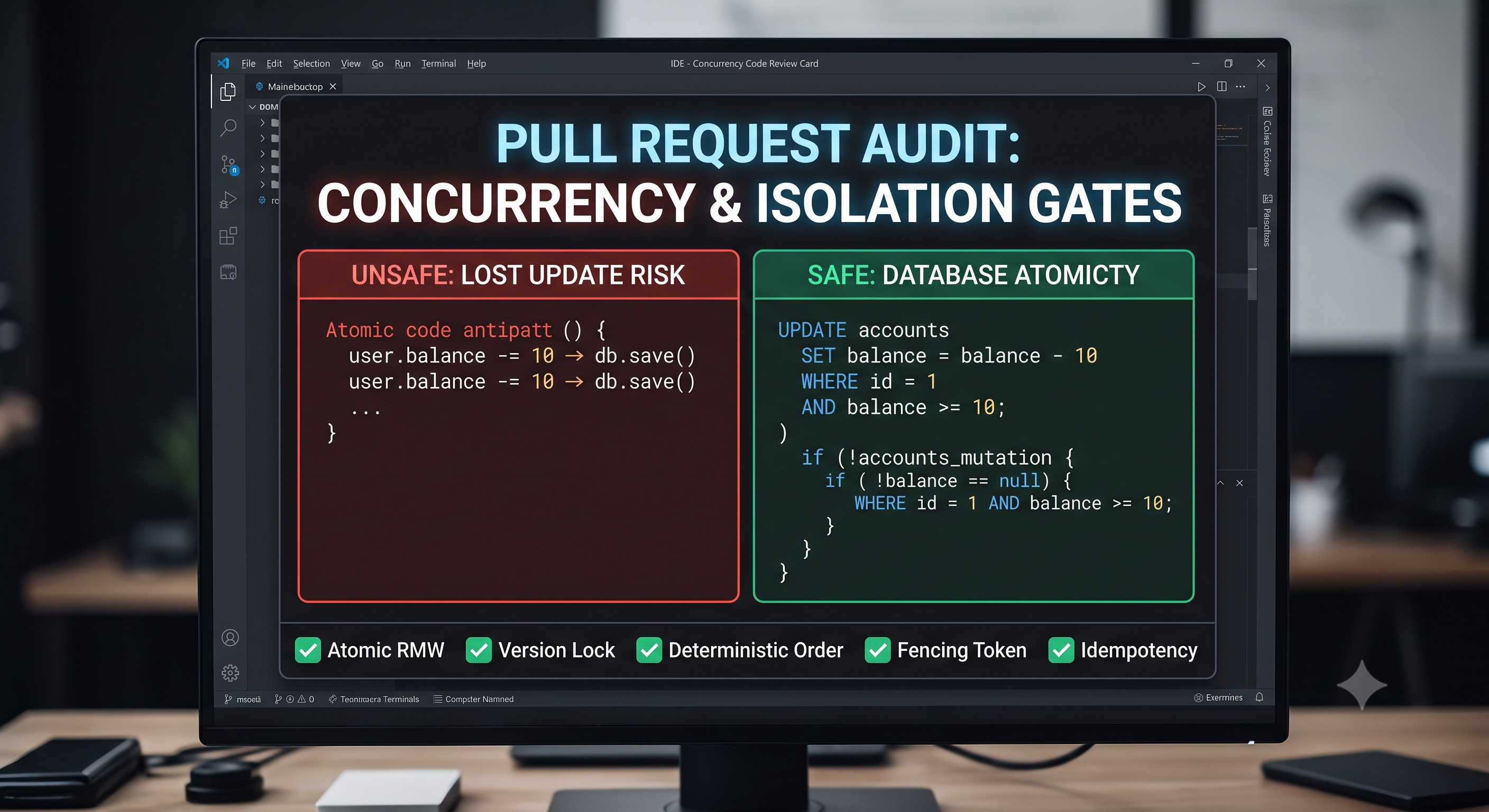
Most developers write code assuming sequential execution. In production, dozens of instances run simultaneously against shared state, turning simple if (balance >= amount) operations into critical bugs.
Distributed architectures and multi-threaded runtimes require proactive defense. Instead of relying on hope or post-incident patches, verify every state-mutating pull request against this 5-Point Concurrency Checklist:
Markdown
[ ] 1. ATOMICITY & READ-MODIFY-WRITE INTEGRITY
- [ ] Identify Read-Modify-Write (RMW): Flag any logic reading a value, modifying it in application memory, and writing it back.
- [ ] Push Computation to the Storage Engine: Replace application-level arithmetic with atomic database operations:
// Antipattern
user.balance -= 50;
db.save(user);
// Atomic Pattern
UPDATE accounts SET balance = balance - 50 WHERE id = :id AND balance >= 50;
[ ] 2. CONCURRENCY CONTROL STRATEGY
- [ ] Optimistic Locking (High Read, Low Write): Ensure records include a `version` or `updated_at` column; reject/retry updates if version matches 0 rows affected.
- [ ] Pessimistic Locking (High Contention): Use `SELECT ... FOR UPDATE` exclusively inside short, explicit transactions. Keep lock scopes minimal to prevent thread exhaustion.
[ ] 3. DISTRIBUTED LOCK HYGIENE
- [ ] Safe TTL Allocation: Verify locks acquired via Redis/Redlock have dynamic heartbeat renewal or TTLs comfortably longer than the worst-case P99 execution time.
- [ ] Deterministic Release: Release locks only via safe Lua scripts verifying ownership tokens (fencing tokens), preventing a lagging worker from releasing another node's lock.
[ ] 4. DEADLOCK PREVENTION (ORDER OF ACQUISITION)
- [ ] Monotonic Resource Ordering: When locking multiple rows or entities, enforce a deterministic lock order across all services (e.g., sort entity IDs alphanumerically before acquiring locks).
- [ ] Strict Transaction Timeouts: Bound every database lock attempt with a explicit timeout to prevent worker pool starvation.
[ ] 5. SAFE RETRY & IDEMPOTENCY BOUNDARIES
- [ ] Jittered Exponential Backoff: Ensure retries on serialization failures or optimistic lock conflicts do not trigger retry storms (thundering herds).
- [ ] Idempotency Keys: Enforce unique idempotency keys on incoming mutation payloads to discard accidental duplicate calls during network partitions.
Rule of Thumb: If two requests arrive at the exact same millisecond, can your database enforce correctness without application logic? If not, the transaction boundary is incomplete.
Discussion Question
What is your team’s preferred strategy for high-contention writes: Optimistic Concurrency Control (OCC) with retries, Pessimistic row-locking, or queue-based serialization?
CTA (Join Developers & Coding)
Want to level up your system design, backend architectures, and distributed systems skills? Join Developers & Coding by Techawks to code, debug, and review alongside software engineers worldwide.
Most developers write code assuming sequential execution. In production, dozens of instances run simultaneously against shared state, turning simple if (balance >= amount) operations into critical bugs.
Distributed architectures and multi-threaded runtimes require proactive defense. Instead of relying on hope or post-incident patches, verify every state-mutating pull request against this 5-Point Concurrency Checklist:
Markdown
[ ] 1. ATOMICITY & READ-MODIFY-WRITE INTEGRITY
- [ ] Identify Read-Modify-Write (RMW): Flag any logic reading a value, modifying it in application memory, and writing it back.
- [ ] Push Computation to the Storage Engine: Replace application-level arithmetic with atomic database operations:
// Antipattern
user.balance -= 50;
db.save(user);
// Atomic Pattern
UPDATE accounts SET balance = balance - 50 WHERE id = :id AND balance >= 50;
[ ] 2. CONCURRENCY CONTROL STRATEGY
- [ ] Optimistic Locking (High Read, Low Write): Ensure records include a `version` or `updated_at` column; reject/retry updates if version matches 0 rows affected.
- [ ] Pessimistic Locking (High Contention): Use `SELECT ... FOR UPDATE` exclusively inside short, explicit transactions. Keep lock scopes minimal to prevent thread exhaustion.
[ ] 3. DISTRIBUTED LOCK HYGIENE
- [ ] Safe TTL Allocation: Verify locks acquired via Redis/Redlock have dynamic heartbeat renewal or TTLs comfortably longer than the worst-case P99 execution time.
- [ ] Deterministic Release: Release locks only via safe Lua scripts verifying ownership tokens (fencing tokens), preventing a lagging worker from releasing another node's lock.
[ ] 4. DEADLOCK PREVENTION (ORDER OF ACQUISITION)
- [ ] Monotonic Resource Ordering: When locking multiple rows or entities, enforce a deterministic lock order across all services (e.g., sort entity IDs alphanumerically before acquiring locks).
- [ ] Strict Transaction Timeouts: Bound every database lock attempt with a explicit timeout to prevent worker pool starvation.
[ ] 5. SAFE RETRY & IDEMPOTENCY BOUNDARIES
- [ ] Jittered Exponential Backoff: Ensure retries on serialization failures or optimistic lock conflicts do not trigger retry storms (thundering herds).
- [ ] Idempotency Keys: Enforce unique idempotency keys on incoming mutation payloads to discard accidental duplicate calls during network partitions.
Rule of Thumb: If two requests arrive at the exact same millisecond, can your database enforce correctness without application logic? If not, the transaction boundary is incomplete.
Discussion Question
What is your team’s preferred strategy for high-contention writes: Optimistic Concurrency Control (OCC) with retries, Pessimistic row-locking, or queue-based serialization?
CTA (Join Developers & Coding)
Want to level up your system design, backend architectures, and distributed systems skills? Join Developers & Coding by Techawks to code, debug, and review alongside software engineers worldwide.
The Concurrent Code Review Checklist: How to Prevent Race Conditions Before Merge
Most developers write code assuming sequential execution. In production, dozens of instances run simultaneously against shared state, turning simple if (balance >= amount) operations into critical bugs.
Distributed architectures and multi-threaded runtimes require proactive defense. Instead of relying on hope or post-incident patches, verify every state-mutating pull request against this 5-Point Concurrency Checklist:
Markdown
[ ] 1. ATOMICITY & READ-MODIFY-WRITE INTEGRITY
- [ ] Identify Read-Modify-Write (RMW): Flag any logic reading a value, modifying it in application memory, and writing it back.
- [ ] Push Computation to the Storage Engine: Replace application-level arithmetic with atomic database operations:
// Antipattern
user.balance -= 50;
db.save(user);
// Atomic Pattern
UPDATE accounts SET balance = balance - 50 WHERE id = :id AND balance >= 50;
[ ] 2. CONCURRENCY CONTROL STRATEGY
- [ ] Optimistic Locking (High Read, Low Write): Ensure records include a `version` or `updated_at` column; reject/retry updates if version matches 0 rows affected.
- [ ] Pessimistic Locking (High Contention): Use `SELECT ... FOR UPDATE` exclusively inside short, explicit transactions. Keep lock scopes minimal to prevent thread exhaustion.
[ ] 3. DISTRIBUTED LOCK HYGIENE
- [ ] Safe TTL Allocation: Verify locks acquired via Redis/Redlock have dynamic heartbeat renewal or TTLs comfortably longer than the worst-case P99 execution time.
- [ ] Deterministic Release: Release locks only via safe Lua scripts verifying ownership tokens (fencing tokens), preventing a lagging worker from releasing another node's lock.
[ ] 4. DEADLOCK PREVENTION (ORDER OF ACQUISITION)
- [ ] Monotonic Resource Ordering: When locking multiple rows or entities, enforce a deterministic lock order across all services (e.g., sort entity IDs alphanumerically before acquiring locks).
- [ ] Strict Transaction Timeouts: Bound every database lock attempt with a explicit timeout to prevent worker pool starvation.
[ ] 5. SAFE RETRY & IDEMPOTENCY BOUNDARIES
- [ ] Jittered Exponential Backoff: Ensure retries on serialization failures or optimistic lock conflicts do not trigger retry storms (thundering herds).
- [ ] Idempotency Keys: Enforce unique idempotency keys on incoming mutation payloads to discard accidental duplicate calls during network partitions.
Rule of Thumb: If two requests arrive at the exact same millisecond, can your database enforce correctness without application logic? If not, the transaction boundary is incomplete.
Discussion Question
What is your team’s preferred strategy for high-contention writes: Optimistic Concurrency Control (OCC) with retries, Pessimistic row-locking, or queue-based serialization?
CTA (Join Developers & Coding)
Want to level up your system design, backend architectures, and distributed systems skills? Join Developers & Coding by Techawks to code, debug, and review alongside software engineers worldwide.

 Arabic
 French
 Spanish
 Portuguese
 Deutsch
 Turkish
 Dutch
Dutch
 Italiano
 Russian
 Romaian
 Portuguese (Brazil)
 Greek
Greek