


How to Master Remote Technical Interviews in the Canadian Tech Market
Whether you are based in Toronto, Vancouver, Montreal, or working remotely from anywhere across Canada, technical hiring processes have largely shifted to virtual-first formats.
Successfully landing your next role means knowing how to communicate complex technical concepts through a screen just as clearly as you write code.Here are three core strategies to elevate your technical interview performance:
1. Talk Through Your Problem-Solving Strategy Out Loud
In a remote interview, silence can create a disconnect. Interviewers are assessing how you think, not just your final solution.
Break down the problem statement before writing a single line of code.State your assumptions clearly and clarify edge cases up front.
Walk the interviewer through your thought process as you evaluate trade-offs (e.g., time complexity vs. space complexity).
2. Contextualize Your Experience for the Canadian Ecosystem
Canadian tech companies—ranging from early-stage startups to major enterprise hubs—prioritize scalable, cross-functional collaboration. When discussing past projects:
Emphasize practical business impact alongside technical achievements (e.g., "Optimized API latency by 35%, which improved end-user checkout conversion")
Highlight experience with modern cloud tooling (AWS, GCP, or Azure) and agile workflows tailored to remote environments.
3. Treat the System Design Phase like an Interactive Architecture Review
System design questions are designed to test real-world trade-offs.
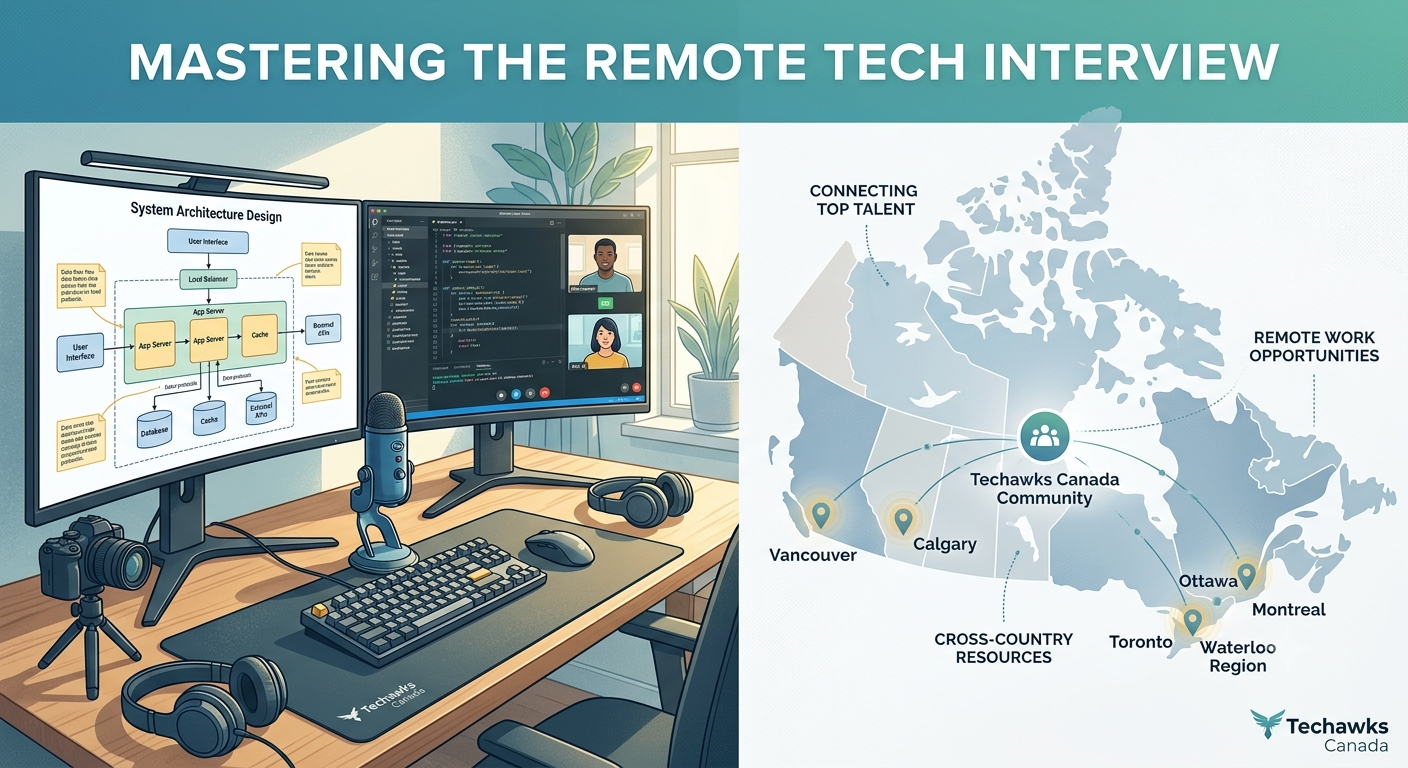
Use virtual whiteboarding tools efficiently. Sketch out clear components (databases, load balancers, microservices).
Ask probing questions about scale, expected traffic, and constraints before proposing a high-level architecture.
Address security, data privacy, and maintainability early in the discussion.
Key Takeaways
Communication over execution: Clearly explaining your logic is just as vital as writing functional code.Business-driven metrics: Frame your technical contributions around measurable outcomes and business value.Collaborative design: Treat system design discussions as a pair-programming session with a peer rather than an exam.
CTA
Looking to connect with top tech talent, industry mentors, and developers across the country? [Join Techawks Canada] today to access exclusive resources, community events, and technical discussions.
Whether you are based in Toronto, Vancouver, Montreal, or working remotely from anywhere across Canada, technical hiring processes have largely shifted to virtual-first formats.
Successfully landing your next role means knowing how to communicate complex technical concepts through a screen just as clearly as you write code.Here are three core strategies to elevate your technical interview performance:
1. Talk Through Your Problem-Solving Strategy Out Loud
In a remote interview, silence can create a disconnect. Interviewers are assessing how you think, not just your final solution.
Break down the problem statement before writing a single line of code.State your assumptions clearly and clarify edge cases up front.
Walk the interviewer through your thought process as you evaluate trade-offs (e.g., time complexity vs. space complexity).
2. Contextualize Your Experience for the Canadian Ecosystem
Canadian tech companies—ranging from early-stage startups to major enterprise hubs—prioritize scalable, cross-functional collaboration. When discussing past projects:
Emphasize practical business impact alongside technical achievements (e.g., "Optimized API latency by 35%, which improved end-user checkout conversion")
Highlight experience with modern cloud tooling (AWS, GCP, or Azure) and agile workflows tailored to remote environments.
3. Treat the System Design Phase like an Interactive Architecture Review
System design questions are designed to test real-world trade-offs.
Use virtual whiteboarding tools efficiently. Sketch out clear components (databases, load balancers, microservices).
Ask probing questions about scale, expected traffic, and constraints before proposing a high-level architecture.
Address security, data privacy, and maintainability early in the discussion.
Key Takeaways
Communication over execution: Clearly explaining your logic is just as vital as writing functional code.Business-driven metrics: Frame your technical contributions around measurable outcomes and business value.Collaborative design: Treat system design discussions as a pair-programming session with a peer rather than an exam.
CTA
Looking to connect with top tech talent, industry mentors, and developers across the country? [Join Techawks Canada] today to access exclusive resources, community events, and technical discussions.
How to Master Remote Technical Interviews in the Canadian Tech Market
Whether you are based in Toronto, Vancouver, Montreal, or working remotely from anywhere across Canada, technical hiring processes have largely shifted to virtual-first formats.
Successfully landing your next role means knowing how to communicate complex technical concepts through a screen just as clearly as you write code.Here are three core strategies to elevate your technical interview performance:
1. Talk Through Your Problem-Solving Strategy Out Loud
In a remote interview, silence can create a disconnect. Interviewers are assessing how you think, not just your final solution.
Break down the problem statement before writing a single line of code.State your assumptions clearly and clarify edge cases up front.
Walk the interviewer through your thought process as you evaluate trade-offs (e.g., time complexity vs. space complexity).
2. Contextualize Your Experience for the Canadian Ecosystem
Canadian tech companies—ranging from early-stage startups to major enterprise hubs—prioritize scalable, cross-functional collaboration. When discussing past projects:
Emphasize practical business impact alongside technical achievements (e.g., "Optimized API latency by 35%, which improved end-user checkout conversion")
Highlight experience with modern cloud tooling (AWS, GCP, or Azure) and agile workflows tailored to remote environments.
3. Treat the System Design Phase like an Interactive Architecture Review
System design questions are designed to test real-world trade-offs.
Use virtual whiteboarding tools efficiently. Sketch out clear components (databases, load balancers, microservices).
Ask probing questions about scale, expected traffic, and constraints before proposing a high-level architecture.
Address security, data privacy, and maintainability early in the discussion.
Key Takeaways
Communication over execution: Clearly explaining your logic is just as vital as writing functional code.Business-driven metrics: Frame your technical contributions around measurable outcomes and business value.Collaborative design: Treat system design discussions as a pair-programming session with a peer rather than an exam.
CTA
Looking to connect with top tech talent, industry mentors, and developers across the country? [Join Techawks Canada] today to access exclusive resources, community events, and technical discussions.

 English
 Arabic
 French
 Spanish
 Portuguese
 Deutsch
 Turkish
 Italiano
 Russian
 Romaian
 Portuguese (Brazil)
 Greek
Greek