


The AI-Era Technical Interview Checklist: How Hiring Bars Shifted From Syntax to Verification
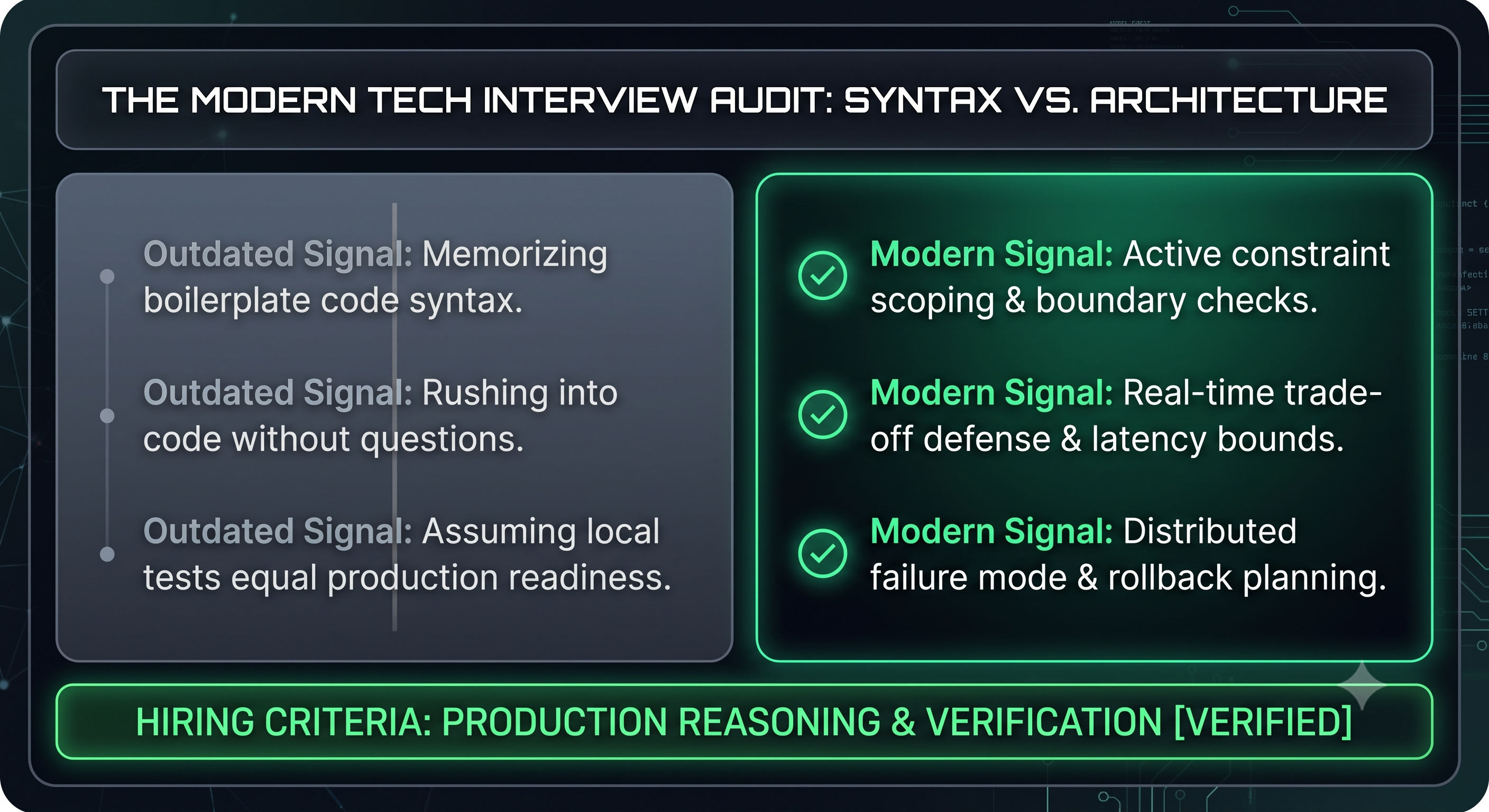
The technical interview loop has evolved. With AI co-pilots and code assistants ubiquitous, interviewers are rarely assessing whether you memorized syntactical edge cases or basic algorithm trivia.
Instead, engineering teams are testing for verification literacy, system constraints, and architectural trade-offs.
If you're interviewing for engineering or AI roles, running through this Technical Interview Readiness Checklist will separate you from candidates who just let tools do the thinking:
Markdown
[ ] 1. PROBLEM SCOPING & CONSTRAINT EXTRACTION
- [ ] Clarify Beyond Happy Paths: Extract explicit boundary parameters (e.g., read vs. write volume, network latency tolerances, memory footprints) before writing line one.
- [ ] State Machine Formulation: Map state mutations and error lifecycles aloud rather than jumping directly to implementation.
[ ] 2. CODE INTENT & RUNTIME REASONING
- [ ] Narrate the "Why": Explain architectural decisions aloud—why an indexed lookup table or asynchronous queue beats an in-memory array for this scale.
- [ ] Cognitive Verification: Demonstrate the ability to spot subtle logic bugs, race conditions, or off-by-one errors without relying on auto-formatters or AI autocompletes.
[ ] 3. SYSTEM RESILIENCY & TRADE-OFF DEFENSE
- [ ] Fallback Planning: Proactively answer: "How does this function fail if a downstream microservice or API times out?"
- [ ] Concurrency & Data Isolation: Address atomicity, idempotent mutations, and database transaction locks without being prompted.
- [ ] Complexity Auditing: State strict Big-O time and space bounds alongside memory allocations under maximum throughput.
[ ] 4. APPLIED AI & MODERN TOOL LITERACY
- [ ] Telemetry & Observability: Show you know how to monitor and log modern pipelines (metrics, traces, latency budgets) instead of treating applications as black boxes.
- [ ] Model Constraint Awareness: For applied AI/ML roles, articulate when deterministic heuristic systems are superior to expensive, non-deterministic model calls.
[ ] 5. STRUCTURED BEHAVIORAL OWNERSHIP
- [ ] Measurable Impact (STAR Format): Prepare scenarios detailing a major production outage, rollback, or architectural compromise with quantifiable business impact.
- [ ] Cross-Functional Pragmatism: Show how you balance developer velocity against technical debt and operational risk.
Key Takeaway: Technical interviewers don’t hire code generators; they hire engineers who know how to validate, debug, and safely deploy systems to production.
Discussion Question
What has been the biggest change you've noticed in recent tech interviews—deeper system design deep-dives, live code review/debugging rounds, or tougher behavioral loops?
CTA (Join Tech Jobs & Opportunities)
Looking to break into top-tier tech teams or land your next engineering role? Join Tech Jobs & Opportunities by Techawks for exclusive job openings, interview post-mortems, and career playbooks with seasoned hiring managers.
The technical interview loop has evolved. With AI co-pilots and code assistants ubiquitous, interviewers are rarely assessing whether you memorized syntactical edge cases or basic algorithm trivia.
Instead, engineering teams are testing for verification literacy, system constraints, and architectural trade-offs.
If you're interviewing for engineering or AI roles, running through this Technical Interview Readiness Checklist will separate you from candidates who just let tools do the thinking:
Markdown
[ ] 1. PROBLEM SCOPING & CONSTRAINT EXTRACTION
- [ ] Clarify Beyond Happy Paths: Extract explicit boundary parameters (e.g., read vs. write volume, network latency tolerances, memory footprints) before writing line one.
- [ ] State Machine Formulation: Map state mutations and error lifecycles aloud rather than jumping directly to implementation.
[ ] 2. CODE INTENT & RUNTIME REASONING
- [ ] Narrate the "Why": Explain architectural decisions aloud—why an indexed lookup table or asynchronous queue beats an in-memory array for this scale.
- [ ] Cognitive Verification: Demonstrate the ability to spot subtle logic bugs, race conditions, or off-by-one errors without relying on auto-formatters or AI autocompletes.
[ ] 3. SYSTEM RESILIENCY & TRADE-OFF DEFENSE
- [ ] Fallback Planning: Proactively answer: "How does this function fail if a downstream microservice or API times out?"
- [ ] Concurrency & Data Isolation: Address atomicity, idempotent mutations, and database transaction locks without being prompted.
- [ ] Complexity Auditing: State strict Big-O time and space bounds alongside memory allocations under maximum throughput.
[ ] 4. APPLIED AI & MODERN TOOL LITERACY
- [ ] Telemetry & Observability: Show you know how to monitor and log modern pipelines (metrics, traces, latency budgets) instead of treating applications as black boxes.
- [ ] Model Constraint Awareness: For applied AI/ML roles, articulate when deterministic heuristic systems are superior to expensive, non-deterministic model calls.
[ ] 5. STRUCTURED BEHAVIORAL OWNERSHIP
- [ ] Measurable Impact (STAR Format): Prepare scenarios detailing a major production outage, rollback, or architectural compromise with quantifiable business impact.
- [ ] Cross-Functional Pragmatism: Show how you balance developer velocity against technical debt and operational risk.
Key Takeaway: Technical interviewers don’t hire code generators; they hire engineers who know how to validate, debug, and safely deploy systems to production.
Discussion Question
What has been the biggest change you've noticed in recent tech interviews—deeper system design deep-dives, live code review/debugging rounds, or tougher behavioral loops?
CTA (Join Tech Jobs & Opportunities)
Looking to break into top-tier tech teams or land your next engineering role? Join Tech Jobs & Opportunities by Techawks for exclusive job openings, interview post-mortems, and career playbooks with seasoned hiring managers.
The AI-Era Technical Interview Checklist: How Hiring Bars Shifted From Syntax to Verification
The technical interview loop has evolved. With AI co-pilots and code assistants ubiquitous, interviewers are rarely assessing whether you memorized syntactical edge cases or basic algorithm trivia.
Instead, engineering teams are testing for verification literacy, system constraints, and architectural trade-offs.
If you're interviewing for engineering or AI roles, running through this Technical Interview Readiness Checklist will separate you from candidates who just let tools do the thinking:
Markdown
[ ] 1. PROBLEM SCOPING & CONSTRAINT EXTRACTION
- [ ] Clarify Beyond Happy Paths: Extract explicit boundary parameters (e.g., read vs. write volume, network latency tolerances, memory footprints) before writing line one.
- [ ] State Machine Formulation: Map state mutations and error lifecycles aloud rather than jumping directly to implementation.
[ ] 2. CODE INTENT & RUNTIME REASONING
- [ ] Narrate the "Why": Explain architectural decisions aloud—why an indexed lookup table or asynchronous queue beats an in-memory array for this scale.
- [ ] Cognitive Verification: Demonstrate the ability to spot subtle logic bugs, race conditions, or off-by-one errors without relying on auto-formatters or AI autocompletes.
[ ] 3. SYSTEM RESILIENCY & TRADE-OFF DEFENSE
- [ ] Fallback Planning: Proactively answer: "How does this function fail if a downstream microservice or API times out?"
- [ ] Concurrency & Data Isolation: Address atomicity, idempotent mutations, and database transaction locks without being prompted.
- [ ] Complexity Auditing: State strict Big-O time and space bounds alongside memory allocations under maximum throughput.
[ ] 4. APPLIED AI & MODERN TOOL LITERACY
- [ ] Telemetry & Observability: Show you know how to monitor and log modern pipelines (metrics, traces, latency budgets) instead of treating applications as black boxes.
- [ ] Model Constraint Awareness: For applied AI/ML roles, articulate when deterministic heuristic systems are superior to expensive, non-deterministic model calls.
[ ] 5. STRUCTURED BEHAVIORAL OWNERSHIP
- [ ] Measurable Impact (STAR Format): Prepare scenarios detailing a major production outage, rollback, or architectural compromise with quantifiable business impact.
- [ ] Cross-Functional Pragmatism: Show how you balance developer velocity against technical debt and operational risk.
Key Takeaway: Technical interviewers don’t hire code generators; they hire engineers who know how to validate, debug, and safely deploy systems to production.
Discussion Question
What has been the biggest change you've noticed in recent tech interviews—deeper system design deep-dives, live code review/debugging rounds, or tougher behavioral loops?
CTA (Join Tech Jobs & Opportunities)
Looking to break into top-tier tech teams or land your next engineering role? Join Tech Jobs & Opportunities by Techawks for exclusive job openings, interview post-mortems, and career playbooks with seasoned hiring managers.

 Arabic
 French
 Spanish
 Portuguese
 Deutsch
 Turkish
 Dutch
Dutch
 Italiano
 Russian
 Romaian
 Portuguese (Brazil)
 Greek
Greek