


The DPDP Consent Architecture Deadline: An Indian Tech Lead’s Production Readiness Checklist
Most technical teams assume compliance begins and ends with updated privacy policy checkboxes and cookie banners. Under the DPDP framework and its Consent Manager rules, compliance is not a legal document—it is a distributed systems problem.
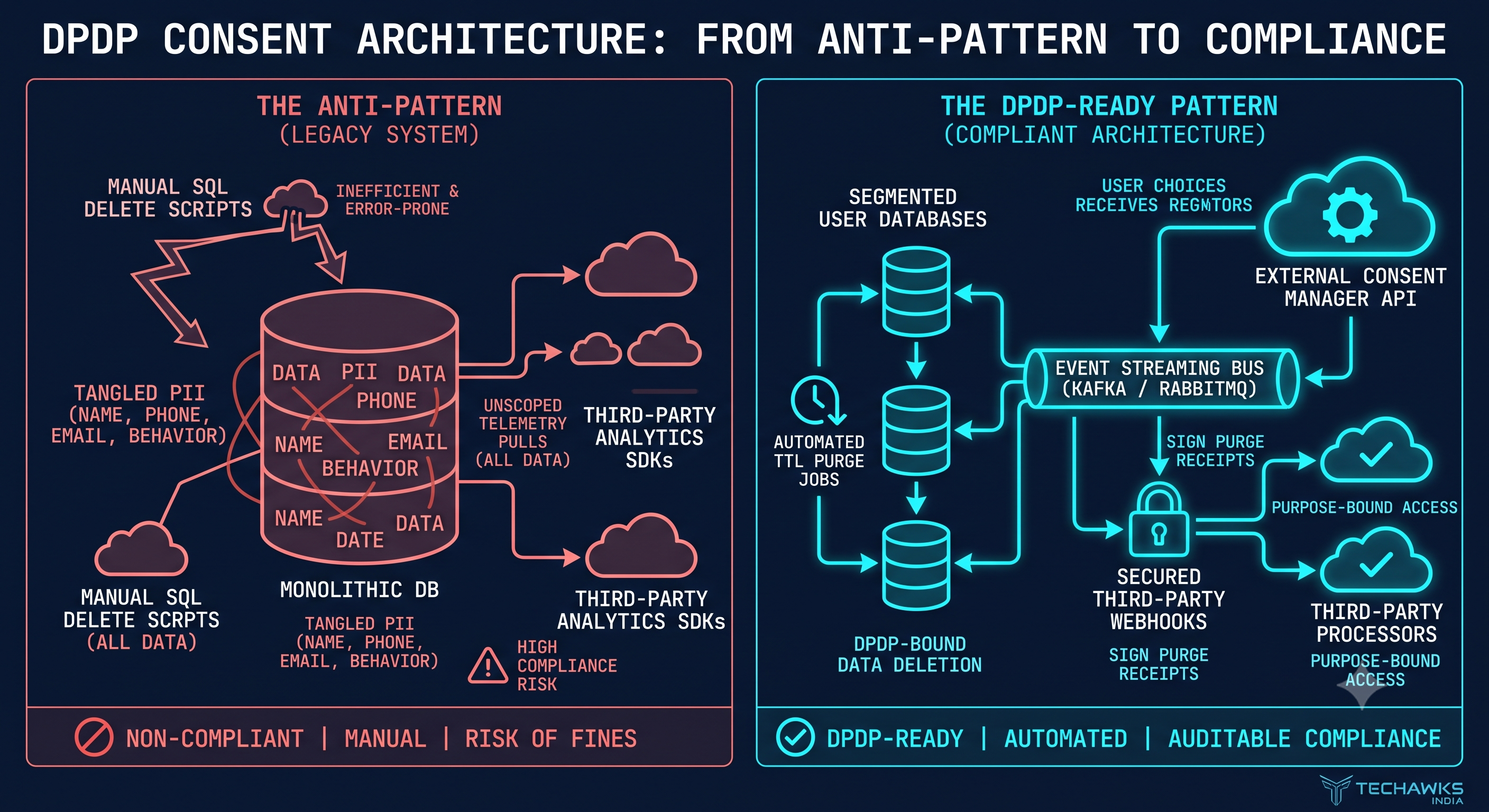
Why It Matters to Indian Tech TeamsWith the operational rollout of the statutory Consent Manager Framework and the Data Protection Board's enforcement mechanisms, data handling requires auditable state machines. If a user revokes consent via an external interoperable Consent Manager, that revocation must propagate deterministically across your microservices, cache layers, and downstream analytics pipelines.
Failure to prove cryptographic verification and purposive data isolation risks penalties reaching up to ₹250 crore per violation.
The Production Readiness Checklist for Engineering Teams
[ ] 1. Decouple User Identity from Behavioral Schemas
└─ Store PII and transactional data in segregated, encrypted partitions.
└─ Enforce cryptographic pseudonymization before piping events to telemetry or training clusters.
[ ] 2. Implement a Real-Time Consent Invalidation Bus
└─ Treat consent state as an event stream (e.g., Kafka topic) rather than a static DB boolean.
└─ Propagate consent withdrawal webhooks downstream with bounded SLA (< 1 hour across active sessions).
[ ] 3. Audit Purpose-Bound API Payloads
└─ Strip all blanket "read-all" scopes across internal microservices.
└─ Gate endpoints using attribute-based access controls (ABAC) tied strictly to active, granular consent IDs.
[ ] 4. Enforce Retention Schedules at the Storage Engine Level
└─ Transition from manual DB cleanup scripts to TTL-based automatic purge policies in primary and secondary stores.
└─ Verify cold-storage archive purges and 7-year audit log retention for consent trails.
[ ] 5. Standardize Data Processor (Vendor) Webhook Protocols
└─ Map every external SDK (analytics, CRM, payment aggregators) handling Indian user telemetry.
└─ Establish signed purge receipts from third-party processors whenever an erasure request is executed.
Compliance isn't solved by adding terms to a signup page—it's solved by how reliably your architecture handles data isolation and deletion requests.
Discussion Question
How is your engineering team currently architecting downstream consent revocation across your caching and asynchronous worker layers?
CTA (Join Techawks India)
Follow Techawks India for real-world engineering blueprints, regulatory architecture breakdowns, and actionable tech insights built for the Indian developer ecosystem.
Most technical teams assume compliance begins and ends with updated privacy policy checkboxes and cookie banners. Under the DPDP framework and its Consent Manager rules, compliance is not a legal document—it is a distributed systems problem.
Why It Matters to Indian Tech TeamsWith the operational rollout of the statutory Consent Manager Framework and the Data Protection Board's enforcement mechanisms, data handling requires auditable state machines. If a user revokes consent via an external interoperable Consent Manager, that revocation must propagate deterministically across your microservices, cache layers, and downstream analytics pipelines.
Failure to prove cryptographic verification and purposive data isolation risks penalties reaching up to ₹250 crore per violation.
The Production Readiness Checklist for Engineering Teams
[ ] 1. Decouple User Identity from Behavioral Schemas
└─ Store PII and transactional data in segregated, encrypted partitions.
└─ Enforce cryptographic pseudonymization before piping events to telemetry or training clusters.
[ ] 2. Implement a Real-Time Consent Invalidation Bus
└─ Treat consent state as an event stream (e.g., Kafka topic) rather than a static DB boolean.
└─ Propagate consent withdrawal webhooks downstream with bounded SLA (< 1 hour across active sessions).
[ ] 3. Audit Purpose-Bound API Payloads
└─ Strip all blanket "read-all" scopes across internal microservices.
└─ Gate endpoints using attribute-based access controls (ABAC) tied strictly to active, granular consent IDs.
[ ] 4. Enforce Retention Schedules at the Storage Engine Level
└─ Transition from manual DB cleanup scripts to TTL-based automatic purge policies in primary and secondary stores.
└─ Verify cold-storage archive purges and 7-year audit log retention for consent trails.
[ ] 5. Standardize Data Processor (Vendor) Webhook Protocols
└─ Map every external SDK (analytics, CRM, payment aggregators) handling Indian user telemetry.
└─ Establish signed purge receipts from third-party processors whenever an erasure request is executed.
Compliance isn't solved by adding terms to a signup page—it's solved by how reliably your architecture handles data isolation and deletion requests.
Discussion Question
How is your engineering team currently architecting downstream consent revocation across your caching and asynchronous worker layers?
CTA (Join Techawks India)
Follow Techawks India for real-world engineering blueprints, regulatory architecture breakdowns, and actionable tech insights built for the Indian developer ecosystem.
The DPDP Consent Architecture Deadline: An Indian Tech Lead’s Production Readiness Checklist
Most technical teams assume compliance begins and ends with updated privacy policy checkboxes and cookie banners. Under the DPDP framework and its Consent Manager rules, compliance is not a legal document—it is a distributed systems problem.
Why It Matters to Indian Tech TeamsWith the operational rollout of the statutory Consent Manager Framework and the Data Protection Board's enforcement mechanisms, data handling requires auditable state machines. If a user revokes consent via an external interoperable Consent Manager, that revocation must propagate deterministically across your microservices, cache layers, and downstream analytics pipelines.
Failure to prove cryptographic verification and purposive data isolation risks penalties reaching up to ₹250 crore per violation.
The Production Readiness Checklist for Engineering Teams
[ ] 1. Decouple User Identity from Behavioral Schemas
└─ Store PII and transactional data in segregated, encrypted partitions.
└─ Enforce cryptographic pseudonymization before piping events to telemetry or training clusters.
[ ] 2. Implement a Real-Time Consent Invalidation Bus
└─ Treat consent state as an event stream (e.g., Kafka topic) rather than a static DB boolean.
└─ Propagate consent withdrawal webhooks downstream with bounded SLA (< 1 hour across active sessions).
[ ] 3. Audit Purpose-Bound API Payloads
└─ Strip all blanket "read-all" scopes across internal microservices.
└─ Gate endpoints using attribute-based access controls (ABAC) tied strictly to active, granular consent IDs.
[ ] 4. Enforce Retention Schedules at the Storage Engine Level
└─ Transition from manual DB cleanup scripts to TTL-based automatic purge policies in primary and secondary stores.
└─ Verify cold-storage archive purges and 7-year audit log retention for consent trails.
[ ] 5. Standardize Data Processor (Vendor) Webhook Protocols
└─ Map every external SDK (analytics, CRM, payment aggregators) handling Indian user telemetry.
└─ Establish signed purge receipts from third-party processors whenever an erasure request is executed.
Compliance isn't solved by adding terms to a signup page—it's solved by how reliably your architecture handles data isolation and deletion requests.
Discussion Question
How is your engineering team currently architecting downstream consent revocation across your caching and asynchronous worker layers?
CTA (Join Techawks India)
Follow Techawks India for real-world engineering blueprints, regulatory architecture breakdowns, and actionable tech insights built for the Indian developer ecosystem.

 Arabic
 French
 Spanish
 Portuguese
 Deutsch
 Turkish
 Dutch
Dutch
 Italiano
 Russian
 Romaian
 Portuguese (Brazil)
 Greek
Greek