


CISA’s Updated SBOM Mandate: A US Engineering Lead’s CI/CD Pipeline Audit Checklist
Most US engineering organizations treated earlier SBOM guidance as an afterthought: generate a CycloneDX or SPDX manifest during the build phase and store it in an S3 bucket.
Under CISA's updated Minimum Elements baseline and tightening federal procurement standards, an SBOM is no longer a passive snapshot. It is an active provenance assertion that demands deep cryptographic signing, transitive dependency tracking, and automated vulnerability correlation across every stage of the software delivery lifecycle.
Why It Matters to US Tech Teams
Enterprise buyers across defense, finance, and critical infrastructure now enforce automated gatekeeping against vendors who cannot provide dynamic provenance. If your build runners ingest untrusted base images, unpinned dependencies, or non-reproducible build artifacts, your software faces delivery blockers, contractual default, or severe enterprise audit penalties.
The CI/CD Software Supply Chain Readiness Checklist
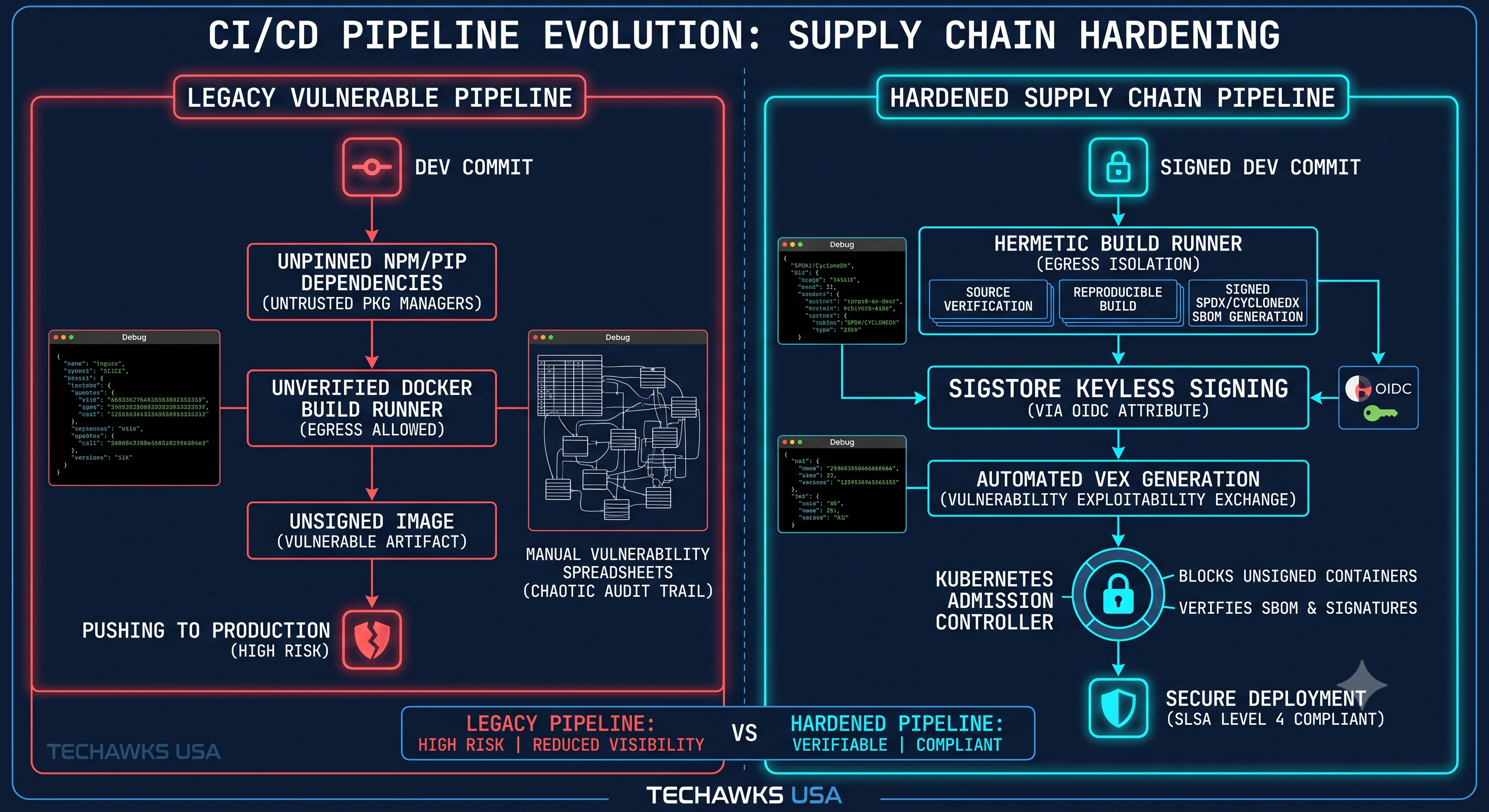
[ ] 1. Enforce Cryptographic Build Provenance (SLSA Level 3+)
└─ Isolate build runners from external network egress during compilation.
└─ Sign container images and binaries with ephemeral, keyless signatures (e.g., Sigstore/Cosign via OIDC).
[ ] 2. Mandate Machine-Readable Transitive Dependency Resolution
└─ Enforce pinned, immutable package hashes in lockfiles across all build targets.
└─ Configure generators to resolve multi-tier sub-dependencies, not just top-level packages.
[ ] 3. Implement Continuous Vulnerability Exploitability Exchange (VEX)
└─ Stop failing PR builds solely on noisy, non-exploitable upstream CVE flags.
└─ Pair your SBOM with an automated VEX generator to publish signed machine attestations on actual exploitability.
[ ] 4. Validate Base Image Lineage & Hermetic Builds
└─ Migrate production runtimes to distroless, minimal images with minimal attack surfaces.
└─ Verify that rebuilds using identical source commits yield bit-for-bit identical hashes.
[ ] 5. Gate Downstream Registries on Policy-as-Code
└─ Deploy admission controllers (e.g., Kyverno, OPA Gatekeeper) in staging/prod Kubernetes clusters.
└─ Reject any artifact deployment missing a verifiable, freshly signed SBOM attestation.
Supply chain security is not solved by scanning code after deployment—it is solved by enforcing cryptographic provenance before bits ever leave the build runner.
Discussion Question
Is your platform team automating VEX statements to reduce false-positive CVE noise in your production pipelines, or are you still handling upstream package alerts manually?
CTA (Join Techawks USA)
Follow Techawks USA for real-world enterprise architectures, secure software supply chain breakdowns, and engineering frameworks built for the US developer ecosystem.
Most US engineering organizations treated earlier SBOM guidance as an afterthought: generate a CycloneDX or SPDX manifest during the build phase and store it in an S3 bucket.
Under CISA's updated Minimum Elements baseline and tightening federal procurement standards, an SBOM is no longer a passive snapshot. It is an active provenance assertion that demands deep cryptographic signing, transitive dependency tracking, and automated vulnerability correlation across every stage of the software delivery lifecycle.
Why It Matters to US Tech Teams
Enterprise buyers across defense, finance, and critical infrastructure now enforce automated gatekeeping against vendors who cannot provide dynamic provenance. If your build runners ingest untrusted base images, unpinned dependencies, or non-reproducible build artifacts, your software faces delivery blockers, contractual default, or severe enterprise audit penalties.
The CI/CD Software Supply Chain Readiness Checklist
[ ] 1. Enforce Cryptographic Build Provenance (SLSA Level 3+)
└─ Isolate build runners from external network egress during compilation.
└─ Sign container images and binaries with ephemeral, keyless signatures (e.g., Sigstore/Cosign via OIDC).
[ ] 2. Mandate Machine-Readable Transitive Dependency Resolution
└─ Enforce pinned, immutable package hashes in lockfiles across all build targets.
└─ Configure generators to resolve multi-tier sub-dependencies, not just top-level packages.
[ ] 3. Implement Continuous Vulnerability Exploitability Exchange (VEX)
└─ Stop failing PR builds solely on noisy, non-exploitable upstream CVE flags.
└─ Pair your SBOM with an automated VEX generator to publish signed machine attestations on actual exploitability.
[ ] 4. Validate Base Image Lineage & Hermetic Builds
└─ Migrate production runtimes to distroless, minimal images with minimal attack surfaces.
└─ Verify that rebuilds using identical source commits yield bit-for-bit identical hashes.
[ ] 5. Gate Downstream Registries on Policy-as-Code
└─ Deploy admission controllers (e.g., Kyverno, OPA Gatekeeper) in staging/prod Kubernetes clusters.
└─ Reject any artifact deployment missing a verifiable, freshly signed SBOM attestation.
Supply chain security is not solved by scanning code after deployment—it is solved by enforcing cryptographic provenance before bits ever leave the build runner.
Discussion Question
Is your platform team automating VEX statements to reduce false-positive CVE noise in your production pipelines, or are you still handling upstream package alerts manually?
CTA (Join Techawks USA)
Follow Techawks USA for real-world enterprise architectures, secure software supply chain breakdowns, and engineering frameworks built for the US developer ecosystem.
CISA’s Updated SBOM Mandate: A US Engineering Lead’s CI/CD Pipeline Audit Checklist
Most US engineering organizations treated earlier SBOM guidance as an afterthought: generate a CycloneDX or SPDX manifest during the build phase and store it in an S3 bucket.
Under CISA's updated Minimum Elements baseline and tightening federal procurement standards, an SBOM is no longer a passive snapshot. It is an active provenance assertion that demands deep cryptographic signing, transitive dependency tracking, and automated vulnerability correlation across every stage of the software delivery lifecycle.
Why It Matters to US Tech Teams
Enterprise buyers across defense, finance, and critical infrastructure now enforce automated gatekeeping against vendors who cannot provide dynamic provenance. If your build runners ingest untrusted base images, unpinned dependencies, or non-reproducible build artifacts, your software faces delivery blockers, contractual default, or severe enterprise audit penalties.
The CI/CD Software Supply Chain Readiness Checklist
[ ] 1. Enforce Cryptographic Build Provenance (SLSA Level 3+)
└─ Isolate build runners from external network egress during compilation.
└─ Sign container images and binaries with ephemeral, keyless signatures (e.g., Sigstore/Cosign via OIDC).
[ ] 2. Mandate Machine-Readable Transitive Dependency Resolution
└─ Enforce pinned, immutable package hashes in lockfiles across all build targets.
└─ Configure generators to resolve multi-tier sub-dependencies, not just top-level packages.
[ ] 3. Implement Continuous Vulnerability Exploitability Exchange (VEX)
└─ Stop failing PR builds solely on noisy, non-exploitable upstream CVE flags.
└─ Pair your SBOM with an automated VEX generator to publish signed machine attestations on actual exploitability.
[ ] 4. Validate Base Image Lineage & Hermetic Builds
└─ Migrate production runtimes to distroless, minimal images with minimal attack surfaces.
└─ Verify that rebuilds using identical source commits yield bit-for-bit identical hashes.
[ ] 5. Gate Downstream Registries on Policy-as-Code
└─ Deploy admission controllers (e.g., Kyverno, OPA Gatekeeper) in staging/prod Kubernetes clusters.
└─ Reject any artifact deployment missing a verifiable, freshly signed SBOM attestation.
Supply chain security is not solved by scanning code after deployment—it is solved by enforcing cryptographic provenance before bits ever leave the build runner.
Discussion Question
Is your platform team automating VEX statements to reduce false-positive CVE noise in your production pipelines, or are you still handling upstream package alerts manually?
CTA (Join Techawks USA)
Follow Techawks USA for real-world enterprise architectures, secure software supply chain breakdowns, and engineering frameworks built for the US developer ecosystem.

 English
 Arabic
 French
 Spanish
 Portuguese
 Deutsch
 Dutch
Dutch
 Italiano
 Russian
 Romaian
 Portuguese (Brazil)
 Greek
Greek