


Beyond the LLM Wrapper: The UAE Tech Lead’s Production AI Governance & Data Sovereignty Checklist
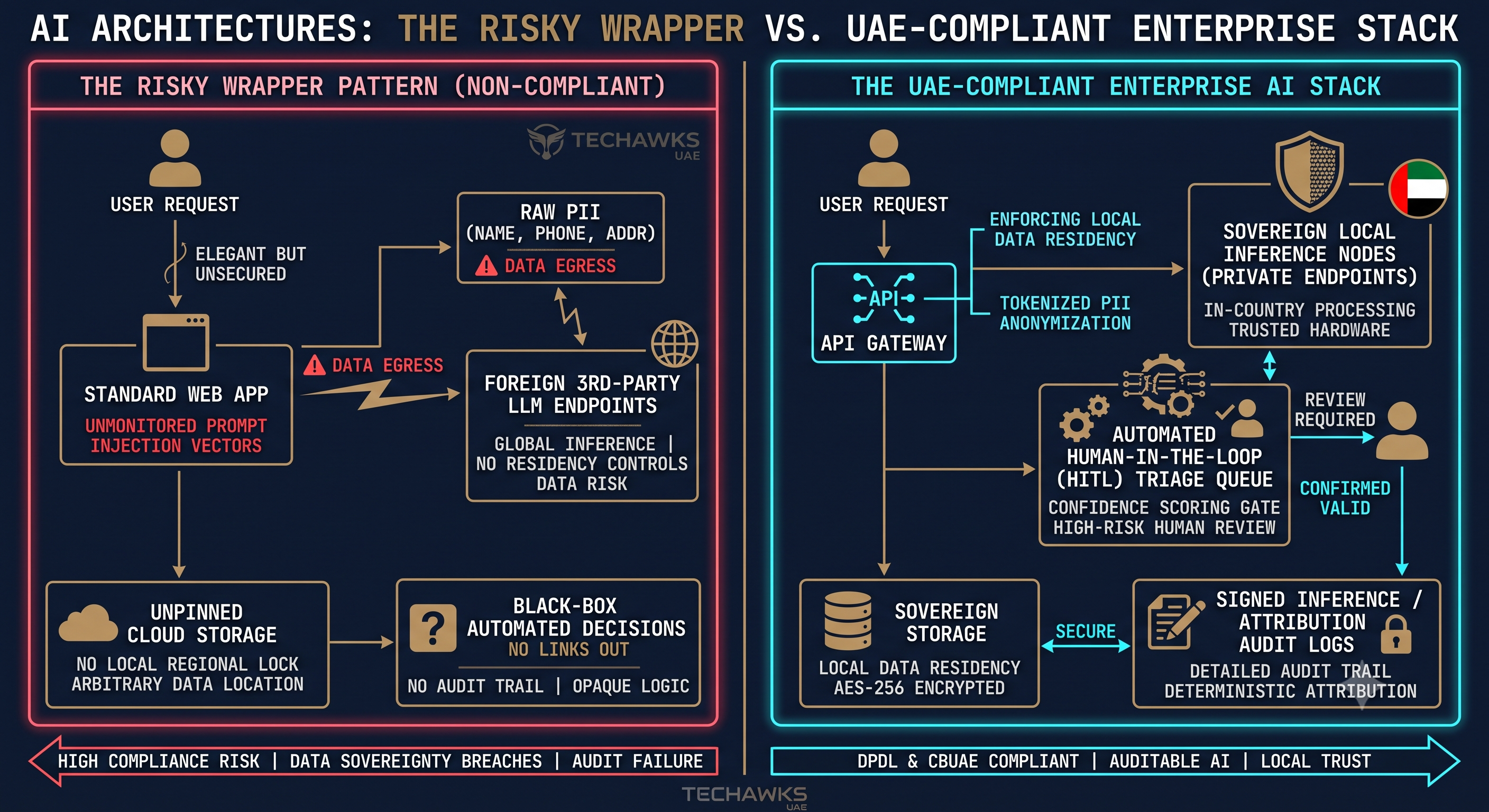
Across the Emirates, AI development is moving rapidly past the experimentation phase. Between Federal Decree-Law No. 45 (PDPL), the Central Bank of the UAE’s (CBUAE) AI/ML governance directives, and specialized free-zone frameworks in DIFC and ADGM, compliance in the UAE is fundamentally an architectural challenge.
Why It Matters to UAE Tech Teams
Unlike European or US models that rely heavily on catch-all legal bases like "legitimate interest," the UAE mainland framework is built on consent-first processing with explicit human-review gates for automated profiling. Meanwhile, local enterprise buyers and financial institutions face binding mandates around explainability, model drift auditing, and in-country data residency.
If your production models cannot provide auditable inference logs, isolate tenant data locally, or allow instantaneous human review for consequential automated actions, your product will fail enterprise procurement audits.
The Production AI Governance & Sovereignty Checklist
[ ] 1. Enforce In-Country Data Residency & Sovereign Inference
└─ Isolate UAE resident PII within local cloud availability zones (e.g., UAE Azure/AWS/Core42 clusters).
└─ Prevent upstream third-party model APIs from using enterprise client prompts for foundational training.
[ ] 2. Architect a Deterministic "Human-in-the-Loop" (HITL) Fallback
└─ Implement confidence scoring thresholds at the inference layer.
└─ Automatically route low-confidence or high-impact automated outputs (credit, KYC, hiring) to a human review queue.
[ ] 3. Decouple Training Data Provenance & Cryptographic Consent Logs
└─ Map every fine-tuning dataset to explicit, auditable user consent records.
└─ Maintain deterministic rollback mechanisms to unlearn or purge vectors derived from revoked personal data.
[ ] 4. Instrument Continuous Model Drift & Bias Telemetry
└─ Run automated weekly bias and distribution skew tests against local demographic parameters.
└─ Establish latency-aware circuit breakers that automatically roll back to baseline checkpoints if hallucinations spike.
[ ] 5. Implement Explainability & Attribution Layers (SHAP / Integrated Gradients)
└─ Store input attribution vectors alongside automated model decisions in cold storage for 5+ years.
└─ Expose human-readable decision factors via consumer-facing APIs when an automated decision affects user status.
Enterprise-grade AI in the Gulf is not determined by prompt engineering—it is determined by deterministic data sovereignty, auditable inference, and verifiable safety gates.
Discussion Question
How is your engineering team currently architecting cross-border data isolation and vector unlearning when fine-tuning models on UAE customer records?
CTA (Join Techawks UAE)
Follow Techawks UAE for production-grade architectural blueprints, regional regulatory breakdowns, and deep technical frameworks built for the UAE builder ecosystem.
Across the Emirates, AI development is moving rapidly past the experimentation phase. Between Federal Decree-Law No. 45 (PDPL), the Central Bank of the UAE’s (CBUAE) AI/ML governance directives, and specialized free-zone frameworks in DIFC and ADGM, compliance in the UAE is fundamentally an architectural challenge.
Why It Matters to UAE Tech Teams
Unlike European or US models that rely heavily on catch-all legal bases like "legitimate interest," the UAE mainland framework is built on consent-first processing with explicit human-review gates for automated profiling. Meanwhile, local enterprise buyers and financial institutions face binding mandates around explainability, model drift auditing, and in-country data residency.
If your production models cannot provide auditable inference logs, isolate tenant data locally, or allow instantaneous human review for consequential automated actions, your product will fail enterprise procurement audits.
The Production AI Governance & Sovereignty Checklist
[ ] 1. Enforce In-Country Data Residency & Sovereign Inference
└─ Isolate UAE resident PII within local cloud availability zones (e.g., UAE Azure/AWS/Core42 clusters).
└─ Prevent upstream third-party model APIs from using enterprise client prompts for foundational training.
[ ] 2. Architect a Deterministic "Human-in-the-Loop" (HITL) Fallback
└─ Implement confidence scoring thresholds at the inference layer.
└─ Automatically route low-confidence or high-impact automated outputs (credit, KYC, hiring) to a human review queue.
[ ] 3. Decouple Training Data Provenance & Cryptographic Consent Logs
└─ Map every fine-tuning dataset to explicit, auditable user consent records.
└─ Maintain deterministic rollback mechanisms to unlearn or purge vectors derived from revoked personal data.
[ ] 4. Instrument Continuous Model Drift & Bias Telemetry
└─ Run automated weekly bias and distribution skew tests against local demographic parameters.
└─ Establish latency-aware circuit breakers that automatically roll back to baseline checkpoints if hallucinations spike.
[ ] 5. Implement Explainability & Attribution Layers (SHAP / Integrated Gradients)
└─ Store input attribution vectors alongside automated model decisions in cold storage for 5+ years.
└─ Expose human-readable decision factors via consumer-facing APIs when an automated decision affects user status.
Enterprise-grade AI in the Gulf is not determined by prompt engineering—it is determined by deterministic data sovereignty, auditable inference, and verifiable safety gates.
Discussion Question
How is your engineering team currently architecting cross-border data isolation and vector unlearning when fine-tuning models on UAE customer records?
CTA (Join Techawks UAE)
Follow Techawks UAE for production-grade architectural blueprints, regional regulatory breakdowns, and deep technical frameworks built for the UAE builder ecosystem.
Beyond the LLM Wrapper: The UAE Tech Lead’s Production AI Governance & Data Sovereignty Checklist
Across the Emirates, AI development is moving rapidly past the experimentation phase. Between Federal Decree-Law No. 45 (PDPL), the Central Bank of the UAE’s (CBUAE) AI/ML governance directives, and specialized free-zone frameworks in DIFC and ADGM, compliance in the UAE is fundamentally an architectural challenge.
Why It Matters to UAE Tech Teams
Unlike European or US models that rely heavily on catch-all legal bases like "legitimate interest," the UAE mainland framework is built on consent-first processing with explicit human-review gates for automated profiling. Meanwhile, local enterprise buyers and financial institutions face binding mandates around explainability, model drift auditing, and in-country data residency.
If your production models cannot provide auditable inference logs, isolate tenant data locally, or allow instantaneous human review for consequential automated actions, your product will fail enterprise procurement audits.
The Production AI Governance & Sovereignty Checklist
[ ] 1. Enforce In-Country Data Residency & Sovereign Inference
└─ Isolate UAE resident PII within local cloud availability zones (e.g., UAE Azure/AWS/Core42 clusters).
└─ Prevent upstream third-party model APIs from using enterprise client prompts for foundational training.
[ ] 2. Architect a Deterministic "Human-in-the-Loop" (HITL) Fallback
└─ Implement confidence scoring thresholds at the inference layer.
└─ Automatically route low-confidence or high-impact automated outputs (credit, KYC, hiring) to a human review queue.
[ ] 3. Decouple Training Data Provenance & Cryptographic Consent Logs
└─ Map every fine-tuning dataset to explicit, auditable user consent records.
└─ Maintain deterministic rollback mechanisms to unlearn or purge vectors derived from revoked personal data.
[ ] 4. Instrument Continuous Model Drift & Bias Telemetry
└─ Run automated weekly bias and distribution skew tests against local demographic parameters.
└─ Establish latency-aware circuit breakers that automatically roll back to baseline checkpoints if hallucinations spike.
[ ] 5. Implement Explainability & Attribution Layers (SHAP / Integrated Gradients)
└─ Store input attribution vectors alongside automated model decisions in cold storage for 5+ years.
└─ Expose human-readable decision factors via consumer-facing APIs when an automated decision affects user status.
Enterprise-grade AI in the Gulf is not determined by prompt engineering—it is determined by deterministic data sovereignty, auditable inference, and verifiable safety gates.
Discussion Question
How is your engineering team currently architecting cross-border data isolation and vector unlearning when fine-tuning models on UAE customer records?
CTA (Join Techawks UAE)
Follow Techawks UAE for production-grade architectural blueprints, regional regulatory breakdowns, and deep technical frameworks built for the UAE builder ecosystem.

 English
 Arabic
 French
 Spanish
 Portuguese
 Deutsch
 Turkish
 Dutch
Dutch
 Italiano
 Romaian
 Portuguese (Brazil)
 Greek
Greek