


Canada’s Critical Cyber Systems Protection Act (Bill C-26): The Infrastructure Lead’s Telemetry and Incident Response Checklist
Canada’s Critical Cyber Systems Protection Act (CCSPA, under Bill C-26) shifts cyber resilience in federally regulated sectors—including finance, telecommunications, interprovincial transport, and energy—from voluntary frameworks to enforceable statutory mandates.
Why It Matters to Canadian Tech Teams
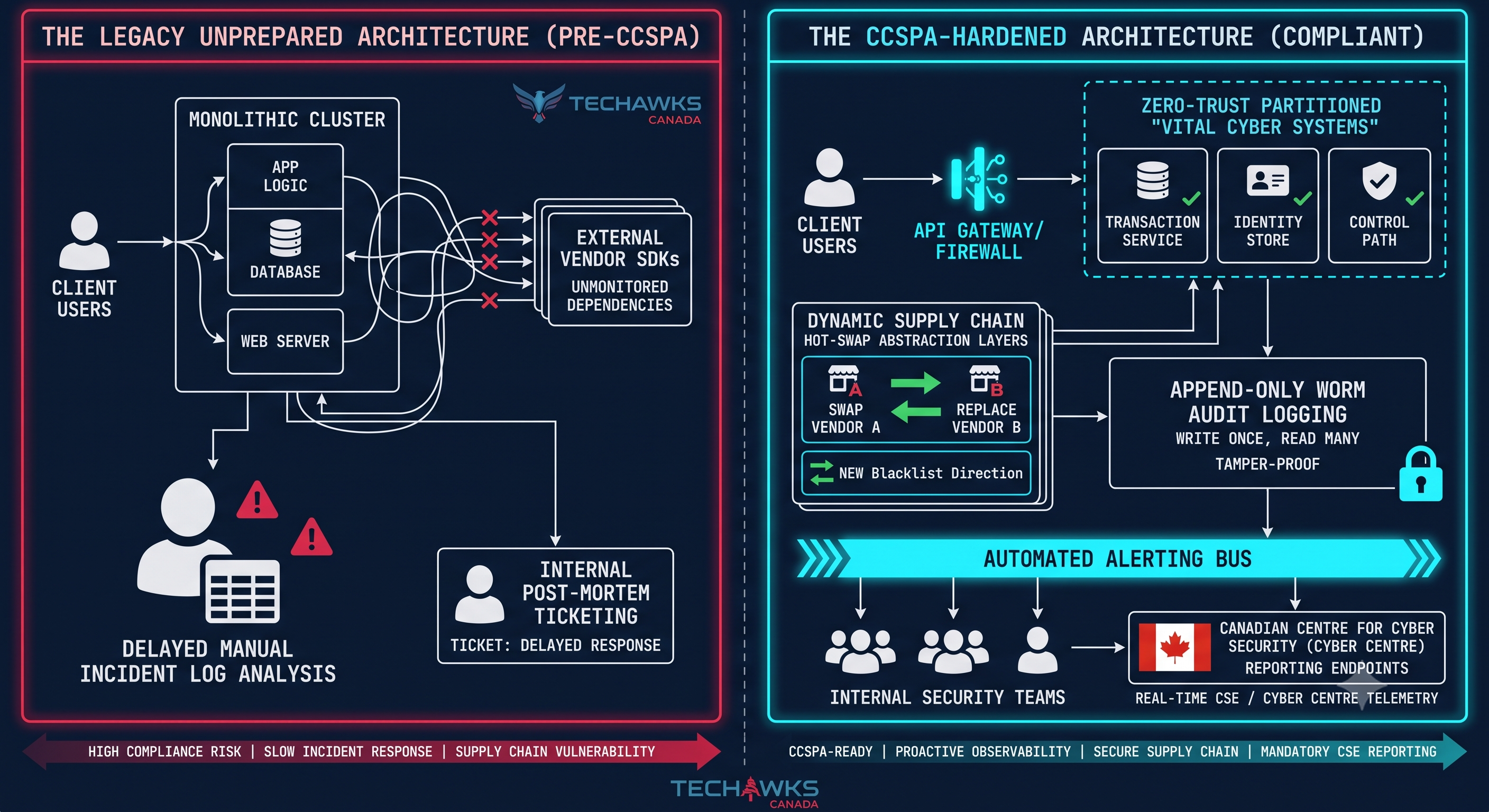
The CCSPA establishes a legally binding reporting pipeline directly to the Communications Security Establishment (CSE) and the Canadian Centre for Cyber Security (Cyber Centre). When a system incident impairs or could impair the confidentiality, integrity, or availability of a critical cyber system, platform teams cannot wait for standard post-mortems or multi-week internal reviews.
Furthermore, the federal government is empowered to issue mandatory Cyber Security Directions—forcing organizations to immediately rip, replace, or block specific third-party technologies or high-risk vendors across their software supply chains.
Non-compliance carries severe administrative monetary penalties (AMPs) of up to $15 million per violation, alongside potential director and officer liability.
The CCSPA Infrastructure & Incident Response Readiness Checklist
[ ] 1. Classify & Isolate "Vital Cyber Systems" in Cloud Topologies
└─ Audit infrastructure to distinguish standard consumer-facing microservices from vital transaction/telecom control paths.
└─ Enforce zero-trust network boundaries and air-gapped IAM policies around mission-critical clusters.
[ ] 2. Architect Real-Time Automated CSE / Cyber Centre Incident Telemetry
└─ Build designated, immutable security event aggregation pipelines targeting CSE notification protocols.
└─ Codify runbooks that flag potential system continuity impacts and trigger immediate regulatory escalations.
[ ] 3. Map Third-Party Dependencies for "Cyber Security Directions"
└─ Catalog all third-party software, hosted services, and managed open-source components embedded in core services.
└─ Establish rapid hot-swap and deprecation workflows should federal regulators blacklist a specific vendor or supply-chain vector.
[ ] 4. Enforce Continuous Supply-Chain Risk Management (SCRM)
└─ Mandate cryptographically signed build provenance and SBOM attestation on all ingestion boundaries.
└─ Continuously monitor upstream container registries for unverified dependencies impacting vital services.
[ ] 5. Implement Tamper-Proof Audit Logging & 90-Day Review Cycles
└─ Store security telemetry and configuration changes in append-only, WORM (Write Once, Read Many) object storage.
└─ Automate regular gap-analysis reports against the Cyber Centre's baseline security controls.
Resilience under Canada's new cybersecurity regime is not a compliance paper exercise—it is built on deterministic system isolation, rapid incident observability, and decoupled supply chain dependencies.
Discussion Question
How is your Canadian engineering or platform team updating its incident escalation workflows to satisfy immediate CSE reporting thresholds without triggering alert fatigue across internal on-call rotations?
CTA (Join Techawks Canada)
Follow Techawks Canada for actionable system design guides, domestic regulatory technical teardowns, and deep architectural insights built for Canadian engineers and tech leaders.
Canada’s Critical Cyber Systems Protection Act (CCSPA, under Bill C-26) shifts cyber resilience in federally regulated sectors—including finance, telecommunications, interprovincial transport, and energy—from voluntary frameworks to enforceable statutory mandates.
Why It Matters to Canadian Tech Teams
The CCSPA establishes a legally binding reporting pipeline directly to the Communications Security Establishment (CSE) and the Canadian Centre for Cyber Security (Cyber Centre). When a system incident impairs or could impair the confidentiality, integrity, or availability of a critical cyber system, platform teams cannot wait for standard post-mortems or multi-week internal reviews.
Furthermore, the federal government is empowered to issue mandatory Cyber Security Directions—forcing organizations to immediately rip, replace, or block specific third-party technologies or high-risk vendors across their software supply chains.
Non-compliance carries severe administrative monetary penalties (AMPs) of up to $15 million per violation, alongside potential director and officer liability.
The CCSPA Infrastructure & Incident Response Readiness Checklist
[ ] 1. Classify & Isolate "Vital Cyber Systems" in Cloud Topologies
└─ Audit infrastructure to distinguish standard consumer-facing microservices from vital transaction/telecom control paths.
└─ Enforce zero-trust network boundaries and air-gapped IAM policies around mission-critical clusters.
[ ] 2. Architect Real-Time Automated CSE / Cyber Centre Incident Telemetry
└─ Build designated, immutable security event aggregation pipelines targeting CSE notification protocols.
└─ Codify runbooks that flag potential system continuity impacts and trigger immediate regulatory escalations.
[ ] 3. Map Third-Party Dependencies for "Cyber Security Directions"
└─ Catalog all third-party software, hosted services, and managed open-source components embedded in core services.
└─ Establish rapid hot-swap and deprecation workflows should federal regulators blacklist a specific vendor or supply-chain vector.
[ ] 4. Enforce Continuous Supply-Chain Risk Management (SCRM)
└─ Mandate cryptographically signed build provenance and SBOM attestation on all ingestion boundaries.
└─ Continuously monitor upstream container registries for unverified dependencies impacting vital services.
[ ] 5. Implement Tamper-Proof Audit Logging & 90-Day Review Cycles
└─ Store security telemetry and configuration changes in append-only, WORM (Write Once, Read Many) object storage.
└─ Automate regular gap-analysis reports against the Cyber Centre's baseline security controls.
Resilience under Canada's new cybersecurity regime is not a compliance paper exercise—it is built on deterministic system isolation, rapid incident observability, and decoupled supply chain dependencies.
Discussion Question
How is your Canadian engineering or platform team updating its incident escalation workflows to satisfy immediate CSE reporting thresholds without triggering alert fatigue across internal on-call rotations?
CTA (Join Techawks Canada)
Follow Techawks Canada for actionable system design guides, domestic regulatory technical teardowns, and deep architectural insights built for Canadian engineers and tech leaders.
Canada’s Critical Cyber Systems Protection Act (Bill C-26): The Infrastructure Lead’s Telemetry and Incident Response Checklist
Canada’s Critical Cyber Systems Protection Act (CCSPA, under Bill C-26) shifts cyber resilience in federally regulated sectors—including finance, telecommunications, interprovincial transport, and energy—from voluntary frameworks to enforceable statutory mandates.
Why It Matters to Canadian Tech Teams
The CCSPA establishes a legally binding reporting pipeline directly to the Communications Security Establishment (CSE) and the Canadian Centre for Cyber Security (Cyber Centre). When a system incident impairs or could impair the confidentiality, integrity, or availability of a critical cyber system, platform teams cannot wait for standard post-mortems or multi-week internal reviews.
Furthermore, the federal government is empowered to issue mandatory Cyber Security Directions—forcing organizations to immediately rip, replace, or block specific third-party technologies or high-risk vendors across their software supply chains.
Non-compliance carries severe administrative monetary penalties (AMPs) of up to $15 million per violation, alongside potential director and officer liability.
The CCSPA Infrastructure & Incident Response Readiness Checklist
[ ] 1. Classify & Isolate "Vital Cyber Systems" in Cloud Topologies
└─ Audit infrastructure to distinguish standard consumer-facing microservices from vital transaction/telecom control paths.
└─ Enforce zero-trust network boundaries and air-gapped IAM policies around mission-critical clusters.
[ ] 2. Architect Real-Time Automated CSE / Cyber Centre Incident Telemetry
└─ Build designated, immutable security event aggregation pipelines targeting CSE notification protocols.
└─ Codify runbooks that flag potential system continuity impacts and trigger immediate regulatory escalations.
[ ] 3. Map Third-Party Dependencies for "Cyber Security Directions"
└─ Catalog all third-party software, hosted services, and managed open-source components embedded in core services.
└─ Establish rapid hot-swap and deprecation workflows should federal regulators blacklist a specific vendor or supply-chain vector.
[ ] 4. Enforce Continuous Supply-Chain Risk Management (SCRM)
└─ Mandate cryptographically signed build provenance and SBOM attestation on all ingestion boundaries.
└─ Continuously monitor upstream container registries for unverified dependencies impacting vital services.
[ ] 5. Implement Tamper-Proof Audit Logging & 90-Day Review Cycles
└─ Store security telemetry and configuration changes in append-only, WORM (Write Once, Read Many) object storage.
└─ Automate regular gap-analysis reports against the Cyber Centre's baseline security controls.
Resilience under Canada's new cybersecurity regime is not a compliance paper exercise—it is built on deterministic system isolation, rapid incident observability, and decoupled supply chain dependencies.
Discussion Question
How is your Canadian engineering or platform team updating its incident escalation workflows to satisfy immediate CSE reporting thresholds without triggering alert fatigue across internal on-call rotations?
CTA (Join Techawks Canada)
Follow Techawks Canada for actionable system design guides, domestic regulatory technical teardowns, and deep architectural insights built for Canadian engineers and tech leaders.

 English
 Arabic
 Spanish
 Portuguese
 Deutsch
 Turkish
 Dutch
Dutch
 Italiano
 Russian
 Romaian
 Portuguese (Brazil)
 Greek
Greek