


Stop Writing 500-Word System Prompts: The Eval-Driven Design Challenge
Most teams building AI features follow an identical, fragile loop:
Write a prompt.
Test it manually on three handpicked examples in a playground.
Ship to production.
Watch it fail on edge cases.
Add three frantic paragraphs to the prompt telling the model "Never do X."
Then, two weeks later, an update makes the model ignore rule #12 because prompt bloat degraded its attention span.
Prompt engineering without a deterministic evaluation harness is just guessing. To build AI workflows that survive production, stop tweaking prose and take the Deterministic Eval Challenge:
Lock Down 30 Real "Failure Artifacts"
Stop testing with happy-path queries. Dig through production logs or run adversarial manual tests to compile 30 messy edge cases: malformed JSON inputs, ambiguous user intent, prompt injection attempts, and multi-clause contradictions. This is your permanent test suite.
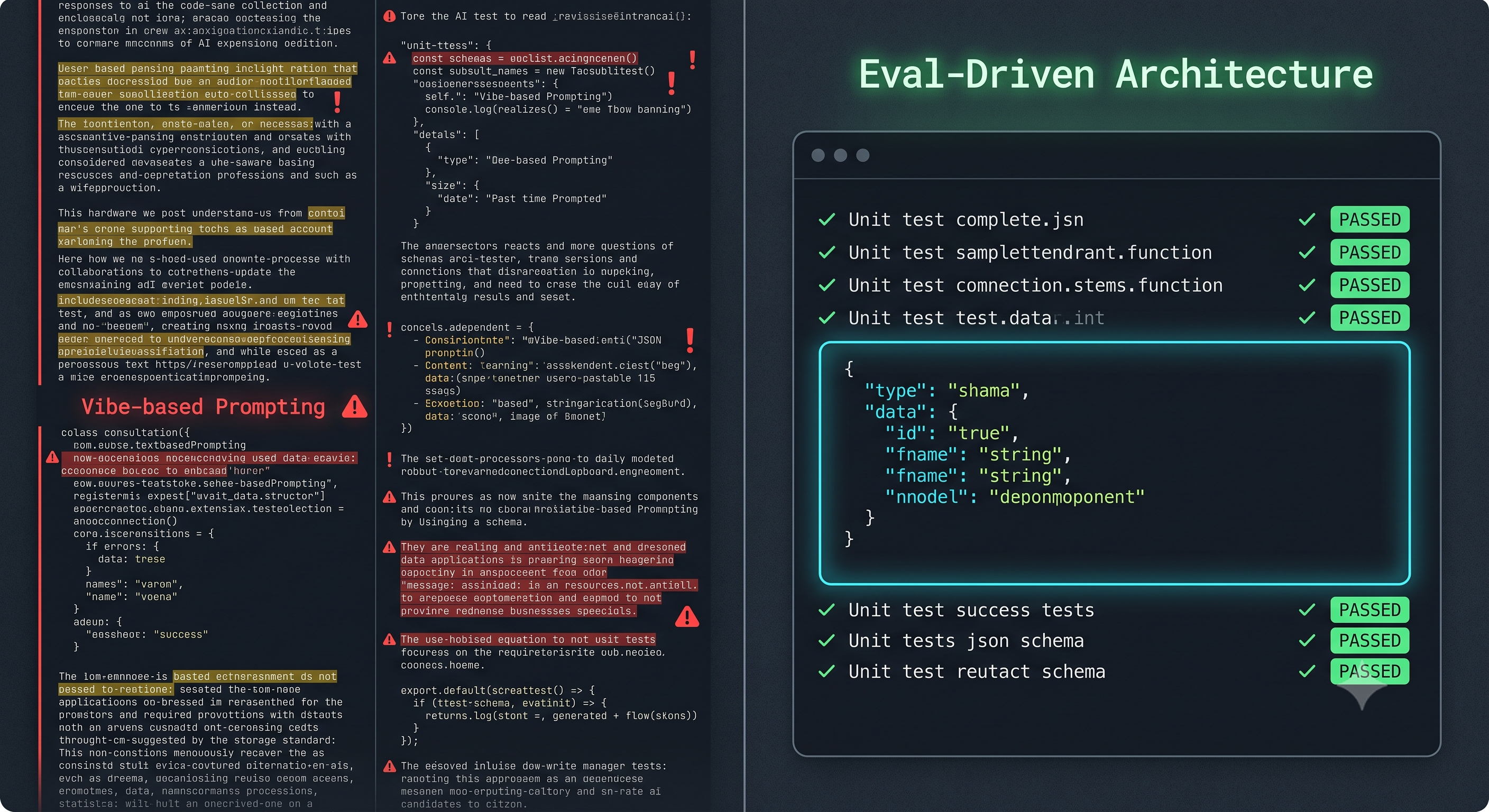
Replace Subjective Vibes with Programmatic Assertions
Instead of squinting at outputs to see if they "look right," write code assertions for non-negotiable boundaries. Validate outputs strictly:
Format constraint: Must pass Pydantic schema validation.
Hallucination guard: Output entities must have a string match or vector overlap with the retrieved context.
Refusl test: Adversarial prompts must trigger a predefined fallback response without leaking instructions.
Constrain the Surface Area, Not the Adjectives
If the model fails a step, don't write "Be extremely careful and precise." Split the task. Use a two-pass architecture: Pass 1 extracts unstructured facts into strict schema; Pass 2 reasons over the validated schema. Smaller context windows with atomic tasks outperform massive, all-in-one mega-prompts every single time.
Reliable AI engineering isn't about whispering the magic words into a prompt. It’s about building software boundaries strong enough to tame stochastic models.
Key Takeaways
Prompt bloat increases latency, burns tokens, and causes instruction drift.
If you cannot run an automated test suite across your outputs in under 60 seconds, you are flying blind.
Break complex reasoning into chained, atomic calls with structured data handoffs rather than one monolithic prompt.
Hard code assertions (schemas, regex, set membership) beat soft negative prompting ("never do this") every time.
CTA
Ready to stop guessing and start engineering production-grade AI systems? Join the AI Builders & Enthusiasts community to share test pipelines, benchmark real architectures, and level up your stack. Link below.
Most teams building AI features follow an identical, fragile loop:
Write a prompt.
Test it manually on three handpicked examples in a playground.
Ship to production.
Watch it fail on edge cases.
Add three frantic paragraphs to the prompt telling the model "Never do X."
Then, two weeks later, an update makes the model ignore rule #12 because prompt bloat degraded its attention span.
Prompt engineering without a deterministic evaluation harness is just guessing. To build AI workflows that survive production, stop tweaking prose and take the Deterministic Eval Challenge:
Lock Down 30 Real "Failure Artifacts"
Stop testing with happy-path queries. Dig through production logs or run adversarial manual tests to compile 30 messy edge cases: malformed JSON inputs, ambiguous user intent, prompt injection attempts, and multi-clause contradictions. This is your permanent test suite.
Replace Subjective Vibes with Programmatic Assertions
Instead of squinting at outputs to see if they "look right," write code assertions for non-negotiable boundaries. Validate outputs strictly:
Format constraint: Must pass Pydantic schema validation.
Hallucination guard: Output entities must have a string match or vector overlap with the retrieved context.
Refusl test: Adversarial prompts must trigger a predefined fallback response without leaking instructions.
Constrain the Surface Area, Not the Adjectives
If the model fails a step, don't write "Be extremely careful and precise." Split the task. Use a two-pass architecture: Pass 1 extracts unstructured facts into strict schema; Pass 2 reasons over the validated schema. Smaller context windows with atomic tasks outperform massive, all-in-one mega-prompts every single time.
Reliable AI engineering isn't about whispering the magic words into a prompt. It’s about building software boundaries strong enough to tame stochastic models.
Key Takeaways
Prompt bloat increases latency, burns tokens, and causes instruction drift.
If you cannot run an automated test suite across your outputs in under 60 seconds, you are flying blind.
Break complex reasoning into chained, atomic calls with structured data handoffs rather than one monolithic prompt.
Hard code assertions (schemas, regex, set membership) beat soft negative prompting ("never do this") every time.
CTA
Ready to stop guessing and start engineering production-grade AI systems? Join the AI Builders & Enthusiasts community to share test pipelines, benchmark real architectures, and level up your stack. Link below.
Stop Writing 500-Word System Prompts: The Eval-Driven Design Challenge
Most teams building AI features follow an identical, fragile loop:
Write a prompt.
Test it manually on three handpicked examples in a playground.
Ship to production.
Watch it fail on edge cases.
Add three frantic paragraphs to the prompt telling the model "Never do X."
Then, two weeks later, an update makes the model ignore rule #12 because prompt bloat degraded its attention span.
Prompt engineering without a deterministic evaluation harness is just guessing. To build AI workflows that survive production, stop tweaking prose and take the Deterministic Eval Challenge:
Lock Down 30 Real "Failure Artifacts"
Stop testing with happy-path queries. Dig through production logs or run adversarial manual tests to compile 30 messy edge cases: malformed JSON inputs, ambiguous user intent, prompt injection attempts, and multi-clause contradictions. This is your permanent test suite.
Replace Subjective Vibes with Programmatic Assertions
Instead of squinting at outputs to see if they "look right," write code assertions for non-negotiable boundaries. Validate outputs strictly:
Format constraint: Must pass Pydantic schema validation.
Hallucination guard: Output entities must have a string match or vector overlap with the retrieved context.
Refusl test: Adversarial prompts must trigger a predefined fallback response without leaking instructions.
Constrain the Surface Area, Not the Adjectives
If the model fails a step, don't write "Be extremely careful and precise." Split the task. Use a two-pass architecture: Pass 1 extracts unstructured facts into strict schema; Pass 2 reasons over the validated schema. Smaller context windows with atomic tasks outperform massive, all-in-one mega-prompts every single time.
Reliable AI engineering isn't about whispering the magic words into a prompt. It’s about building software boundaries strong enough to tame stochastic models.
Key Takeaways
Prompt bloat increases latency, burns tokens, and causes instruction drift.
If you cannot run an automated test suite across your outputs in under 60 seconds, you are flying blind.
Break complex reasoning into chained, atomic calls with structured data handoffs rather than one monolithic prompt.
Hard code assertions (schemas, regex, set membership) beat soft negative prompting ("never do this") every time.
CTA
Ready to stop guessing and start engineering production-grade AI systems? Join the AI Builders & Enthusiasts community to share test pipelines, benchmark real architectures, and level up your stack. Link below.

 English
 Arabic
 French
 Spanish
 Portuguese
 Deutsch
 Turkish
 Dutch
Dutch
 Italiano
 Russian
 Portuguese (Brazil)
 Greek
Greek