


The Zero-else Challenge: Why Guard Clauses Will Instantly Level Up Your Codebase
Deep nesting is the silent killer of readability. Every time you wrap a block of business logic inside another else branch, you force the next developer (and your future self) to keep an invisible stack of state conditions in their head just to trace a single execution path.
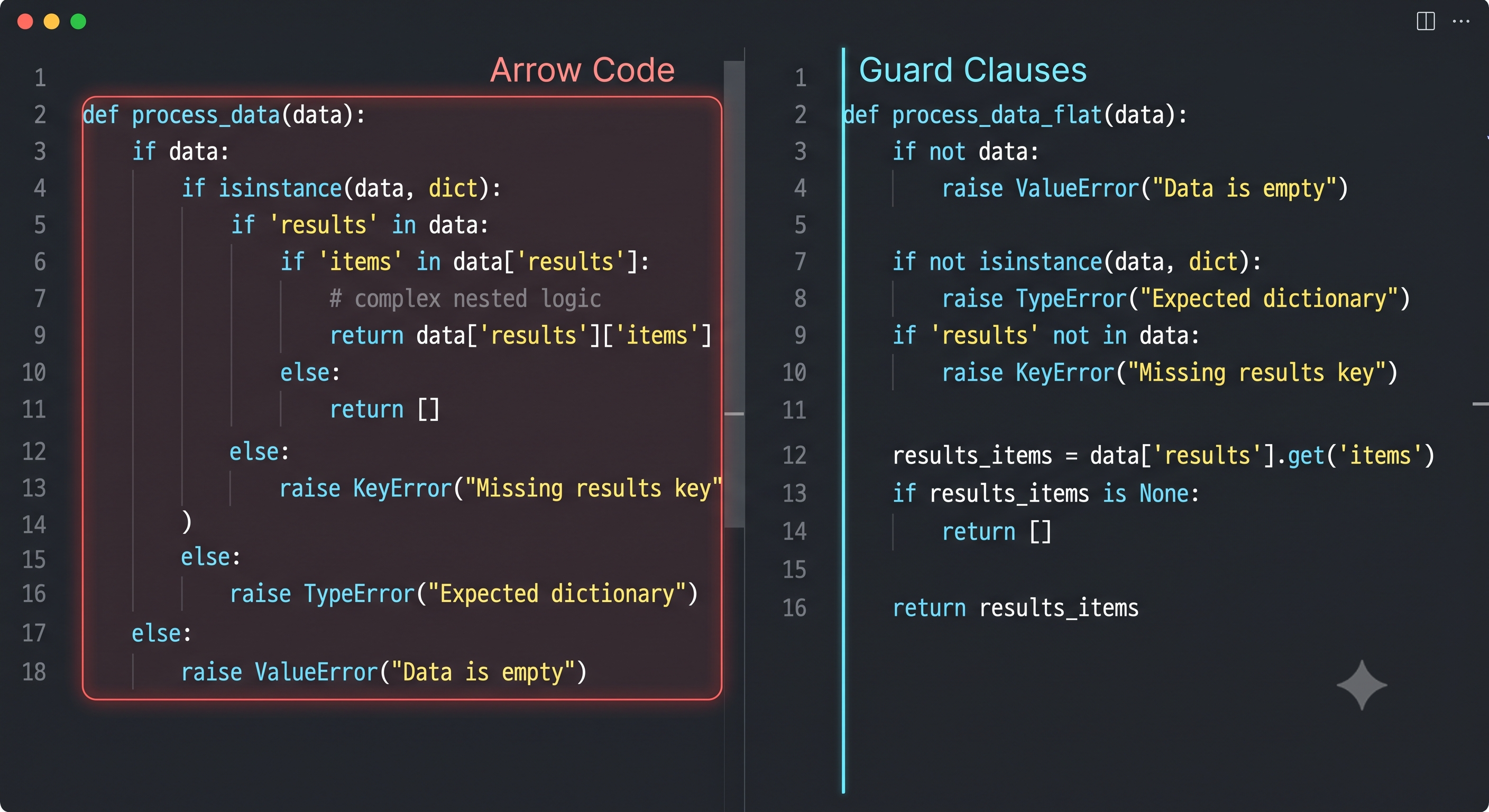
The easiest way to write cleaner, more resilient, and self-documenting code is to adopt Bouncer Pattern Programming.
Take the Zero-else Challenge on your next pull request:
Invert the Condition and Return EarlyInstead of checking if the input is valid and wrapping 40 lines of logic inside the block, check for the failure condition immediately. Exit, throw, or return early at the very top:TypeScript// ❌ Arrow Anti-Pattern
function processUser(user) {
if (user) {
if (user.isActive) {
if (user.hasPermission) {
// actual core logic hidden here
} else {
throw new Error("Forbidden");
}
} else {
throw new Error("Inactive");
}
} else {
throw new Error("Not Found");
}
}
// ✅ Guard Clauses
function processUser(user) {
if (!user) throw new Error("Not Found");
if (!user.isActive) throw new Error("Inactive");
if (!user.hasPermission) throw new Error("Forbidden");
// Flat, unindented core execution path
}
Replace Conditional Branching with Lookup Tables
If you find yourself writing chained else if statements or sprawling switch blocks to handle types, map them into a Record or hash map. State lookups are O(1), decouple action from condition, and make adding new variants trivial without mutating control flow.
Treat the Happy Path as the Main EventThe core intent of your function should live at indentation level 0. Everything else is just security checking tickets at the door. If input passes the guards, it flows linearly straight down.
When you remove the else keyword, your cyclomatic complexity drops, unit tests become dead simple, and edge cases stop hiding in dark corners.
Key Takeaways
Deeply nested control flow dramatically increases cognitive load and hides edge-case bugs.
Guard clauses handle preconditions and failures upfront, keeping the happy path flat and readable.
Invert your logic: test for what can go wrong first, exit immediately, and let valid data flow through.
Dynamic dispatch or lookup tables beat sprawling else if chains for mapping states.
CTA
Ready to sharpen your software craftsmanship and build cleaner architectures?
Join the Developers & Coding community to review real-world PRs, debate clean code patterns, and grow with engineers who care about code quality.
Deep nesting is the silent killer of readability. Every time you wrap a block of business logic inside another else branch, you force the next developer (and your future self) to keep an invisible stack of state conditions in their head just to trace a single execution path.
The easiest way to write cleaner, more resilient, and self-documenting code is to adopt Bouncer Pattern Programming.
Take the Zero-else Challenge on your next pull request:
Invert the Condition and Return EarlyInstead of checking if the input is valid and wrapping 40 lines of logic inside the block, check for the failure condition immediately. Exit, throw, or return early at the very top:TypeScript// ❌ Arrow Anti-Pattern
function processUser(user) {
if (user) {
if (user.isActive) {
if (user.hasPermission) {
// actual core logic hidden here
} else {
throw new Error("Forbidden");
}
} else {
throw new Error("Inactive");
}
} else {
throw new Error("Not Found");
}
}
// ✅ Guard Clauses
function processUser(user) {
if (!user) throw new Error("Not Found");
if (!user.isActive) throw new Error("Inactive");
if (!user.hasPermission) throw new Error("Forbidden");
// Flat, unindented core execution path
}
Replace Conditional Branching with Lookup Tables
If you find yourself writing chained else if statements or sprawling switch blocks to handle types, map them into a Record or hash map. State lookups are O(1), decouple action from condition, and make adding new variants trivial without mutating control flow.
Treat the Happy Path as the Main EventThe core intent of your function should live at indentation level 0. Everything else is just security checking tickets at the door. If input passes the guards, it flows linearly straight down.
When you remove the else keyword, your cyclomatic complexity drops, unit tests become dead simple, and edge cases stop hiding in dark corners.
Key Takeaways
Deeply nested control flow dramatically increases cognitive load and hides edge-case bugs.
Guard clauses handle preconditions and failures upfront, keeping the happy path flat and readable.
Invert your logic: test for what can go wrong first, exit immediately, and let valid data flow through.
Dynamic dispatch or lookup tables beat sprawling else if chains for mapping states.
CTA
Ready to sharpen your software craftsmanship and build cleaner architectures?
Join the Developers & Coding community to review real-world PRs, debate clean code patterns, and grow with engineers who care about code quality.
The Zero-else Challenge: Why Guard Clauses Will Instantly Level Up Your Codebase
Deep nesting is the silent killer of readability. Every time you wrap a block of business logic inside another else branch, you force the next developer (and your future self) to keep an invisible stack of state conditions in their head just to trace a single execution path.
The easiest way to write cleaner, more resilient, and self-documenting code is to adopt Bouncer Pattern Programming.
Take the Zero-else Challenge on your next pull request:
Invert the Condition and Return EarlyInstead of checking if the input is valid and wrapping 40 lines of logic inside the block, check for the failure condition immediately. Exit, throw, or return early at the very top:TypeScript// ❌ Arrow Anti-Pattern
function processUser(user) {
if (user) {
if (user.isActive) {
if (user.hasPermission) {
// actual core logic hidden here
} else {
throw new Error("Forbidden");
}
} else {
throw new Error("Inactive");
}
} else {
throw new Error("Not Found");
}
}
// ✅ Guard Clauses
function processUser(user) {
if (!user) throw new Error("Not Found");
if (!user.isActive) throw new Error("Inactive");
if (!user.hasPermission) throw new Error("Forbidden");
// Flat, unindented core execution path
}
Replace Conditional Branching with Lookup Tables
If you find yourself writing chained else if statements or sprawling switch blocks to handle types, map them into a Record or hash map. State lookups are O(1), decouple action from condition, and make adding new variants trivial without mutating control flow.
Treat the Happy Path as the Main EventThe core intent of your function should live at indentation level 0. Everything else is just security checking tickets at the door. If input passes the guards, it flows linearly straight down.
When you remove the else keyword, your cyclomatic complexity drops, unit tests become dead simple, and edge cases stop hiding in dark corners.
Key Takeaways
Deeply nested control flow dramatically increases cognitive load and hides edge-case bugs.
Guard clauses handle preconditions and failures upfront, keeping the happy path flat and readable.
Invert your logic: test for what can go wrong first, exit immediately, and let valid data flow through.
Dynamic dispatch or lookup tables beat sprawling else if chains for mapping states.
CTA
Ready to sharpen your software craftsmanship and build cleaner architectures?
Join the Developers & Coding community to review real-world PRs, debate clean code patterns, and grow with engineers who care about code quality.

 Arabic
 French
 Spanish
 Portuguese
 Deutsch
 Turkish
 Dutch
Dutch
 Italiano
 Russian
 Romaian
 Portuguese (Brazil)
 Greek
Greek