


The Test-Time Compute Myth: Why Bigger Reasoning Budgets Can Degrade Your Output
As reasoning-first models and test-time compute scaling dominate modern AI engineering roadmaps, many builders operate under an unexamined assumption: giving an LLM unlimited internal scratchpad space always improves downstream problem-solving.
Production reality tells a different story.
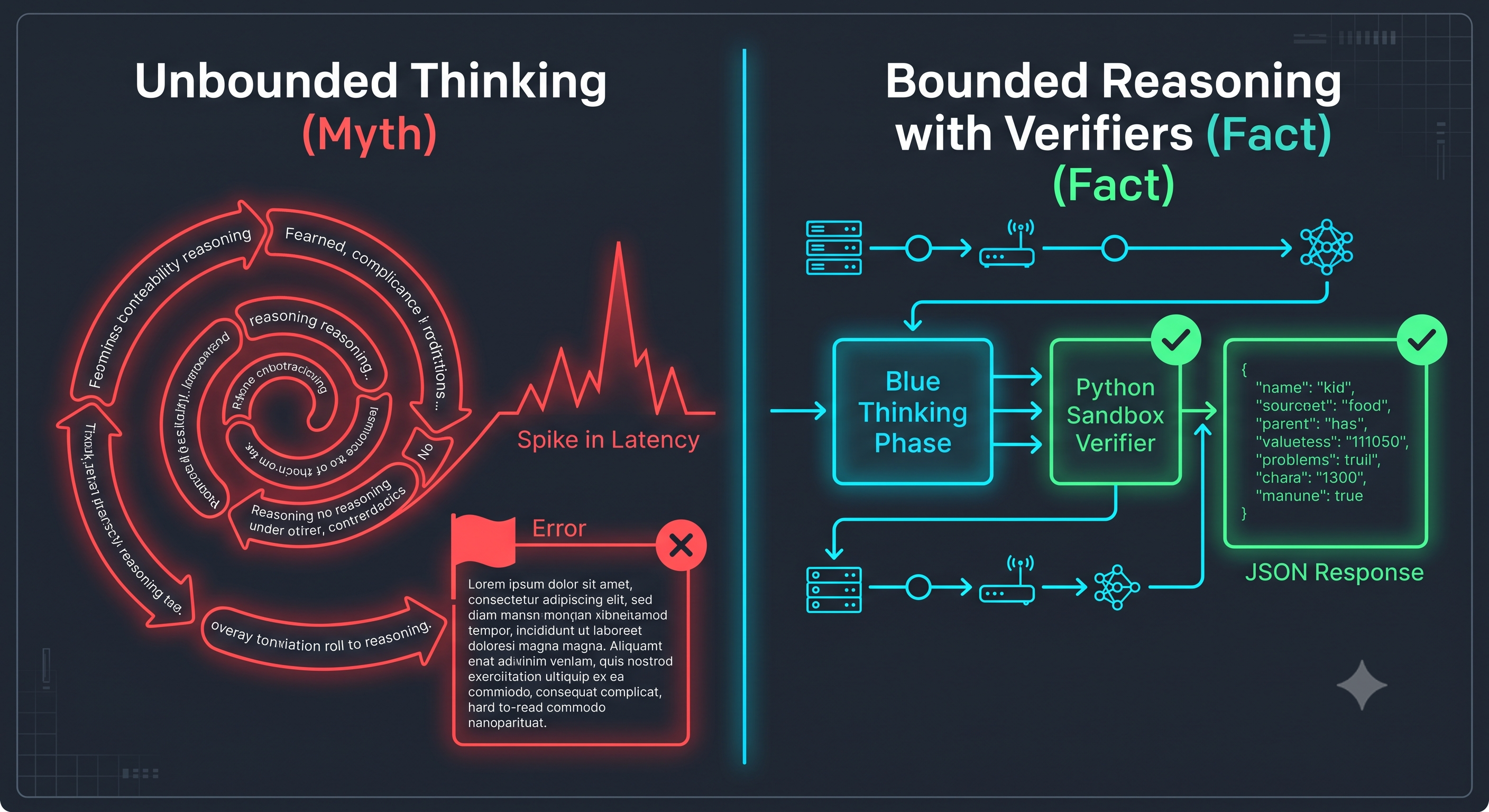
Myth: Maximizing test-time reasoning tokens automatically increases model accuracy and guarantees correct deduction.
Fact: Uncalibrated test-time compute often leads to "over-thinking" failure modes—where models hallucinate edge-case constraints, second-guess initially correct answers, and explode inference latency by orders of magnitude on simple deterministic subtasks.
Why this matters for your AI stack:
Test-time compute is not a magic wand; it is search over token trajectories. When a model reasons across ungrounded context, its search space expands exponentially. Without external verification boundaries, the probability of exploring degenerate or circular reasoning paths rises with every extra thinking token.
How to engineer predictable reasoning pipelines:
Enforce Adaptive Routing, Not Universal Deliberation
Never run simple retrieval, schema transformation, or standard entity extraction through a full reasoning loop. Use a fast, lightweight classification model or semantic router at your gateway to split tasks: deterministic lookups stay fast and shallow; multi-step algorithmic planning gets routed to reasoning models.
Ground Intermediate Deliberation with Tool Calls
Models struggle when forced to simulate execution purely inside hidden scratchpads. Instead of letting a model mentally simulate arithmetic, SQL queries, or nested regex, force it to invoke deterministic code sandboxes (e.g., via Model Context Protocol tools) to verify intermediate assertions before continuing its chain of thought.
Set Dynamic Budgets and Early-Exit Bounds
Monitor output token ceilings and stop-sequence thresholds strictly. If a model’s hidden reasoning chain exceeds a domain-specific step budget without generating a tool call or state resolution, cut the path short and trigger a structured fallback.
High-leverage AI engineering isn't about letting models spend infinite compute wandering down cognitive rabbit holes. It is about constraining when, where, and how deliberate reasoning actually happens.
Discussion Question
How is your team currently benchmarking the trade-off between extended test-time reasoning latency and measurable output accuracy in production?
CTA
Ready to build reliable, production-grade AI pipelines without getting trapped in the hype? Join the AI Builders & Enthusiasts community to swap architecture benchmarks, discuss eval frameworks, and engineer systems that scale.
As reasoning-first models and test-time compute scaling dominate modern AI engineering roadmaps, many builders operate under an unexamined assumption: giving an LLM unlimited internal scratchpad space always improves downstream problem-solving.
Production reality tells a different story.
Myth: Maximizing test-time reasoning tokens automatically increases model accuracy and guarantees correct deduction.
Fact: Uncalibrated test-time compute often leads to "over-thinking" failure modes—where models hallucinate edge-case constraints, second-guess initially correct answers, and explode inference latency by orders of magnitude on simple deterministic subtasks.
Why this matters for your AI stack:
Test-time compute is not a magic wand; it is search over token trajectories. When a model reasons across ungrounded context, its search space expands exponentially. Without external verification boundaries, the probability of exploring degenerate or circular reasoning paths rises with every extra thinking token.
How to engineer predictable reasoning pipelines:
Enforce Adaptive Routing, Not Universal Deliberation
Never run simple retrieval, schema transformation, or standard entity extraction through a full reasoning loop. Use a fast, lightweight classification model or semantic router at your gateway to split tasks: deterministic lookups stay fast and shallow; multi-step algorithmic planning gets routed to reasoning models.
Ground Intermediate Deliberation with Tool Calls
Models struggle when forced to simulate execution purely inside hidden scratchpads. Instead of letting a model mentally simulate arithmetic, SQL queries, or nested regex, force it to invoke deterministic code sandboxes (e.g., via Model Context Protocol tools) to verify intermediate assertions before continuing its chain of thought.
Set Dynamic Budgets and Early-Exit Bounds
Monitor output token ceilings and stop-sequence thresholds strictly. If a model’s hidden reasoning chain exceeds a domain-specific step budget without generating a tool call or state resolution, cut the path short and trigger a structured fallback.
High-leverage AI engineering isn't about letting models spend infinite compute wandering down cognitive rabbit holes. It is about constraining when, where, and how deliberate reasoning actually happens.
Discussion Question
How is your team currently benchmarking the trade-off between extended test-time reasoning latency and measurable output accuracy in production?
CTA
Ready to build reliable, production-grade AI pipelines without getting trapped in the hype? Join the AI Builders & Enthusiasts community to swap architecture benchmarks, discuss eval frameworks, and engineer systems that scale.
The Test-Time Compute Myth: Why Bigger Reasoning Budgets Can Degrade Your Output
As reasoning-first models and test-time compute scaling dominate modern AI engineering roadmaps, many builders operate under an unexamined assumption: giving an LLM unlimited internal scratchpad space always improves downstream problem-solving.
Production reality tells a different story.
Myth: Maximizing test-time reasoning tokens automatically increases model accuracy and guarantees correct deduction.
Fact: Uncalibrated test-time compute often leads to "over-thinking" failure modes—where models hallucinate edge-case constraints, second-guess initially correct answers, and explode inference latency by orders of magnitude on simple deterministic subtasks.
Why this matters for your AI stack:
Test-time compute is not a magic wand; it is search over token trajectories. When a model reasons across ungrounded context, its search space expands exponentially. Without external verification boundaries, the probability of exploring degenerate or circular reasoning paths rises with every extra thinking token.
How to engineer predictable reasoning pipelines:
Enforce Adaptive Routing, Not Universal Deliberation
Never run simple retrieval, schema transformation, or standard entity extraction through a full reasoning loop. Use a fast, lightweight classification model or semantic router at your gateway to split tasks: deterministic lookups stay fast and shallow; multi-step algorithmic planning gets routed to reasoning models.
Ground Intermediate Deliberation with Tool Calls
Models struggle when forced to simulate execution purely inside hidden scratchpads. Instead of letting a model mentally simulate arithmetic, SQL queries, or nested regex, force it to invoke deterministic code sandboxes (e.g., via Model Context Protocol tools) to verify intermediate assertions before continuing its chain of thought.
Set Dynamic Budgets and Early-Exit Bounds
Monitor output token ceilings and stop-sequence thresholds strictly. If a model’s hidden reasoning chain exceeds a domain-specific step budget without generating a tool call or state resolution, cut the path short and trigger a structured fallback.
High-leverage AI engineering isn't about letting models spend infinite compute wandering down cognitive rabbit holes. It is about constraining when, where, and how deliberate reasoning actually happens.
Discussion Question
How is your team currently benchmarking the trade-off between extended test-time reasoning latency and measurable output accuracy in production?
CTA
Ready to build reliable, production-grade AI pipelines without getting trapped in the hype? Join the AI Builders & Enthusiasts community to swap architecture benchmarks, discuss eval frameworks, and engineer systems that scale.

 English
 Arabic
 French
 Spanish
 Portuguese
 Deutsch
 Turkish
 Italiano
 Russian
 Romaian
 Portuguese (Brazil)
 Greek
Greek