


The 100% Code Coverage Illusion: Why Green CI Pipelines Still Ship Production Incidents
Engineering teams routinely elevate test coverage percentages into the ultimate proxy for code quality. Teams mandate 90%+ thresholds, celebrate fully shaded green coverage heatmaps, and assume that because a line was executed by a test runner, it is protected from breaking in the wild.
In practice, high code coverage often breeds dangerous complacency.
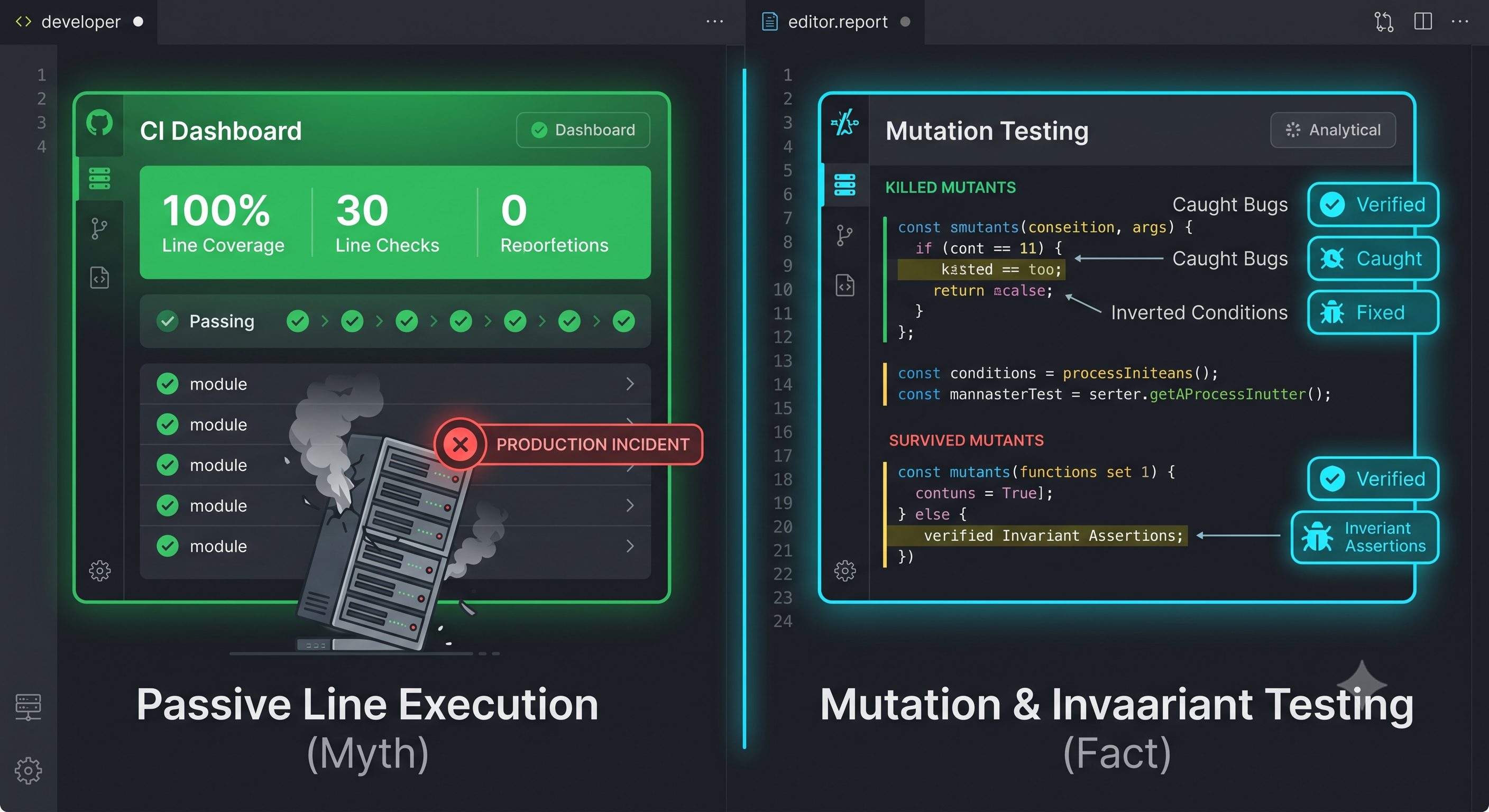
Myth: Reaching 95% to 100% line coverage means your codebase is well-tested and resilient against regression bugs.
Fact: Line coverage only measures whether an interpreter stepped through an instruction. It does not measure whether your assertions validated the resulting state, handled unhandled network failures, or tested boundary states.
Why this matters for your engineering team:
When engineering culture emphasizes coverage percentage as a hard gate, developers inevitably game the metric. They write tests that execute 50 lines of complex logic without asserting edge-case outputs, or they heavily mock external dependencies until the test suite is verifying nothing more than its own mocks.
TypeScript
// ❌ 100% Line Coverage, 0% Bug Prevention
test("processOrder runs successfully", () => {
const result = processOrder({ id: "123", total: -50, items: [] });
expect(result).toBeDefined(); // Passes line execution, misses invalid state bug!
});
// ✅ Property & Boundary Assertion
test("rejects order with negative total or empty cart", () => {
expect(() => processOrder({ id: "123", total: -50, items: [] }))
.toThrow(ValidationError);
});
How to test for actual software resilience:
Adopt Mutation Testing
Run a mutation testing tool (such as Stryker or Mutmut). These tools inject artificial bugs into your code (inverting conditionals, altering arithmetic) and check if your test suite fails. If your tests still pass when logic is mutated, your tests have high coverage but zero detection capability.
Prioritize Boundary & Invariant Testing Over Lines
Test system invariants: empty arrays, integer overflows, null values, expired tokens, and race conditions. A function with 60% coverage that thoroughly asserts state invariants under erratic network conditions is far more reliable than one with 100% coverage executing only the happy path.
Audit Your Mock-to-Code Ratio
If your test file contains 80 lines of mock setup to test 10 lines of implementation, you aren't testing code; you're testing an imaginary execution environment. Use lightweight integration tests with ephemeral containers (like Testcontainers) instead of mocking every single database call and external client.
High-leverage engineering isn't about satisfying a test runner’s coverage metric. It is about proving that critical invariants hold true under unexpected failure.
Discussion Question
What is the most severe production bug your team has ever shipped that still slipped past a suite of passing unit tests?
CTA
Ready to sharpen your software craftsmanship and move past cosmetic engineering metrics? Join the Developers & Coding community to review real-world architectural patterns, debate clean code practices, and level up your engineering standards. Link below.
Engineering teams routinely elevate test coverage percentages into the ultimate proxy for code quality. Teams mandate 90%+ thresholds, celebrate fully shaded green coverage heatmaps, and assume that because a line was executed by a test runner, it is protected from breaking in the wild.
In practice, high code coverage often breeds dangerous complacency.
Myth: Reaching 95% to 100% line coverage means your codebase is well-tested and resilient against regression bugs.
Fact: Line coverage only measures whether an interpreter stepped through an instruction. It does not measure whether your assertions validated the resulting state, handled unhandled network failures, or tested boundary states.
Why this matters for your engineering team:
When engineering culture emphasizes coverage percentage as a hard gate, developers inevitably game the metric. They write tests that execute 50 lines of complex logic without asserting edge-case outputs, or they heavily mock external dependencies until the test suite is verifying nothing more than its own mocks.
TypeScript
// ❌ 100% Line Coverage, 0% Bug Prevention
test("processOrder runs successfully", () => {
const result = processOrder({ id: "123", total: -50, items: [] });
expect(result).toBeDefined(); // Passes line execution, misses invalid state bug!
});
// ✅ Property & Boundary Assertion
test("rejects order with negative total or empty cart", () => {
expect(() => processOrder({ id: "123", total: -50, items: [] }))
.toThrow(ValidationError);
});
How to test for actual software resilience:
Adopt Mutation Testing
Run a mutation testing tool (such as Stryker or Mutmut). These tools inject artificial bugs into your code (inverting conditionals, altering arithmetic) and check if your test suite fails. If your tests still pass when logic is mutated, your tests have high coverage but zero detection capability.
Prioritize Boundary & Invariant Testing Over Lines
Test system invariants: empty arrays, integer overflows, null values, expired tokens, and race conditions. A function with 60% coverage that thoroughly asserts state invariants under erratic network conditions is far more reliable than one with 100% coverage executing only the happy path.
Audit Your Mock-to-Code Ratio
If your test file contains 80 lines of mock setup to test 10 lines of implementation, you aren't testing code; you're testing an imaginary execution environment. Use lightweight integration tests with ephemeral containers (like Testcontainers) instead of mocking every single database call and external client.
High-leverage engineering isn't about satisfying a test runner’s coverage metric. It is about proving that critical invariants hold true under unexpected failure.
Discussion Question
What is the most severe production bug your team has ever shipped that still slipped past a suite of passing unit tests?
CTA
Ready to sharpen your software craftsmanship and move past cosmetic engineering metrics? Join the Developers & Coding community to review real-world architectural patterns, debate clean code practices, and level up your engineering standards. Link below.
The 100% Code Coverage Illusion: Why Green CI Pipelines Still Ship Production Incidents
Engineering teams routinely elevate test coverage percentages into the ultimate proxy for code quality. Teams mandate 90%+ thresholds, celebrate fully shaded green coverage heatmaps, and assume that because a line was executed by a test runner, it is protected from breaking in the wild.
In practice, high code coverage often breeds dangerous complacency.
Myth: Reaching 95% to 100% line coverage means your codebase is well-tested and resilient against regression bugs.
Fact: Line coverage only measures whether an interpreter stepped through an instruction. It does not measure whether your assertions validated the resulting state, handled unhandled network failures, or tested boundary states.
Why this matters for your engineering team:
When engineering culture emphasizes coverage percentage as a hard gate, developers inevitably game the metric. They write tests that execute 50 lines of complex logic without asserting edge-case outputs, or they heavily mock external dependencies until the test suite is verifying nothing more than its own mocks.
TypeScript
// ❌ 100% Line Coverage, 0% Bug Prevention
test("processOrder runs successfully", () => {
const result = processOrder({ id: "123", total: -50, items: [] });
expect(result).toBeDefined(); // Passes line execution, misses invalid state bug!
});
// ✅ Property & Boundary Assertion
test("rejects order with negative total or empty cart", () => {
expect(() => processOrder({ id: "123", total: -50, items: [] }))
.toThrow(ValidationError);
});
How to test for actual software resilience:
Adopt Mutation Testing
Run a mutation testing tool (such as Stryker or Mutmut). These tools inject artificial bugs into your code (inverting conditionals, altering arithmetic) and check if your test suite fails. If your tests still pass when logic is mutated, your tests have high coverage but zero detection capability.
Prioritize Boundary & Invariant Testing Over Lines
Test system invariants: empty arrays, integer overflows, null values, expired tokens, and race conditions. A function with 60% coverage that thoroughly asserts state invariants under erratic network conditions is far more reliable than one with 100% coverage executing only the happy path.
Audit Your Mock-to-Code Ratio
If your test file contains 80 lines of mock setup to test 10 lines of implementation, you aren't testing code; you're testing an imaginary execution environment. Use lightweight integration tests with ephemeral containers (like Testcontainers) instead of mocking every single database call and external client.
High-leverage engineering isn't about satisfying a test runner’s coverage metric. It is about proving that critical invariants hold true under unexpected failure.
Discussion Question
What is the most severe production bug your team has ever shipped that still slipped past a suite of passing unit tests?
CTA
Ready to sharpen your software craftsmanship and move past cosmetic engineering metrics? Join the Developers & Coding community to review real-world architectural patterns, debate clean code practices, and level up your engineering standards. Link below.

 English
 Arabic
 French
 Portuguese
 Deutsch
 Turkish
 Dutch
Dutch
 Italiano
 Russian
 Romaian
 Portuguese (Brazil)
 Greek
Greek