


The ATS "White Font" Myth: Why Algorithmic Keyword Stuffing Destroys Your Interview Rate
As Applicant Tracking Systems (ATS) and automated screening tools evolve, job seeker folklore keeps circulating dangerous shortcuts. Candidates spend hours "hacking" parsers with hidden text, matching every single keyword, and treating resume screening like an SEO trick.
In the modern hiring market, that tactic accomplishes the opposite of what you want.
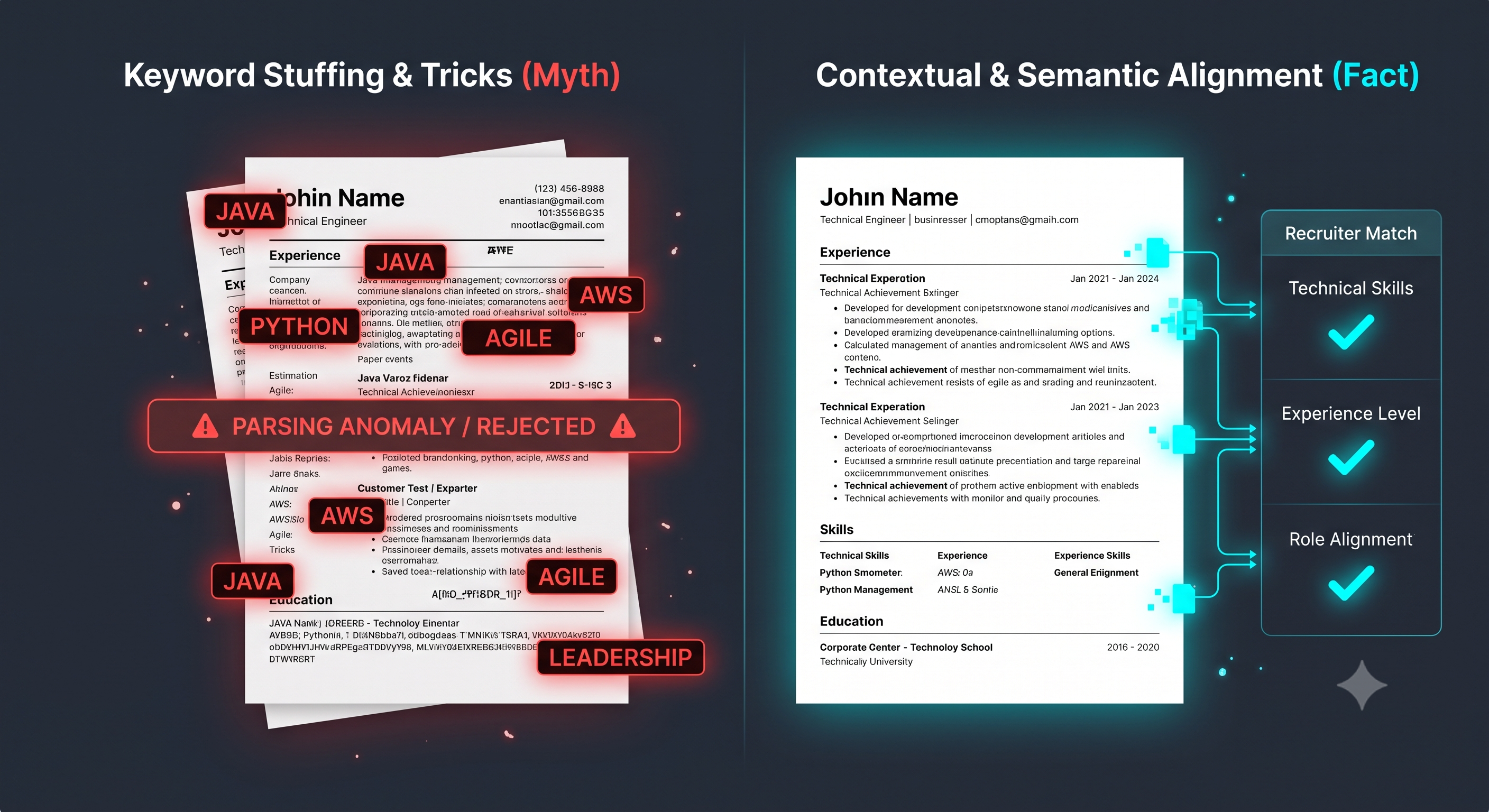
Myth: Modern ATS engines are primitive keyword counters that can be tricked by pasting hidden job requirements or cramming unverified acronyms into your resume.
Fact: Contemporary recruiting systems and talent intelligence tools use contextual parsing, semantic matching, and plain-text stripping. Hidden text is flagged as an evasion anomaly, while keyword stuffing without contextual evidence triggers immediate automated deprioritization.
Why this matters for your job search:
ATS software doesn't just scan for standalone words like "Kubernetes" or "System Design". It maps semantic proximity: how the word is used, the duration of experience associated with it, and the measurable business outcome tied to that skill.
When an engineering hiring manager opens a flagged resume that scored a "99% match" but reads like an unreadable list of technologies, they reject it within five seconds.
How to optimize for automated parsers and human decision-makers:
Match Context, Not Just Raw Keywords
Never list a critical skill solely in a comma-separated "Skills" cloud at the bottom. Pair every required capability directly with a verified project impact:
❌ Skills: Python, AWS, Microservices, CI/CD.
✅ Architected Python microservices on AWS, reducing build times by 35% across four continuous deployment pipelines.
Use Single-Column, Unstyled Semantic Hierarchy
Modern parsers choke on two-column layouts, custom graphical icons, and floating text boxes. Use standard, predictable headings (Work Experience, Technical Skills, Education). Let your content, not unusual formatting, do the work.
Pass the "Human Glancability" Test
Remember that the ATS only determines whether a recruiter looks at your resume. If you pass the parser with artificial density but present a wall of unreadable jargon, the recruiter moves to the next profile. Format for a 10-second human scan: bold impact metrics, tight bullets, and zero fluff.
Getting noticed in tech hiring isn't about gaming an algorithm. It is about proving relevant competence so clearly that both the parser and the engineering lead arrive at the exact same conclusion.
Discussion Question
Have you ever audited how an ATS actually extracts and parses your plain-text resume data before submitting it?
CTA
Ready to build a high-signal application that cuts through automated noise and lands technical interviews? Join the Tech Jobs & Opportunities community to review resume audits, interview teardowns, and actionable career strategies with peers worldwide.
As Applicant Tracking Systems (ATS) and automated screening tools evolve, job seeker folklore keeps circulating dangerous shortcuts. Candidates spend hours "hacking" parsers with hidden text, matching every single keyword, and treating resume screening like an SEO trick.
In the modern hiring market, that tactic accomplishes the opposite of what you want.
Myth: Modern ATS engines are primitive keyword counters that can be tricked by pasting hidden job requirements or cramming unverified acronyms into your resume.
Fact: Contemporary recruiting systems and talent intelligence tools use contextual parsing, semantic matching, and plain-text stripping. Hidden text is flagged as an evasion anomaly, while keyword stuffing without contextual evidence triggers immediate automated deprioritization.
Why this matters for your job search:
ATS software doesn't just scan for standalone words like "Kubernetes" or "System Design". It maps semantic proximity: how the word is used, the duration of experience associated with it, and the measurable business outcome tied to that skill.
When an engineering hiring manager opens a flagged resume that scored a "99% match" but reads like an unreadable list of technologies, they reject it within five seconds.
How to optimize for automated parsers and human decision-makers:
Match Context, Not Just Raw Keywords
Never list a critical skill solely in a comma-separated "Skills" cloud at the bottom. Pair every required capability directly with a verified project impact:
❌ Skills: Python, AWS, Microservices, CI/CD.
✅ Architected Python microservices on AWS, reducing build times by 35% across four continuous deployment pipelines.
Use Single-Column, Unstyled Semantic Hierarchy
Modern parsers choke on two-column layouts, custom graphical icons, and floating text boxes. Use standard, predictable headings (Work Experience, Technical Skills, Education). Let your content, not unusual formatting, do the work.
Pass the "Human Glancability" Test
Remember that the ATS only determines whether a recruiter looks at your resume. If you pass the parser with artificial density but present a wall of unreadable jargon, the recruiter moves to the next profile. Format for a 10-second human scan: bold impact metrics, tight bullets, and zero fluff.
Getting noticed in tech hiring isn't about gaming an algorithm. It is about proving relevant competence so clearly that both the parser and the engineering lead arrive at the exact same conclusion.
Discussion Question
Have you ever audited how an ATS actually extracts and parses your plain-text resume data before submitting it?
CTA
Ready to build a high-signal application that cuts through automated noise and lands technical interviews? Join the Tech Jobs & Opportunities community to review resume audits, interview teardowns, and actionable career strategies with peers worldwide.
The ATS "White Font" Myth: Why Algorithmic Keyword Stuffing Destroys Your Interview Rate
As Applicant Tracking Systems (ATS) and automated screening tools evolve, job seeker folklore keeps circulating dangerous shortcuts. Candidates spend hours "hacking" parsers with hidden text, matching every single keyword, and treating resume screening like an SEO trick.
In the modern hiring market, that tactic accomplishes the opposite of what you want.
Myth: Modern ATS engines are primitive keyword counters that can be tricked by pasting hidden job requirements or cramming unverified acronyms into your resume.
Fact: Contemporary recruiting systems and talent intelligence tools use contextual parsing, semantic matching, and plain-text stripping. Hidden text is flagged as an evasion anomaly, while keyword stuffing without contextual evidence triggers immediate automated deprioritization.
Why this matters for your job search:
ATS software doesn't just scan for standalone words like "Kubernetes" or "System Design". It maps semantic proximity: how the word is used, the duration of experience associated with it, and the measurable business outcome tied to that skill.
When an engineering hiring manager opens a flagged resume that scored a "99% match" but reads like an unreadable list of technologies, they reject it within five seconds.
How to optimize for automated parsers and human decision-makers:
Match Context, Not Just Raw Keywords
Never list a critical skill solely in a comma-separated "Skills" cloud at the bottom. Pair every required capability directly with a verified project impact:
❌ Skills: Python, AWS, Microservices, CI/CD.
✅ Architected Python microservices on AWS, reducing build times by 35% across four continuous deployment pipelines.
Use Single-Column, Unstyled Semantic Hierarchy
Modern parsers choke on two-column layouts, custom graphical icons, and floating text boxes. Use standard, predictable headings (Work Experience, Technical Skills, Education). Let your content, not unusual formatting, do the work.
Pass the "Human Glancability" Test
Remember that the ATS only determines whether a recruiter looks at your resume. If you pass the parser with artificial density but present a wall of unreadable jargon, the recruiter moves to the next profile. Format for a 10-second human scan: bold impact metrics, tight bullets, and zero fluff.
Getting noticed in tech hiring isn't about gaming an algorithm. It is about proving relevant competence so clearly that both the parser and the engineering lead arrive at the exact same conclusion.
Discussion Question
Have you ever audited how an ATS actually extracts and parses your plain-text resume data before submitting it?
CTA
Ready to build a high-signal application that cuts through automated noise and lands technical interviews? Join the Tech Jobs & Opportunities community to review resume audits, interview teardowns, and actionable career strategies with peers worldwide.

 English
 Arabic
 French
 Spanish
 Portuguese
 Turkish
 Dutch
Dutch
 Italiano
 Russian
 Romaian
 Portuguese (Brazil)
 Greek
Greek