


Stop Measuring Feature Velocity: The "Kill-or-Keep" Product Audit
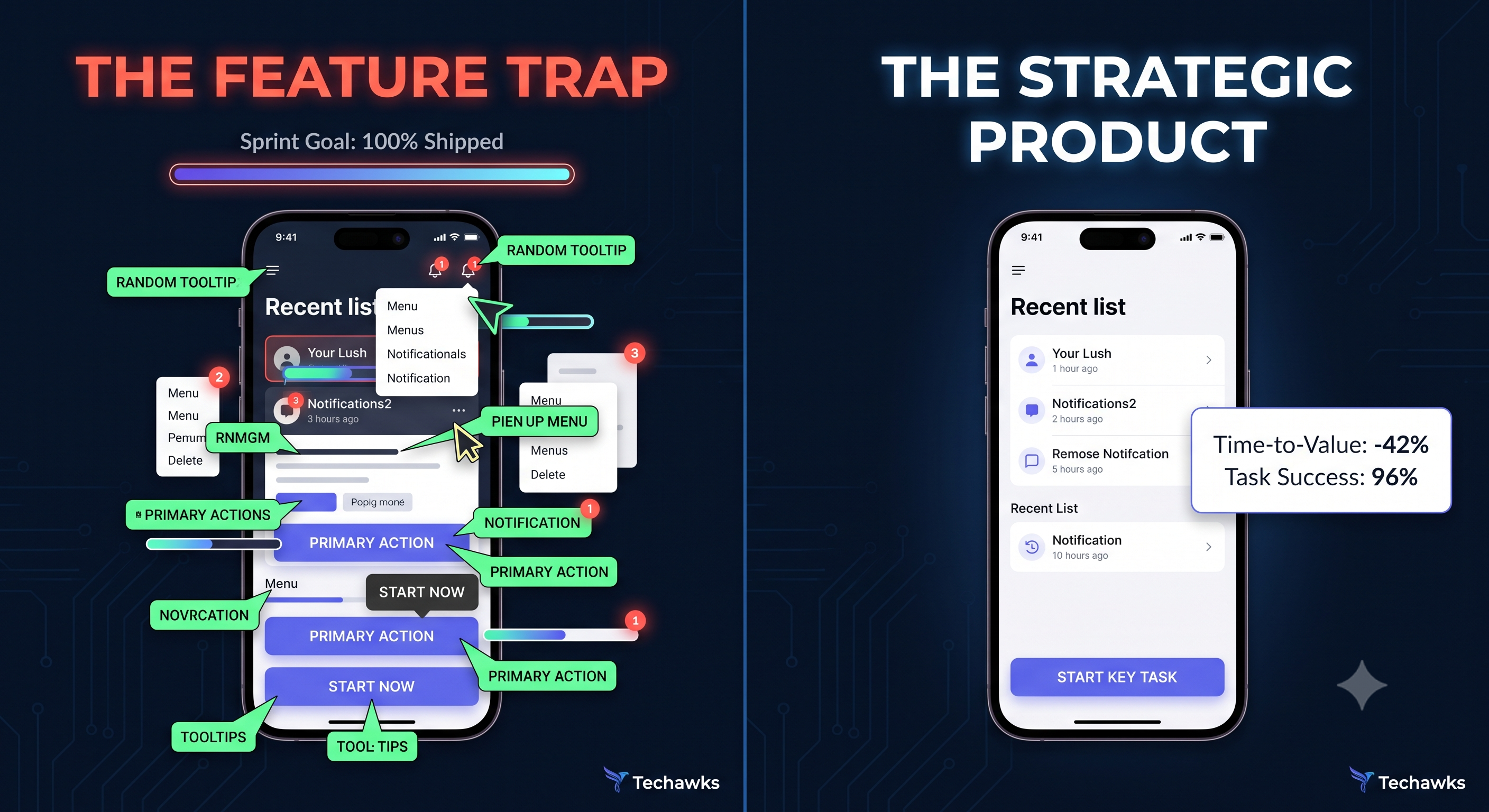
Most product teams fall into the "Feature Factory" trap. Roadmaps are treated like conveyor belts where success is measured by release dates, story points burned, and launch announcements. But every new button, tab, and configuration toggle adds cognitive overhead for your users and maintenance debt for your engineers.
When you default to adding rather than refining or removing, you dilute your core value proposition:
The Sunk Cost Delusion: Teams protect underperforming features simply because they took four sprints to build.
Cognitive Load Creep: What feels like "optional functionality" to an internal team translates to friction and paralysis of choice for a new user.
Ghost Engagement: Users clicking an element repeatedly doesn't automatically mean it's valuable—it often means the design is misleading or navigation is broken.
The 14-Day "Kill-or-Keep" Challenge:
Select one core workflow or major module in your product and run this audit before adding another ticket to your backlog:
Step 1: Map the Tail End. Pull usage analytics for every single interaction element in that workflow over the past 90 days. Identify the bottom 20% of features by recurring, intentional engagement.
Step 2: Run "Friction or Function" Interviews. Talk to 5 active users who ignore those low-usage elements. Verify whether they don't use them because they don't need them, or because the affordance is invisible.
Step 3: Propose One Sunset Candidate. Pick at least one low-utility, high-maintenance feature to deprecate or collapse into a secondary menu. Calculate the saved engineering overhead and the reduction in click steps for the primary path.
Step 4: Shift from Output to Outcome Metrics. Replace "features delivered" on your roadmap status update with "time-to-core-value reduced" or "task completion rate improved."
Key Takeaways
Addition is easy; subtraction is strategy: Great UX is defined by what you leave out, not how many edge cases you cram onto the screen.
Low usage is active technical debt: Neglected features still require QA, documentation, regression testing, and design consistency.
Value over velocity: Shipping faster is pointless if you are delivering functionality users have to navigate around rather than through.
CTA
Ready to move past output-driven backlogs and master outcome-focused design? Join the Product, UX & Design community to collaborate on user research frameworks, interface minimalism, and product strategy.
Most product teams fall into the "Feature Factory" trap. Roadmaps are treated like conveyor belts where success is measured by release dates, story points burned, and launch announcements. But every new button, tab, and configuration toggle adds cognitive overhead for your users and maintenance debt for your engineers.
When you default to adding rather than refining or removing, you dilute your core value proposition:
The Sunk Cost Delusion: Teams protect underperforming features simply because they took four sprints to build.
Cognitive Load Creep: What feels like "optional functionality" to an internal team translates to friction and paralysis of choice for a new user.
Ghost Engagement: Users clicking an element repeatedly doesn't automatically mean it's valuable—it often means the design is misleading or navigation is broken.
The 14-Day "Kill-or-Keep" Challenge:
Select one core workflow or major module in your product and run this audit before adding another ticket to your backlog:
Step 1: Map the Tail End. Pull usage analytics for every single interaction element in that workflow over the past 90 days. Identify the bottom 20% of features by recurring, intentional engagement.
Step 2: Run "Friction or Function" Interviews. Talk to 5 active users who ignore those low-usage elements. Verify whether they don't use them because they don't need them, or because the affordance is invisible.
Step 3: Propose One Sunset Candidate. Pick at least one low-utility, high-maintenance feature to deprecate or collapse into a secondary menu. Calculate the saved engineering overhead and the reduction in click steps for the primary path.
Step 4: Shift from Output to Outcome Metrics. Replace "features delivered" on your roadmap status update with "time-to-core-value reduced" or "task completion rate improved."
Key Takeaways
Addition is easy; subtraction is strategy: Great UX is defined by what you leave out, not how many edge cases you cram onto the screen.
Low usage is active technical debt: Neglected features still require QA, documentation, regression testing, and design consistency.
Value over velocity: Shipping faster is pointless if you are delivering functionality users have to navigate around rather than through.
CTA
Ready to move past output-driven backlogs and master outcome-focused design? Join the Product, UX & Design community to collaborate on user research frameworks, interface minimalism, and product strategy.
Stop Measuring Feature Velocity: The "Kill-or-Keep" Product Audit
Most product teams fall into the "Feature Factory" trap. Roadmaps are treated like conveyor belts where success is measured by release dates, story points burned, and launch announcements. But every new button, tab, and configuration toggle adds cognitive overhead for your users and maintenance debt for your engineers.
When you default to adding rather than refining or removing, you dilute your core value proposition:
The Sunk Cost Delusion: Teams protect underperforming features simply because they took four sprints to build.
Cognitive Load Creep: What feels like "optional functionality" to an internal team translates to friction and paralysis of choice for a new user.
Ghost Engagement: Users clicking an element repeatedly doesn't automatically mean it's valuable—it often means the design is misleading or navigation is broken.
The 14-Day "Kill-or-Keep" Challenge:
Select one core workflow or major module in your product and run this audit before adding another ticket to your backlog:
Step 1: Map the Tail End. Pull usage analytics for every single interaction element in that workflow over the past 90 days. Identify the bottom 20% of features by recurring, intentional engagement.
Step 2: Run "Friction or Function" Interviews. Talk to 5 active users who ignore those low-usage elements. Verify whether they don't use them because they don't need them, or because the affordance is invisible.
Step 3: Propose One Sunset Candidate. Pick at least one low-utility, high-maintenance feature to deprecate or collapse into a secondary menu. Calculate the saved engineering overhead and the reduction in click steps for the primary path.
Step 4: Shift from Output to Outcome Metrics. Replace "features delivered" on your roadmap status update with "time-to-core-value reduced" or "task completion rate improved."
Key Takeaways
Addition is easy; subtraction is strategy: Great UX is defined by what you leave out, not how many edge cases you cram onto the screen.
Low usage is active technical debt: Neglected features still require QA, documentation, regression testing, and design consistency.
Value over velocity: Shipping faster is pointless if you are delivering functionality users have to navigate around rather than through.
CTA
Ready to move past output-driven backlogs and master outcome-focused design? Join the Product, UX & Design community to collaborate on user research frameworks, interface minimalism, and product strategy.

 English
 Arabic
 French
 Spanish
 Portuguese
 Deutsch
 Dutch
Dutch
 Italiano
 Russian
 Romaian
 Portuguese (Brazil)
 Greek
Greek