


Chat UI Is Not the Default: The Fallacy of Conversational Everything
As agentic and generative features rapidly scale across modern software, conversational chat has become the lazy fallback pattern for digital products. Teams assume natural language is the ultimate interface because humans naturally speak in sentences.
In day-to-day software design, however, chat is often one of the lowest-bandwidth interaction modes available.
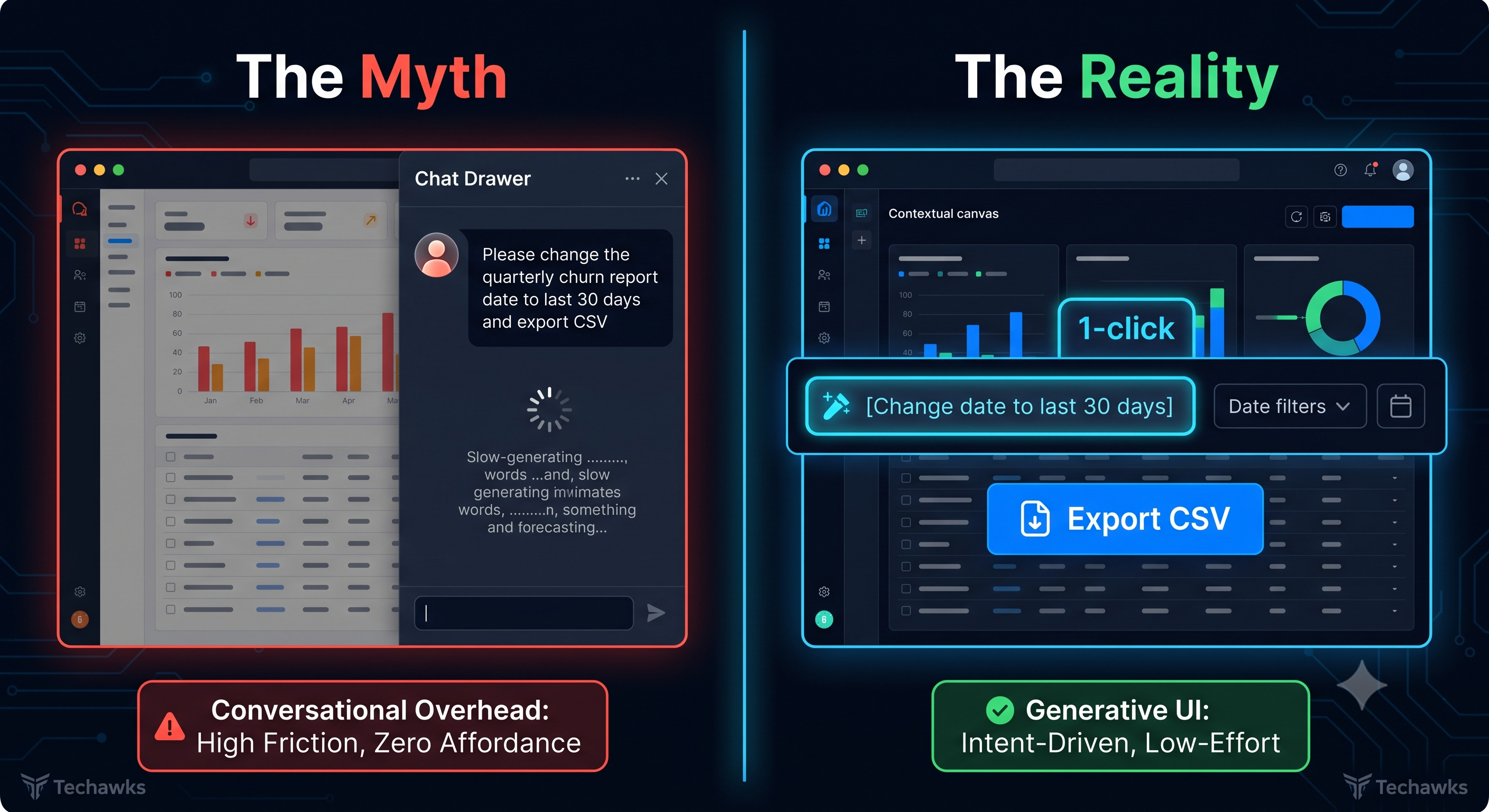
Myth: The ultimate UX for autonomous and generative AI is a conversational chat interface.
Fact: Chat demands high cognitive effort, hides application affordances, and replaces single-click actions with tedious typing and vague prompt engineering.
Why chat-first interfaces break user experience in complex workflows:
The Blank Slate Paralysis: Structured GUI controls (buttons, segmented toggles, dropdowns) reveal system capabilities at a glance. An empty text input conceals what the system can and cannot do, leaving users guessing the right vocabulary to get results.
Bandwidth Degradation: Selecting a date range or adjusting a filter requires two clicks in a visual UI (<1 second). Explaining that same operation in conversational natural language requires typing a 15-word prompt, waiting for generation, and reading a wordy response.
Loss of Deterministic Control: Users want predictability for repeatable workflows. Chat output is inherently non-deterministic and ephemeral, making auditability, batch edits, and spatial comparison unnecessarily frustrating.
How to Design AI-Native UX Without Defaulting to Chat:
Use Inline Contextual Augmentation: Embed AI where work already happens. Offer inline micro-completions, contextual suggestions, or side-by-side alternative variations rather than forcing users into a disconnected messaging window.
Implement "Generative GUI" (Structured Controls over Prompting): Surface clickable chips, sliders, and interactive preview cards that allow users to steer agent parameters visually without formulating natural language commands.
Design Clear Intervention Points: For autonomous agents, replace conversational back-and-forth with an Agent Activity Timeline and high-contrast approval checkpoints showing Intent, Confidence, and a single-click Override.
Discussion Question
Where have you seen AI features fail by forcing a chat interface when a structured, one-click GUI element would have been 10x faster?
CTA
Ready to move past conversational gimmicks and master genuine human-agent interface design? Join the Product, UX & Design community to collaborate on interaction models, heuristic frameworks, and product strategy.
As agentic and generative features rapidly scale across modern software, conversational chat has become the lazy fallback pattern for digital products. Teams assume natural language is the ultimate interface because humans naturally speak in sentences.
In day-to-day software design, however, chat is often one of the lowest-bandwidth interaction modes available.
Myth: The ultimate UX for autonomous and generative AI is a conversational chat interface.
Fact: Chat demands high cognitive effort, hides application affordances, and replaces single-click actions with tedious typing and vague prompt engineering.
Why chat-first interfaces break user experience in complex workflows:
The Blank Slate Paralysis: Structured GUI controls (buttons, segmented toggles, dropdowns) reveal system capabilities at a glance. An empty text input conceals what the system can and cannot do, leaving users guessing the right vocabulary to get results.
Bandwidth Degradation: Selecting a date range or adjusting a filter requires two clicks in a visual UI (<1 second). Explaining that same operation in conversational natural language requires typing a 15-word prompt, waiting for generation, and reading a wordy response.
Loss of Deterministic Control: Users want predictability for repeatable workflows. Chat output is inherently non-deterministic and ephemeral, making auditability, batch edits, and spatial comparison unnecessarily frustrating.
How to Design AI-Native UX Without Defaulting to Chat:
Use Inline Contextual Augmentation: Embed AI where work already happens. Offer inline micro-completions, contextual suggestions, or side-by-side alternative variations rather than forcing users into a disconnected messaging window.
Implement "Generative GUI" (Structured Controls over Prompting): Surface clickable chips, sliders, and interactive preview cards that allow users to steer agent parameters visually without formulating natural language commands.
Design Clear Intervention Points: For autonomous agents, replace conversational back-and-forth with an Agent Activity Timeline and high-contrast approval checkpoints showing Intent, Confidence, and a single-click Override.
Discussion Question
Where have you seen AI features fail by forcing a chat interface when a structured, one-click GUI element would have been 10x faster?
CTA
Ready to move past conversational gimmicks and master genuine human-agent interface design? Join the Product, UX & Design community to collaborate on interaction models, heuristic frameworks, and product strategy.
Chat UI Is Not the Default: The Fallacy of Conversational Everything
As agentic and generative features rapidly scale across modern software, conversational chat has become the lazy fallback pattern for digital products. Teams assume natural language is the ultimate interface because humans naturally speak in sentences.
In day-to-day software design, however, chat is often one of the lowest-bandwidth interaction modes available.
Myth: The ultimate UX for autonomous and generative AI is a conversational chat interface.
Fact: Chat demands high cognitive effort, hides application affordances, and replaces single-click actions with tedious typing and vague prompt engineering.
Why chat-first interfaces break user experience in complex workflows:
The Blank Slate Paralysis: Structured GUI controls (buttons, segmented toggles, dropdowns) reveal system capabilities at a glance. An empty text input conceals what the system can and cannot do, leaving users guessing the right vocabulary to get results.
Bandwidth Degradation: Selecting a date range or adjusting a filter requires two clicks in a visual UI (<1 second). Explaining that same operation in conversational natural language requires typing a 15-word prompt, waiting for generation, and reading a wordy response.
Loss of Deterministic Control: Users want predictability for repeatable workflows. Chat output is inherently non-deterministic and ephemeral, making auditability, batch edits, and spatial comparison unnecessarily frustrating.
How to Design AI-Native UX Without Defaulting to Chat:
Use Inline Contextual Augmentation: Embed AI where work already happens. Offer inline micro-completions, contextual suggestions, or side-by-side alternative variations rather than forcing users into a disconnected messaging window.
Implement "Generative GUI" (Structured Controls over Prompting): Surface clickable chips, sliders, and interactive preview cards that allow users to steer agent parameters visually without formulating natural language commands.
Design Clear Intervention Points: For autonomous agents, replace conversational back-and-forth with an Agent Activity Timeline and high-contrast approval checkpoints showing Intent, Confidence, and a single-click Override.
Discussion Question
Where have you seen AI features fail by forcing a chat interface when a structured, one-click GUI element would have been 10x faster?
CTA
Ready to move past conversational gimmicks and master genuine human-agent interface design? Join the Product, UX & Design community to collaborate on interaction models, heuristic frameworks, and product strategy.

 English
 Arabic
 French
 Spanish
 Portuguese
 Turkish
 Dutch
Dutch
 Italiano
 Russian
 Romaian
 Portuguese (Brazil)
 Greek
Greek