


The SOC 2 "Screenshot Trap": Why US Tech Needs Continuous Evidence Pipelines
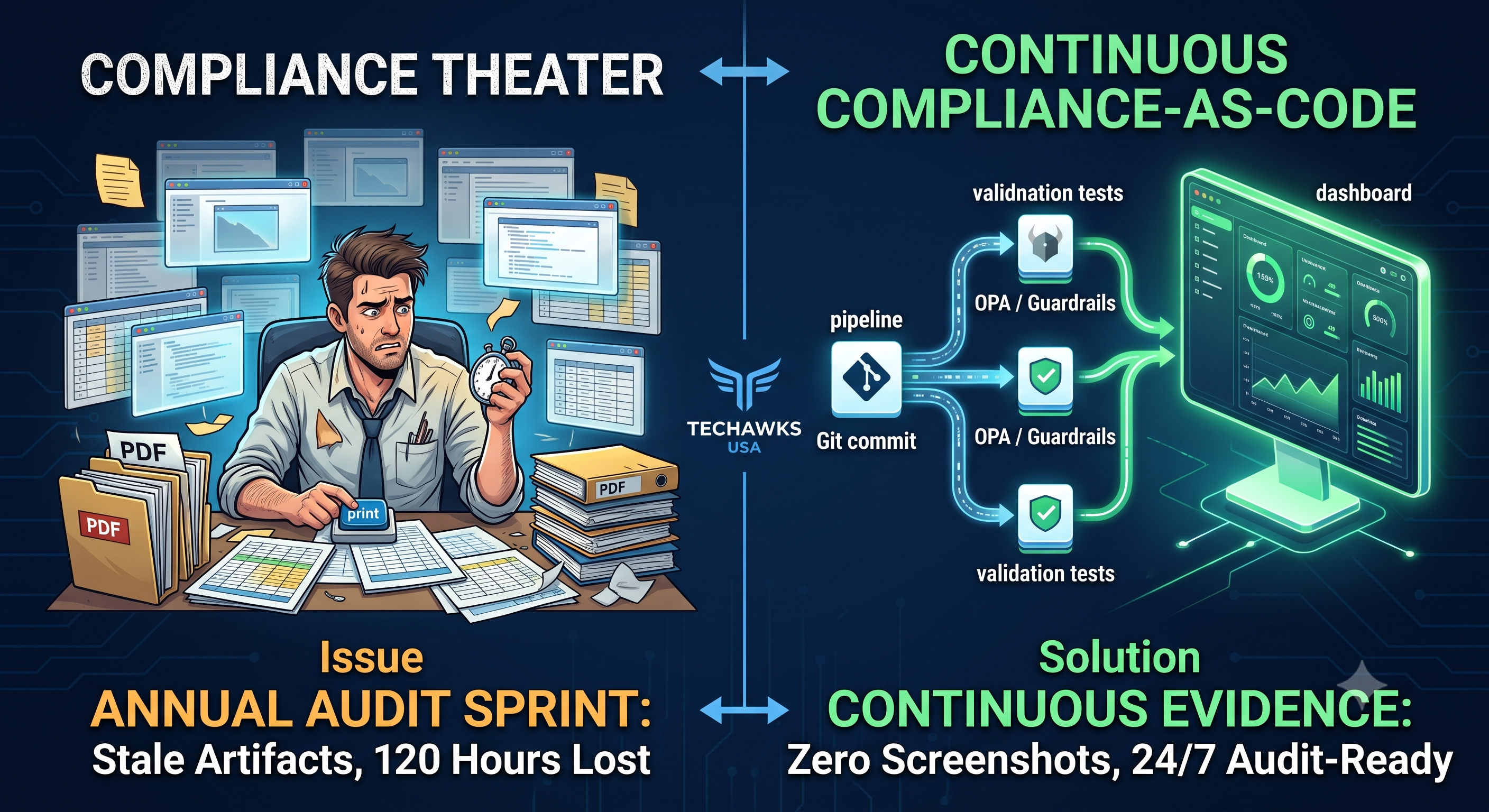
Across the US tech landscape—from Silicon Valley startups to enterprise platforms—teams treat compliance frameworks (SOC 2 Type II, NIST 800-53, FedRAMP) like an open-book final exam. Engineers scramble at the end of every audit window to gather static PDFs, ticket exports, and dashboard grabs to satisfy external auditors.
This manual approach introduces dangerous operational blind spots into production systems.
Myth: "Passing an annual SOC 2 or NIST audit proves our cloud infrastructure is secure."
Fact: An annual audit proves point-in-time compliance on the day a screenshot was captured; it does not protect against configuration drift, leaked credentials, or shadow infrastructure introduced ten minutes later.
Why the traditional screenshot-and-spreadsheet compliance model fails modern US software stacks:
The Drift Window: If an engineer temporarily disables MFA or opens a staging security group to 0.0.0.0/0 to troubleshoot a bug and leaves it open for three weeks, a static annual audit will never register it—yet the attack vector is live.
High Engineering Toll: Senior engineers lose an estimated 100+ sprint hours per quarter gathering point-in-time artifacts, pulling attention directly away from core product roadmaps and architectural resilience.
Audit Fatigue and Stale Controls: When compliance is disconnected from daily developer tooling, policy enforcement becomes purely reactive rather than baked into pull requests.
How US Platform Teams Shift to Continuous Automated Compliance:
Transition to Compliance-as-Code: Treat security controls identically to unit tests. Use Open Policy Agent (OPA) or Kyverno to define your compliance baselines (e.g., encryption-at-rest, mandatory branch approvals, key rotation) directly in Git.
Stream Evidence Automatically via API: Replace manual screenshot gathering by leveraging continuous compliance platforms and read-only cloud auditing APIs to collect cryptographically verifiable logs every 24 hours.
Block Non-Compliant Commits at the Gate: Enforce pre-merge checks in your CI/CD pipeline. If an infrastructure pull request provisions an unencrypted S3 bucket or an overly permissive IAM role, break the build before deployment rather than waiting for an auditor to flag it months later.
Discussion Question
Is your team still stuck in the annual "screenshot sprint" for compliance audits, or have you hooked your IaC pipelines directly into continuous automated evidence collection?
CTA
Ready to trade manual audit scrambles for automated, continuous cloud governance tailored to modern enterprise standards? Join Techawks USA to debate platform engineering best practices, compliance architectures, and scalable cloud systems.
Across the US tech landscape—from Silicon Valley startups to enterprise platforms—teams treat compliance frameworks (SOC 2 Type II, NIST 800-53, FedRAMP) like an open-book final exam. Engineers scramble at the end of every audit window to gather static PDFs, ticket exports, and dashboard grabs to satisfy external auditors.
This manual approach introduces dangerous operational blind spots into production systems.
Myth: "Passing an annual SOC 2 or NIST audit proves our cloud infrastructure is secure."
Fact: An annual audit proves point-in-time compliance on the day a screenshot was captured; it does not protect against configuration drift, leaked credentials, or shadow infrastructure introduced ten minutes later.
Why the traditional screenshot-and-spreadsheet compliance model fails modern US software stacks:
The Drift Window: If an engineer temporarily disables MFA or opens a staging security group to 0.0.0.0/0 to troubleshoot a bug and leaves it open for three weeks, a static annual audit will never register it—yet the attack vector is live.
High Engineering Toll: Senior engineers lose an estimated 100+ sprint hours per quarter gathering point-in-time artifacts, pulling attention directly away from core product roadmaps and architectural resilience.
Audit Fatigue and Stale Controls: When compliance is disconnected from daily developer tooling, policy enforcement becomes purely reactive rather than baked into pull requests.
How US Platform Teams Shift to Continuous Automated Compliance:
Transition to Compliance-as-Code: Treat security controls identically to unit tests. Use Open Policy Agent (OPA) or Kyverno to define your compliance baselines (e.g., encryption-at-rest, mandatory branch approvals, key rotation) directly in Git.
Stream Evidence Automatically via API: Replace manual screenshot gathering by leveraging continuous compliance platforms and read-only cloud auditing APIs to collect cryptographically verifiable logs every 24 hours.
Block Non-Compliant Commits at the Gate: Enforce pre-merge checks in your CI/CD pipeline. If an infrastructure pull request provisions an unencrypted S3 bucket or an overly permissive IAM role, break the build before deployment rather than waiting for an auditor to flag it months later.
Discussion Question
Is your team still stuck in the annual "screenshot sprint" for compliance audits, or have you hooked your IaC pipelines directly into continuous automated evidence collection?
CTA
Ready to trade manual audit scrambles for automated, continuous cloud governance tailored to modern enterprise standards? Join Techawks USA to debate platform engineering best practices, compliance architectures, and scalable cloud systems.
The SOC 2 "Screenshot Trap": Why US Tech Needs Continuous Evidence Pipelines
Across the US tech landscape—from Silicon Valley startups to enterprise platforms—teams treat compliance frameworks (SOC 2 Type II, NIST 800-53, FedRAMP) like an open-book final exam. Engineers scramble at the end of every audit window to gather static PDFs, ticket exports, and dashboard grabs to satisfy external auditors.
This manual approach introduces dangerous operational blind spots into production systems.
Myth: "Passing an annual SOC 2 or NIST audit proves our cloud infrastructure is secure."
Fact: An annual audit proves point-in-time compliance on the day a screenshot was captured; it does not protect against configuration drift, leaked credentials, or shadow infrastructure introduced ten minutes later.
Why the traditional screenshot-and-spreadsheet compliance model fails modern US software stacks:
The Drift Window: If an engineer temporarily disables MFA or opens a staging security group to 0.0.0.0/0 to troubleshoot a bug and leaves it open for three weeks, a static annual audit will never register it—yet the attack vector is live.
High Engineering Toll: Senior engineers lose an estimated 100+ sprint hours per quarter gathering point-in-time artifacts, pulling attention directly away from core product roadmaps and architectural resilience.
Audit Fatigue and Stale Controls: When compliance is disconnected from daily developer tooling, policy enforcement becomes purely reactive rather than baked into pull requests.
How US Platform Teams Shift to Continuous Automated Compliance:
Transition to Compliance-as-Code: Treat security controls identically to unit tests. Use Open Policy Agent (OPA) or Kyverno to define your compliance baselines (e.g., encryption-at-rest, mandatory branch approvals, key rotation) directly in Git.
Stream Evidence Automatically via API: Replace manual screenshot gathering by leveraging continuous compliance platforms and read-only cloud auditing APIs to collect cryptographically verifiable logs every 24 hours.
Block Non-Compliant Commits at the Gate: Enforce pre-merge checks in your CI/CD pipeline. If an infrastructure pull request provisions an unencrypted S3 bucket or an overly permissive IAM role, break the build before deployment rather than waiting for an auditor to flag it months later.
Discussion Question
Is your team still stuck in the annual "screenshot sprint" for compliance audits, or have you hooked your IaC pipelines directly into continuous automated evidence collection?
CTA
Ready to trade manual audit scrambles for automated, continuous cloud governance tailored to modern enterprise standards? Join Techawks USA to debate platform engineering best practices, compliance architectures, and scalable cloud systems.

 Arabic
 French
 Spanish
 Portuguese
 Deutsch
 Turkish
 Dutch
Dutch
 Italiano
 Russian
 Romaian
 Portuguese (Brazil)
 Greek
Greek