


Stop Polling Tool Schemas: The Power of First-Class MCP in LangChain
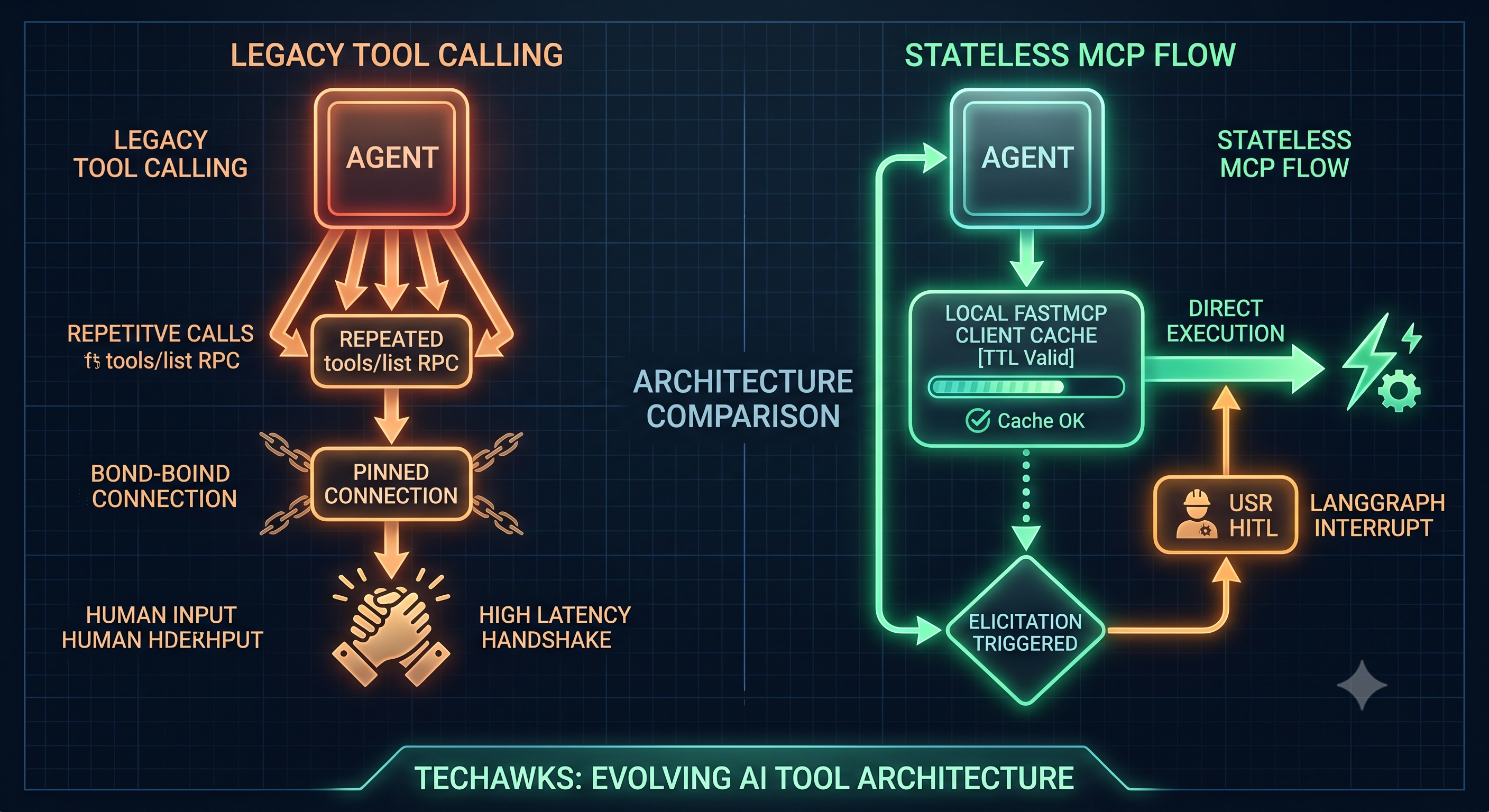
Connecting AI agents to databases, developer tooling, and APIs used to require messy custom wrappers or clunky adapters. Anthropic’s Model Context Protocol (MCP) solved the interface problem, but early production deployments ran straight into a scalability barrier: session pinning and redundant tool discovery.
With MCP integrated directly into LangChain via FastMCP, two critical production primitives are now standard: Stateless Client Caching and Interrupt-Driven Elicitation.
Why It Matters
Zero-Latency Handshakes: Under older stateful setups, clients had to request the tool catalog (tools/list) upon every agent spin-up. With the stateless core, servers now advertise TTLs. Clients cache tool signatures locally, dropping invocation overhead to near-zero.
True Human-in-the-Loop (HITL) Without Connection Holding: If a tool requires parameter clarification or permission (e.g., executing an SQL DROP or confirming a Stripe charge), the protocol uses elicitation. Instead of holding open idle sockets, the request pauses, triggers a LangGraph interrupt, and resumes when the input arrives.
The Playbook: Implementing Native MCP in 3 Steps
Install the Core Extension
Retire deprecated adapter packages (langchain-mcp-adapters):
Bash
pip install "langchain[mcp]>=1.4.0"
Configure Client-Side Schema Caching
Configure FastMCP to leverage cached manifests instead of polling endpoints on every cycle:
Python
from fastmcp import Client
from langchain.mcp import MCPAdapter
# Enable client-side caching to eliminate redundant discovery calls
client = Client("https://api.internal/mcp", cache=True)
async with MCPAdapter(client) as adapter:
agent_tools = adapter.get_tools()
# Tools are served directly from cache while TTL holds
Handle Mid-Execution Elicitation
Pair the MCP adapter with LangGraph’s native interrupt(). When a server requires authorization or missing arguments, the agent yields control deterministically without risking connection dropouts or token leakage.
Standardizing tool invocation is the first requirement of scalable agent engineering. Moving discovery to the edge and decoupling execution state turns unstable prototypes into durable microservices.
Discussion Question
Are you currently running agent tools over custom REST APIs, OpenAPI specs, or native MCP servers? What is your biggest hurdle with multi-tool latency in production?
CTA
Join AI Builders & Enthusiasts: Connect with engineers, researchers, and AI builders shipping stateful agents, MCP architectures, and production-grade LLM systems
Connecting AI agents to databases, developer tooling, and APIs used to require messy custom wrappers or clunky adapters. Anthropic’s Model Context Protocol (MCP) solved the interface problem, but early production deployments ran straight into a scalability barrier: session pinning and redundant tool discovery.
With MCP integrated directly into LangChain via FastMCP, two critical production primitives are now standard: Stateless Client Caching and Interrupt-Driven Elicitation.
Why It Matters
Zero-Latency Handshakes: Under older stateful setups, clients had to request the tool catalog (tools/list) upon every agent spin-up. With the stateless core, servers now advertise TTLs. Clients cache tool signatures locally, dropping invocation overhead to near-zero.
True Human-in-the-Loop (HITL) Without Connection Holding: If a tool requires parameter clarification or permission (e.g., executing an SQL DROP or confirming a Stripe charge), the protocol uses elicitation. Instead of holding open idle sockets, the request pauses, triggers a LangGraph interrupt, and resumes when the input arrives.
The Playbook: Implementing Native MCP in 3 Steps
Install the Core Extension
Retire deprecated adapter packages (langchain-mcp-adapters):
Bash
pip install "langchain[mcp]>=1.4.0"
Configure Client-Side Schema Caching
Configure FastMCP to leverage cached manifests instead of polling endpoints on every cycle:
Python
from fastmcp import Client
from langchain.mcp import MCPAdapter
# Enable client-side caching to eliminate redundant discovery calls
client = Client("https://api.internal/mcp", cache=True)
async with MCPAdapter(client) as adapter:
agent_tools = adapter.get_tools()
# Tools are served directly from cache while TTL holds
Handle Mid-Execution Elicitation
Pair the MCP adapter with LangGraph’s native interrupt(). When a server requires authorization or missing arguments, the agent yields control deterministically without risking connection dropouts or token leakage.
Standardizing tool invocation is the first requirement of scalable agent engineering. Moving discovery to the edge and decoupling execution state turns unstable prototypes into durable microservices.
Discussion Question
Are you currently running agent tools over custom REST APIs, OpenAPI specs, or native MCP servers? What is your biggest hurdle with multi-tool latency in production?
CTA
Join AI Builders & Enthusiasts: Connect with engineers, researchers, and AI builders shipping stateful agents, MCP architectures, and production-grade LLM systems
Stop Polling Tool Schemas: The Power of First-Class MCP in LangChain
Connecting AI agents to databases, developer tooling, and APIs used to require messy custom wrappers or clunky adapters. Anthropic’s Model Context Protocol (MCP) solved the interface problem, but early production deployments ran straight into a scalability barrier: session pinning and redundant tool discovery.
With MCP integrated directly into LangChain via FastMCP, two critical production primitives are now standard: Stateless Client Caching and Interrupt-Driven Elicitation.
Why It Matters
Zero-Latency Handshakes: Under older stateful setups, clients had to request the tool catalog (tools/list) upon every agent spin-up. With the stateless core, servers now advertise TTLs. Clients cache tool signatures locally, dropping invocation overhead to near-zero.
True Human-in-the-Loop (HITL) Without Connection Holding: If a tool requires parameter clarification or permission (e.g., executing an SQL DROP or confirming a Stripe charge), the protocol uses elicitation. Instead of holding open idle sockets, the request pauses, triggers a LangGraph interrupt, and resumes when the input arrives.
The Playbook: Implementing Native MCP in 3 Steps
Install the Core Extension
Retire deprecated adapter packages (langchain-mcp-adapters):
Bash
pip install "langchain[mcp]>=1.4.0"
Configure Client-Side Schema Caching
Configure FastMCP to leverage cached manifests instead of polling endpoints on every cycle:
Python
from fastmcp import Client
from langchain.mcp import MCPAdapter
# Enable client-side caching to eliminate redundant discovery calls
client = Client("https://api.internal/mcp", cache=True)
async with MCPAdapter(client) as adapter:
agent_tools = adapter.get_tools()
# Tools are served directly from cache while TTL holds
Handle Mid-Execution Elicitation
Pair the MCP adapter with LangGraph’s native interrupt(). When a server requires authorization or missing arguments, the agent yields control deterministically without risking connection dropouts or token leakage.
Standardizing tool invocation is the first requirement of scalable agent engineering. Moving discovery to the edge and decoupling execution state turns unstable prototypes into durable microservices.
Discussion Question
Are you currently running agent tools over custom REST APIs, OpenAPI specs, or native MCP servers? What is your biggest hurdle with multi-tool latency in production?
CTA
Join AI Builders & Enthusiasts: Connect with engineers, researchers, and AI builders shipping stateful agents, MCP architectures, and production-grade LLM systems

 English
 Arabic
 French
 Portuguese
 Deutsch
 Turkish
 Dutch
Dutch
 Italiano
 Russian
 Romaian
 Portuguese (Brazil)
 Greek
Greek