


The Death of Feature Factory PMs: Why "Human-in-the-Loop" Is Your Next Career Moat
Recent industry benchmarks reveal a striking reality: over 97% of enterprise users override AI agent recommendations when the underlying reasoning isn't transparent or steerable. Meanwhile, Gartner reports that only 22% of enterprise AI initiatives have successfully scaled across business units.
The bottleneck in tech today isn't algorithm capability—it’s trust architecture.
If your product portfolio is focused purely on prompting AI to write tickets faster or slapping a chat wrapper onto existing dashboards, your product career is running on borrowed time. When software shifts from deterministic buttons to probabilistic agent workflows, the role of product managers and UX designers fundamentally changes.
Here is the three-part framework top product leaders are using to design high-trust systems:
1. Shift from Task Execution to "Escalation Boundaries"
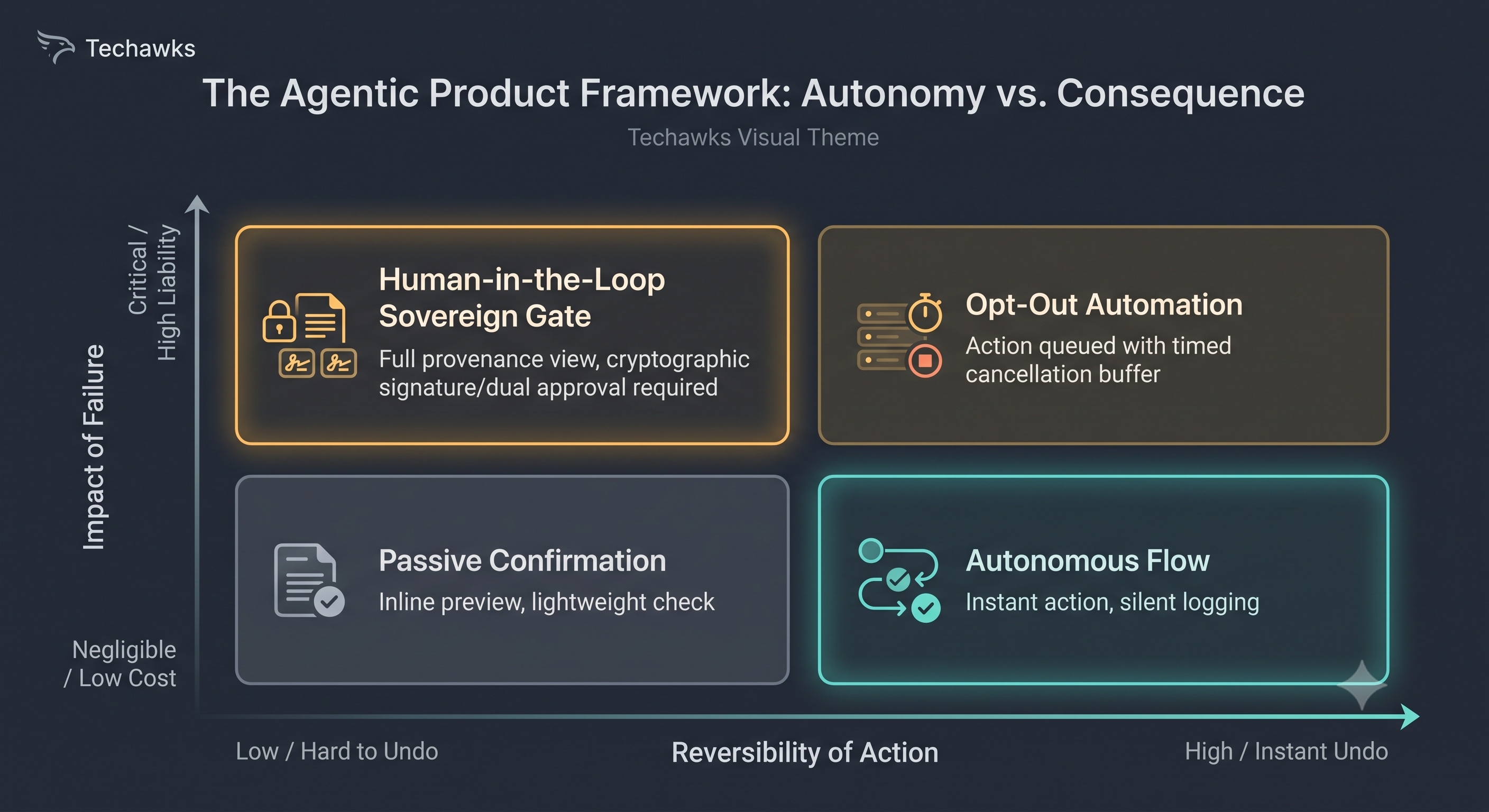
Traditional UX optimizes for zero friction. In autonomous and agentic systems, friction is a safety feature. Your job as a PM/Designer is not to automate every step; it is to map the Reversibility Matrix:
Low-impact / High-reversibility (e.g., categorizing a ticket, draft summarization): Full autonomy.
High-impact / Irreversible (e.g., executing a contract, modifying billing logic): Mandate Explicit Gateways—requiring active human sign-off with clear provenance trails.
2. Design "Provenance-First" Affordances
Users don’t trust black-box automation. High-leverage designers are deprecating vague progress spinners in favor of Inspectable State Engines:
Show intermediate tool-use steps in plain language.
Provide dynamic confidence ratings.
Enable one-click parameter rewinds rather than forcing the user to start over.
3. Redefine Your Value Equation
In the pre-agent era, PM value was measured by velocity: How fast did you ship?
In the agentic era, PM value is measured by Error Margin & Governance: How reliably does the system fail gracefully when the model is uncertain?
Career takeaway: Don’t just learn how to use AI tools—learn how to design systems that keep humans sovereign. The builders who master explainability, fallback architecture, and agent control planes are the ones setting the product agenda for the next decade.
Discussion Question
When you’re designing an automated or agentic workflow, where do you draw the line between frictionless autonomy and mandatory human friction? What signals trigger a manual override in your product?
CTA
Ready to move past feature-building and master systems-level product leadership?
👉 Join Product, UX & Design on Techawks for daily frameworks, deep dives, and peer critiques with top industry leaders.
Recent industry benchmarks reveal a striking reality: over 97% of enterprise users override AI agent recommendations when the underlying reasoning isn't transparent or steerable. Meanwhile, Gartner reports that only 22% of enterprise AI initiatives have successfully scaled across business units.
The bottleneck in tech today isn't algorithm capability—it’s trust architecture.
If your product portfolio is focused purely on prompting AI to write tickets faster or slapping a chat wrapper onto existing dashboards, your product career is running on borrowed time. When software shifts from deterministic buttons to probabilistic agent workflows, the role of product managers and UX designers fundamentally changes.
Here is the three-part framework top product leaders are using to design high-trust systems:
1. Shift from Task Execution to "Escalation Boundaries"
Traditional UX optimizes for zero friction. In autonomous and agentic systems, friction is a safety feature. Your job as a PM/Designer is not to automate every step; it is to map the Reversibility Matrix:
Low-impact / High-reversibility (e.g., categorizing a ticket, draft summarization): Full autonomy.
High-impact / Irreversible (e.g., executing a contract, modifying billing logic): Mandate Explicit Gateways—requiring active human sign-off with clear provenance trails.
2. Design "Provenance-First" Affordances
Users don’t trust black-box automation. High-leverage designers are deprecating vague progress spinners in favor of Inspectable State Engines:
Show intermediate tool-use steps in plain language.
Provide dynamic confidence ratings.
Enable one-click parameter rewinds rather than forcing the user to start over.
3. Redefine Your Value Equation
In the pre-agent era, PM value was measured by velocity: How fast did you ship?
In the agentic era, PM value is measured by Error Margin & Governance: How reliably does the system fail gracefully when the model is uncertain?
Career takeaway: Don’t just learn how to use AI tools—learn how to design systems that keep humans sovereign. The builders who master explainability, fallback architecture, and agent control planes are the ones setting the product agenda for the next decade.
Discussion Question
When you’re designing an automated or agentic workflow, where do you draw the line between frictionless autonomy and mandatory human friction? What signals trigger a manual override in your product?
CTA
Ready to move past feature-building and master systems-level product leadership?
👉 Join Product, UX & Design on Techawks for daily frameworks, deep dives, and peer critiques with top industry leaders.
The Death of Feature Factory PMs: Why "Human-in-the-Loop" Is Your Next Career Moat
Recent industry benchmarks reveal a striking reality: over 97% of enterprise users override AI agent recommendations when the underlying reasoning isn't transparent or steerable. Meanwhile, Gartner reports that only 22% of enterprise AI initiatives have successfully scaled across business units.
The bottleneck in tech today isn't algorithm capability—it’s trust architecture.
If your product portfolio is focused purely on prompting AI to write tickets faster or slapping a chat wrapper onto existing dashboards, your product career is running on borrowed time. When software shifts from deterministic buttons to probabilistic agent workflows, the role of product managers and UX designers fundamentally changes.
Here is the three-part framework top product leaders are using to design high-trust systems:
1. Shift from Task Execution to "Escalation Boundaries"
Traditional UX optimizes for zero friction. In autonomous and agentic systems, friction is a safety feature. Your job as a PM/Designer is not to automate every step; it is to map the Reversibility Matrix:
Low-impact / High-reversibility (e.g., categorizing a ticket, draft summarization): Full autonomy.
High-impact / Irreversible (e.g., executing a contract, modifying billing logic): Mandate Explicit Gateways—requiring active human sign-off with clear provenance trails.
2. Design "Provenance-First" Affordances
Users don’t trust black-box automation. High-leverage designers are deprecating vague progress spinners in favor of Inspectable State Engines:
Show intermediate tool-use steps in plain language.
Provide dynamic confidence ratings.
Enable one-click parameter rewinds rather than forcing the user to start over.
3. Redefine Your Value Equation
In the pre-agent era, PM value was measured by velocity: How fast did you ship?
In the agentic era, PM value is measured by Error Margin & Governance: How reliably does the system fail gracefully when the model is uncertain?
Career takeaway: Don’t just learn how to use AI tools—learn how to design systems that keep humans sovereign. The builders who master explainability, fallback architecture, and agent control planes are the ones setting the product agenda for the next decade.
Discussion Question
When you’re designing an automated or agentic workflow, where do you draw the line between frictionless autonomy and mandatory human friction? What signals trigger a manual override in your product?
CTA
Ready to move past feature-building and master systems-level product leadership?
👉 Join Product, UX & Design on Techawks for daily frameworks, deep dives, and peer critiques with top industry leaders.

 Arabic
 French
 Spanish
 Portuguese
 Deutsch
 Turkish
 Dutch
Dutch
 Italiano
 Russian
 Romaian
 Portuguese (Brazil)
 Greek
Greek