


The "GCC 4.0" Pivot: Why India’s Tech Career Ladder Just Changed Rules
India’s Global Capability Centers (GCCs) have officially crossed 2,100+ entities employing over 2.3 million professionals, with GCCs generating nearly $100B in economic value.
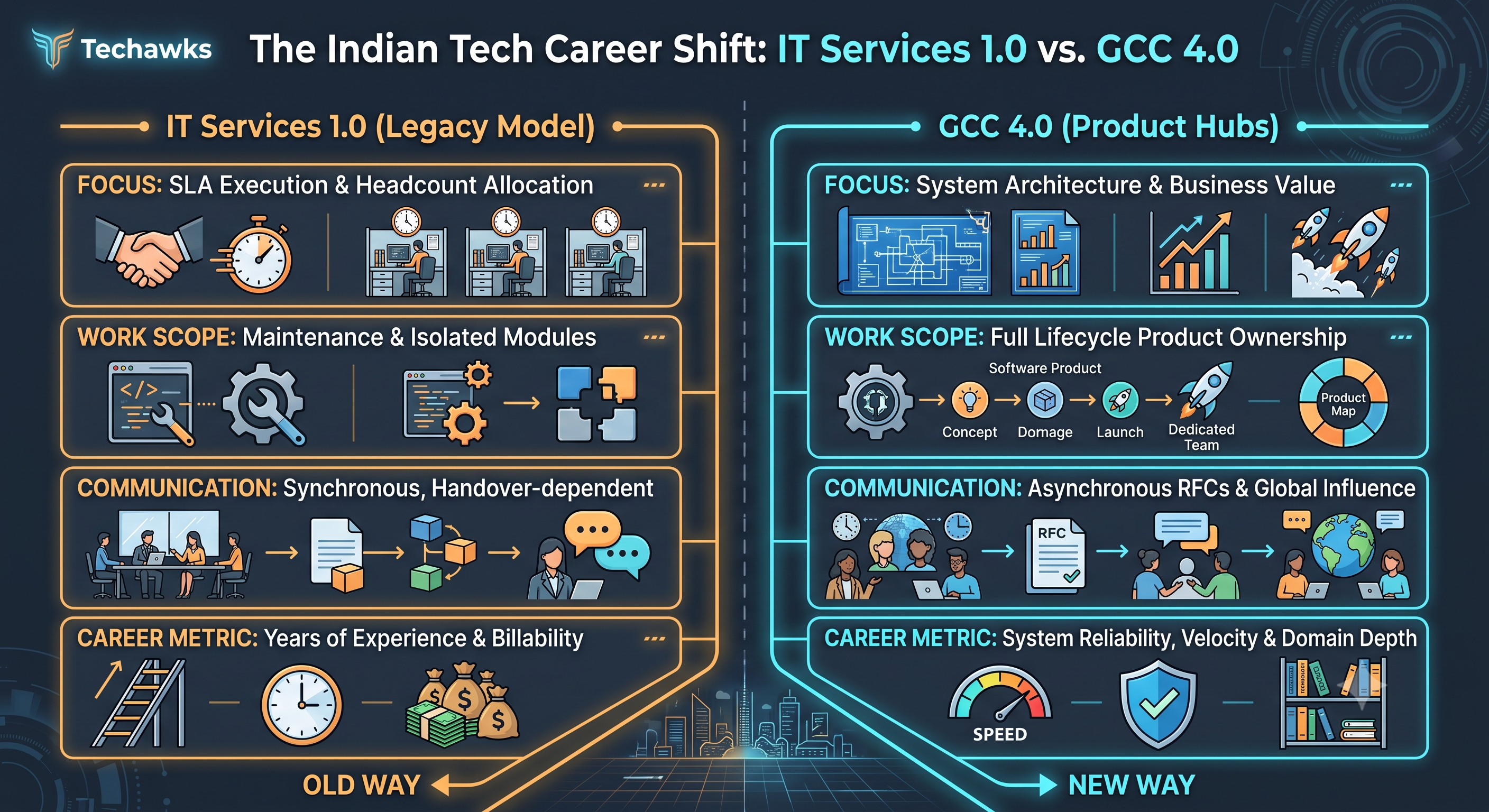
The defining structural shift across Bengaluru, Hyderabad, and Pune isn't just headcount—it is the extinction of the offshore cost-center model. Global headquarters are no longer sending repetitive maintenance slices to India; they are anchoring core product ownership, AI architecture, and global P&L accountability directly into Indian engineering hubs.
Yet, thousands of Indian engineers with 4–10 years of experience are hitting a ceiling in interviews. Why?
Because the skills that earned you a senior rating in the traditional IT-services era—client SLA adherence, manual bug fixes, and waiting for user stories—are liabilities in modern product GCCs.
Here is the 3-step transition playbook to command the top 15–25% compensation tier in India’s GCC landscape:
1. Shift from "Billable Ticket Taker" to "Product Problem Owner"
In legacy setups, your metric was billable hours or completing Jira tasks handed down from US/EU teams. In GCC 4.0, product teams want end-to-end provenance.
Stop answering interviewers with "I was allocated to module X."
Frame impact in systems terms: "We identified a 32% latency bottleneck in core transaction processing and redesigned the event pipeline without cross-border dependencies."
2. Master "Asynchronous Global Influence"
GCC leadership roles are increasingly run out of India. That requires high-fidelity technical writing and architectural governance:
Can you author a concise RFC (Request for Comments) that convinces an executive team in London, Zurich, or San Francisco?
Can you negotiate technical trade-offs across distributed time zones without needing a synchronous midnight meeting?
3. Anchor Your Stack in "AI-Native Integration"
Over 64% of new tech openings across India's top GCCs now mandate AI, data systems, or intelligent automation competencies.
It’s no longer enough to know pure Java or React.
You must understand how to integrate LLM orchestration, implement vector databases, enforce data compliance (DPDP Act & GDPR), and design resilient fallback systems.
Career Takeaway: India has transitioned from the world’s back office to its core engineering boardroom. The engineers capturing outsized career leverage aren't just shipping code—they are owning the architecture and the business outcomes behind it.
Discussion Question
For tech professionals in Bengaluru, Hyderabad, Pune, and Chennai: If you have made the jump from a service company or legacy unit to a GCC/product engineering hub, what was the hardest cultural mindset to unlearn?
CTA
Ready to build high-impact technical ownership and accelerate your engineering career in India?
👉 Join Techawks India for architecture breakdowns, salary insights, and practical frameworks from top local engineering leaders.
India’s Global Capability Centers (GCCs) have officially crossed 2,100+ entities employing over 2.3 million professionals, with GCCs generating nearly $100B in economic value.
The defining structural shift across Bengaluru, Hyderabad, and Pune isn't just headcount—it is the extinction of the offshore cost-center model. Global headquarters are no longer sending repetitive maintenance slices to India; they are anchoring core product ownership, AI architecture, and global P&L accountability directly into Indian engineering hubs.
Yet, thousands of Indian engineers with 4–10 years of experience are hitting a ceiling in interviews. Why?
Because the skills that earned you a senior rating in the traditional IT-services era—client SLA adherence, manual bug fixes, and waiting for user stories—are liabilities in modern product GCCs.
Here is the 3-step transition playbook to command the top 15–25% compensation tier in India’s GCC landscape:
1. Shift from "Billable Ticket Taker" to "Product Problem Owner"
In legacy setups, your metric was billable hours or completing Jira tasks handed down from US/EU teams. In GCC 4.0, product teams want end-to-end provenance.
Stop answering interviewers with "I was allocated to module X."
Frame impact in systems terms: "We identified a 32% latency bottleneck in core transaction processing and redesigned the event pipeline without cross-border dependencies."
2. Master "Asynchronous Global Influence"
GCC leadership roles are increasingly run out of India. That requires high-fidelity technical writing and architectural governance:
Can you author a concise RFC (Request for Comments) that convinces an executive team in London, Zurich, or San Francisco?
Can you negotiate technical trade-offs across distributed time zones without needing a synchronous midnight meeting?
3. Anchor Your Stack in "AI-Native Integration"
Over 64% of new tech openings across India's top GCCs now mandate AI, data systems, or intelligent automation competencies.
It’s no longer enough to know pure Java or React.
You must understand how to integrate LLM orchestration, implement vector databases, enforce data compliance (DPDP Act & GDPR), and design resilient fallback systems.
Career Takeaway: India has transitioned from the world’s back office to its core engineering boardroom. The engineers capturing outsized career leverage aren't just shipping code—they are owning the architecture and the business outcomes behind it.
Discussion Question
For tech professionals in Bengaluru, Hyderabad, Pune, and Chennai: If you have made the jump from a service company or legacy unit to a GCC/product engineering hub, what was the hardest cultural mindset to unlearn?
CTA
Ready to build high-impact technical ownership and accelerate your engineering career in India?
👉 Join Techawks India for architecture breakdowns, salary insights, and practical frameworks from top local engineering leaders.
The "GCC 4.0" Pivot: Why India’s Tech Career Ladder Just Changed Rules
India’s Global Capability Centers (GCCs) have officially crossed 2,100+ entities employing over 2.3 million professionals, with GCCs generating nearly $100B in economic value.
The defining structural shift across Bengaluru, Hyderabad, and Pune isn't just headcount—it is the extinction of the offshore cost-center model. Global headquarters are no longer sending repetitive maintenance slices to India; they are anchoring core product ownership, AI architecture, and global P&L accountability directly into Indian engineering hubs.
Yet, thousands of Indian engineers with 4–10 years of experience are hitting a ceiling in interviews. Why?
Because the skills that earned you a senior rating in the traditional IT-services era—client SLA adherence, manual bug fixes, and waiting for user stories—are liabilities in modern product GCCs.
Here is the 3-step transition playbook to command the top 15–25% compensation tier in India’s GCC landscape:
1. Shift from "Billable Ticket Taker" to "Product Problem Owner"
In legacy setups, your metric was billable hours or completing Jira tasks handed down from US/EU teams. In GCC 4.0, product teams want end-to-end provenance.
Stop answering interviewers with "I was allocated to module X."
Frame impact in systems terms: "We identified a 32% latency bottleneck in core transaction processing and redesigned the event pipeline without cross-border dependencies."
2. Master "Asynchronous Global Influence"
GCC leadership roles are increasingly run out of India. That requires high-fidelity technical writing and architectural governance:
Can you author a concise RFC (Request for Comments) that convinces an executive team in London, Zurich, or San Francisco?
Can you negotiate technical trade-offs across distributed time zones without needing a synchronous midnight meeting?
3. Anchor Your Stack in "AI-Native Integration"
Over 64% of new tech openings across India's top GCCs now mandate AI, data systems, or intelligent automation competencies.
It’s no longer enough to know pure Java or React.
You must understand how to integrate LLM orchestration, implement vector databases, enforce data compliance (DPDP Act & GDPR), and design resilient fallback systems.
Career Takeaway: India has transitioned from the world’s back office to its core engineering boardroom. The engineers capturing outsized career leverage aren't just shipping code—they are owning the architecture and the business outcomes behind it.
Discussion Question
For tech professionals in Bengaluru, Hyderabad, Pune, and Chennai: If you have made the jump from a service company or legacy unit to a GCC/product engineering hub, what was the hardest cultural mindset to unlearn?
CTA
Ready to build high-impact technical ownership and accelerate your engineering career in India?
👉 Join Techawks India for architecture breakdowns, salary insights, and practical frameworks from top local engineering leaders.

 English
 Arabic
 French
 Spanish
 Portuguese
 Deutsch
 Turkish
 Italiano
 Russian
 Romaian
 Portuguese (Brazil)
 Greek
Greek