


The 1,000% Surge of the "Forward-Deployed Engineer": What Silicon Valley’s Hiring Shift Means for You
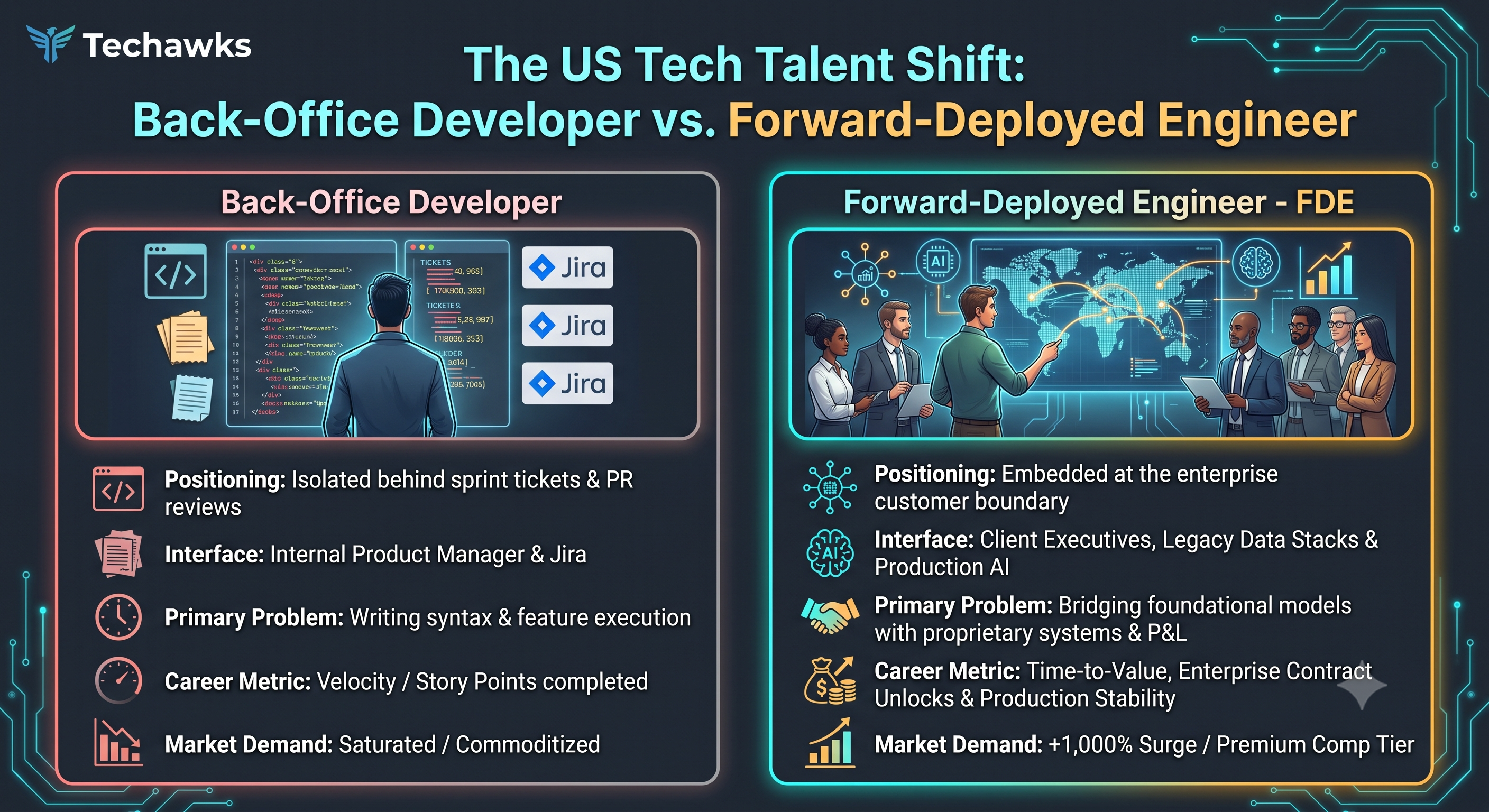
Labor market data shows a sharp divergence in US tech hiring: while traditional software engineering job postings remain subdued compared to pre-pandemic highs, job openings for Forward-Deployed Engineers (FDEs) have surged over 1,000% year-over-year, with median base salaries passing $188,000 and total compensation at top AI firms reaching up to $400,000.
What was once Palantir’s proprietary talent playbook has now been adopted by OpenAI, Anthropic, Google, Microsoft, and Meta.
Why? Because enterprise AI has hit the "Production Chasm."
US enterprises don’t need more foundational LLMs; they need engineers who can bridge the messy reality between advanced models and brittle, proprietary enterprise infrastructure—data silos, legacy ERPs, and compliance boundaries.
The engineers winning the highest compensation bands in the US aren't just writing algorithms; they are acting as technical operators at the customer perimeter.
Here is how to adapt your skill profile for the forward-deployed era:
1. Transition from "Lab Code" to "Production Data Plumbing"
Enterprises rarely fail with AI because the model was inadequate; they fail because data ingestion pipelines broke, latency spiked, or auth contexts leaked.
Modern leverage belongs to engineers who master high-throughput data ingestion, vector index synchronization, and reliable API middleware.
Shift your portfolio from toy demo apps to solving dirty enterprise data problems: schema drift, caching architectures, and rate-limiting fallbacks.
2. Pair Systems Engineering with "Executive Translation"
The traditional wall separating "engineers who code" from "solutions architects who talk to customers" is collapsing.
An FDE operates essentially like an embedded startup CTO: diagnosing a customer’s domain friction on Monday and deploying an end-to-end integration by Thursday.
Build the muscle to pitch architectural trade-offs directly to non-technical executive stakeholders without hand-waving or jargon.
3. Anchor Value to Business Unit P&L, Not Just Velocity
In a competitive US tech job market, story points shipped are no longer defensible career currency. High-leverage engineers frame their output in P&L terms:
Legacy Framing: "Refactored the authentication service to Go."
FDE Framing: "Embedded with enterprise onboarding, cut partner data ingestion time by 65%, and unlocked $2.4M in stalled enterprise contracts."
Career Takeaway: The highest-paid engineers in the US over the next 3–5 years will not be isolated code producers. They will be the hybrid builders who can step out of the terminal, sit across from the customer, and make complex AI systems actually work in messy production environments.
Discussion Question
Have you noticed your engineering role shifting closer to direct client problems and enterprise integrations? What’s the hardest part of moving from pure product development to customer-facing systems engineering?
CTA
Looking to navigate the evolving US tech market and build high-leverage engineering skills?
👉 Join Techawks USA for compensation benchmarks, architectural breakdowns, and strategic career playbooks from top builders across the country.
Labor market data shows a sharp divergence in US tech hiring: while traditional software engineering job postings remain subdued compared to pre-pandemic highs, job openings for Forward-Deployed Engineers (FDEs) have surged over 1,000% year-over-year, with median base salaries passing $188,000 and total compensation at top AI firms reaching up to $400,000.
What was once Palantir’s proprietary talent playbook has now been adopted by OpenAI, Anthropic, Google, Microsoft, and Meta.
Why? Because enterprise AI has hit the "Production Chasm."
US enterprises don’t need more foundational LLMs; they need engineers who can bridge the messy reality between advanced models and brittle, proprietary enterprise infrastructure—data silos, legacy ERPs, and compliance boundaries.
The engineers winning the highest compensation bands in the US aren't just writing algorithms; they are acting as technical operators at the customer perimeter.
Here is how to adapt your skill profile for the forward-deployed era:
1. Transition from "Lab Code" to "Production Data Plumbing"
Enterprises rarely fail with AI because the model was inadequate; they fail because data ingestion pipelines broke, latency spiked, or auth contexts leaked.
Modern leverage belongs to engineers who master high-throughput data ingestion, vector index synchronization, and reliable API middleware.
Shift your portfolio from toy demo apps to solving dirty enterprise data problems: schema drift, caching architectures, and rate-limiting fallbacks.
2. Pair Systems Engineering with "Executive Translation"
The traditional wall separating "engineers who code" from "solutions architects who talk to customers" is collapsing.
An FDE operates essentially like an embedded startup CTO: diagnosing a customer’s domain friction on Monday and deploying an end-to-end integration by Thursday.
Build the muscle to pitch architectural trade-offs directly to non-technical executive stakeholders without hand-waving or jargon.
3. Anchor Value to Business Unit P&L, Not Just Velocity
In a competitive US tech job market, story points shipped are no longer defensible career currency. High-leverage engineers frame their output in P&L terms:
Legacy Framing: "Refactored the authentication service to Go."
FDE Framing: "Embedded with enterprise onboarding, cut partner data ingestion time by 65%, and unlocked $2.4M in stalled enterprise contracts."
Career Takeaway: The highest-paid engineers in the US over the next 3–5 years will not be isolated code producers. They will be the hybrid builders who can step out of the terminal, sit across from the customer, and make complex AI systems actually work in messy production environments.
Discussion Question
Have you noticed your engineering role shifting closer to direct client problems and enterprise integrations? What’s the hardest part of moving from pure product development to customer-facing systems engineering?
CTA
Looking to navigate the evolving US tech market and build high-leverage engineering skills?
👉 Join Techawks USA for compensation benchmarks, architectural breakdowns, and strategic career playbooks from top builders across the country.
The 1,000% Surge of the "Forward-Deployed Engineer": What Silicon Valley’s Hiring Shift Means for You
Labor market data shows a sharp divergence in US tech hiring: while traditional software engineering job postings remain subdued compared to pre-pandemic highs, job openings for Forward-Deployed Engineers (FDEs) have surged over 1,000% year-over-year, with median base salaries passing $188,000 and total compensation at top AI firms reaching up to $400,000.
What was once Palantir’s proprietary talent playbook has now been adopted by OpenAI, Anthropic, Google, Microsoft, and Meta.
Why? Because enterprise AI has hit the "Production Chasm."
US enterprises don’t need more foundational LLMs; they need engineers who can bridge the messy reality between advanced models and brittle, proprietary enterprise infrastructure—data silos, legacy ERPs, and compliance boundaries.
The engineers winning the highest compensation bands in the US aren't just writing algorithms; they are acting as technical operators at the customer perimeter.
Here is how to adapt your skill profile for the forward-deployed era:
1. Transition from "Lab Code" to "Production Data Plumbing"
Enterprises rarely fail with AI because the model was inadequate; they fail because data ingestion pipelines broke, latency spiked, or auth contexts leaked.
Modern leverage belongs to engineers who master high-throughput data ingestion, vector index synchronization, and reliable API middleware.
Shift your portfolio from toy demo apps to solving dirty enterprise data problems: schema drift, caching architectures, and rate-limiting fallbacks.
2. Pair Systems Engineering with "Executive Translation"
The traditional wall separating "engineers who code" from "solutions architects who talk to customers" is collapsing.
An FDE operates essentially like an embedded startup CTO: diagnosing a customer’s domain friction on Monday and deploying an end-to-end integration by Thursday.
Build the muscle to pitch architectural trade-offs directly to non-technical executive stakeholders without hand-waving or jargon.
3. Anchor Value to Business Unit P&L, Not Just Velocity
In a competitive US tech job market, story points shipped are no longer defensible career currency. High-leverage engineers frame their output in P&L terms:
Legacy Framing: "Refactored the authentication service to Go."
FDE Framing: "Embedded with enterprise onboarding, cut partner data ingestion time by 65%, and unlocked $2.4M in stalled enterprise contracts."
Career Takeaway: The highest-paid engineers in the US over the next 3–5 years will not be isolated code producers. They will be the hybrid builders who can step out of the terminal, sit across from the customer, and make complex AI systems actually work in messy production environments.
Discussion Question
Have you noticed your engineering role shifting closer to direct client problems and enterprise integrations? What’s the hardest part of moving from pure product development to customer-facing systems engineering?
CTA
Looking to navigate the evolving US tech market and build high-leverage engineering skills?
👉 Join Techawks USA for compensation benchmarks, architectural breakdowns, and strategic career playbooks from top builders across the country.

 English
 Arabic
 French
 Spanish
 Portuguese
 Turkish
 Dutch
Dutch
 Italiano
 Russian
 Romaian
 Portuguese (Brazil)
 Greek
Greek