


The 24-Hour Mandate: Why UK Engineers Must Master "Compliance-as-Architecture"
As the Cyber Security and Resilience (CSR) Bill advances toward enactment, the UK tech ecosystem is experiencing its biggest regulatory overhaul since GDPR.
The mandate is straightforward and uncompromising:
Expanded scope covering data centers, managed service providers (MSPs), cloud platforms, and critical supply chain dependencies.
Mandatory initial incident reporting within 24 hours (and full forensic breakdowns within 72 hours).
Fines scaling up to £17 million or 4% of global turnover.
This changes software engineering in London, Manchester, Cambridge, and Edinburgh overnight.
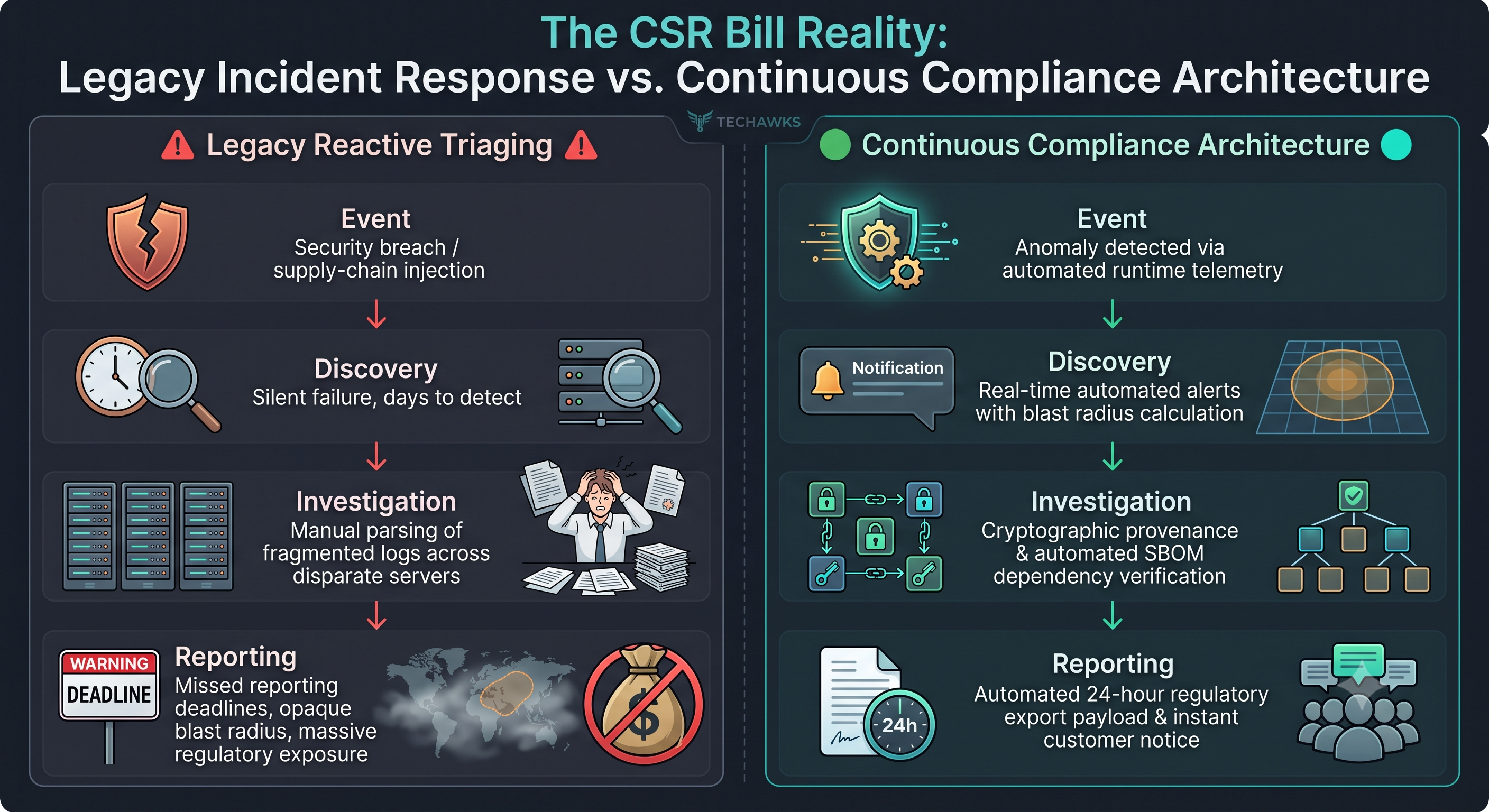
Historically, UK engineering teams treated compliance as an audit task handled at the end of the quarter by security consultants. But when a production incident carries statutory 24-hour reporting obligations and multi-million-pound liabilities across your digital supply chain, compliance is no longer an audit checklist—it is runtime system architecture.
The engineers capturing outsized compensation and senior staff titles across the UK are those who understand how to design for forensic provenance and automated resilience:
1. Architect for 24-Hour Forensic Observability
If a breach or critical anomaly occurs at 3 AM on Saturday, can your team trace the root vulnerability, blast radius, and impacted customer records before the 24-hour statutory clock expires?
Moving beyond basic APM metrics (CPU/memory) into immutable audit telemetry.
Implementing structured provenance logs and cryptographically verifiable event trails that can be exported for regulators without requiring days of manual log digging.
2. Codify Software Supply Chain Security (SSDF & SBOM)
Because the CSR Bill specifically brings critical software vendors and digital supply chains into legal scope, blind npm install or unpinned container dependencies are now corporate liabilities.
Enforce automated Software Bill of Materials (SBOM) generation at CI/CD runtime.
Implement provenance attestation (e.g., Sigstore/Cosign) so upstream open-source compromises are caught and quarantined before reaching UK deployment clusters.
3. Shift from "Feature Speed" to "Defensible Systems Engineering"
In the UK venture and scale-up market, tech diligence has fundamentally changed. Private equity and enterprise buyers are applying a "compliance premium"—prioritizing startups and scale-ups with verifiable governance over fragile code shipped quickly.
The most defensible UK engineers aren't just shipping PRs faster; they are designing fault-isolated micro-architectures that prove third-party failures can't take down the entire core platform.
Career Takeaway: In the UK tech ecosystem, regulatory compliance and technical architecture have officially merged. The engineers who treat resilience, supply chain transparency, and automated reporting as first-class architectural constraints will hold the steering wheel in enterprise UK tech.
Discussion Question
Under a strict 24-hour incident notification window, what is currently the biggest gap in your infrastructure: supply-chain dependency mapping, real-time audit logging, or cross-functional triage workflows?
CTA
Looking to master systems-level resilience and advance your engineering career across the UK tech landscape?
👉 Join Techawks UK for deep-dive architecture breakdowns, regulatory engineering frameworks, and insights from leading British tech leaders.
As the Cyber Security and Resilience (CSR) Bill advances toward enactment, the UK tech ecosystem is experiencing its biggest regulatory overhaul since GDPR.
The mandate is straightforward and uncompromising:
Expanded scope covering data centers, managed service providers (MSPs), cloud platforms, and critical supply chain dependencies.
Mandatory initial incident reporting within 24 hours (and full forensic breakdowns within 72 hours).
Fines scaling up to £17 million or 4% of global turnover.
This changes software engineering in London, Manchester, Cambridge, and Edinburgh overnight.
Historically, UK engineering teams treated compliance as an audit task handled at the end of the quarter by security consultants. But when a production incident carries statutory 24-hour reporting obligations and multi-million-pound liabilities across your digital supply chain, compliance is no longer an audit checklist—it is runtime system architecture.
The engineers capturing outsized compensation and senior staff titles across the UK are those who understand how to design for forensic provenance and automated resilience:
1. Architect for 24-Hour Forensic Observability
If a breach or critical anomaly occurs at 3 AM on Saturday, can your team trace the root vulnerability, blast radius, and impacted customer records before the 24-hour statutory clock expires?
Moving beyond basic APM metrics (CPU/memory) into immutable audit telemetry.
Implementing structured provenance logs and cryptographically verifiable event trails that can be exported for regulators without requiring days of manual log digging.
2. Codify Software Supply Chain Security (SSDF & SBOM)
Because the CSR Bill specifically brings critical software vendors and digital supply chains into legal scope, blind npm install or unpinned container dependencies are now corporate liabilities.
Enforce automated Software Bill of Materials (SBOM) generation at CI/CD runtime.
Implement provenance attestation (e.g., Sigstore/Cosign) so upstream open-source compromises are caught and quarantined before reaching UK deployment clusters.
3. Shift from "Feature Speed" to "Defensible Systems Engineering"
In the UK venture and scale-up market, tech diligence has fundamentally changed. Private equity and enterprise buyers are applying a "compliance premium"—prioritizing startups and scale-ups with verifiable governance over fragile code shipped quickly.
The most defensible UK engineers aren't just shipping PRs faster; they are designing fault-isolated micro-architectures that prove third-party failures can't take down the entire core platform.
Career Takeaway: In the UK tech ecosystem, regulatory compliance and technical architecture have officially merged. The engineers who treat resilience, supply chain transparency, and automated reporting as first-class architectural constraints will hold the steering wheel in enterprise UK tech.
Discussion Question
Under a strict 24-hour incident notification window, what is currently the biggest gap in your infrastructure: supply-chain dependency mapping, real-time audit logging, or cross-functional triage workflows?
CTA
Looking to master systems-level resilience and advance your engineering career across the UK tech landscape?
👉 Join Techawks UK for deep-dive architecture breakdowns, regulatory engineering frameworks, and insights from leading British tech leaders.
The 24-Hour Mandate: Why UK Engineers Must Master "Compliance-as-Architecture"
As the Cyber Security and Resilience (CSR) Bill advances toward enactment, the UK tech ecosystem is experiencing its biggest regulatory overhaul since GDPR.
The mandate is straightforward and uncompromising:
Expanded scope covering data centers, managed service providers (MSPs), cloud platforms, and critical supply chain dependencies.
Mandatory initial incident reporting within 24 hours (and full forensic breakdowns within 72 hours).
Fines scaling up to £17 million or 4% of global turnover.
This changes software engineering in London, Manchester, Cambridge, and Edinburgh overnight.
Historically, UK engineering teams treated compliance as an audit task handled at the end of the quarter by security consultants. But when a production incident carries statutory 24-hour reporting obligations and multi-million-pound liabilities across your digital supply chain, compliance is no longer an audit checklist—it is runtime system architecture.
The engineers capturing outsized compensation and senior staff titles across the UK are those who understand how to design for forensic provenance and automated resilience:
1. Architect for 24-Hour Forensic Observability
If a breach or critical anomaly occurs at 3 AM on Saturday, can your team trace the root vulnerability, blast radius, and impacted customer records before the 24-hour statutory clock expires?
Moving beyond basic APM metrics (CPU/memory) into immutable audit telemetry.
Implementing structured provenance logs and cryptographically verifiable event trails that can be exported for regulators without requiring days of manual log digging.
2. Codify Software Supply Chain Security (SSDF & SBOM)
Because the CSR Bill specifically brings critical software vendors and digital supply chains into legal scope, blind npm install or unpinned container dependencies are now corporate liabilities.
Enforce automated Software Bill of Materials (SBOM) generation at CI/CD runtime.
Implement provenance attestation (e.g., Sigstore/Cosign) so upstream open-source compromises are caught and quarantined before reaching UK deployment clusters.
3. Shift from "Feature Speed" to "Defensible Systems Engineering"
In the UK venture and scale-up market, tech diligence has fundamentally changed. Private equity and enterprise buyers are applying a "compliance premium"—prioritizing startups and scale-ups with verifiable governance over fragile code shipped quickly.
The most defensible UK engineers aren't just shipping PRs faster; they are designing fault-isolated micro-architectures that prove third-party failures can't take down the entire core platform.
Career Takeaway: In the UK tech ecosystem, regulatory compliance and technical architecture have officially merged. The engineers who treat resilience, supply chain transparency, and automated reporting as first-class architectural constraints will hold the steering wheel in enterprise UK tech.
Discussion Question
Under a strict 24-hour incident notification window, what is currently the biggest gap in your infrastructure: supply-chain dependency mapping, real-time audit logging, or cross-functional triage workflows?
CTA
Looking to master systems-level resilience and advance your engineering career across the UK tech landscape?
👉 Join Techawks UK for deep-dive architecture breakdowns, regulatory engineering frameworks, and insights from leading British tech leaders.

 English
 French
 Spanish
 Portuguese
 Deutsch
 Turkish
 Dutch
Dutch
 Italiano
 Russian
 Romaian
 Portuguese (Brazil)
 Greek
Greek