


Canada’s $2B Sovereign Compute Bet: Why Canadian Engineers Must Pivot from "API Wrappers" to Compute-Aware Systems
Canada has launched its $2 Billion Canadian Sovereign AI Compute Strategy—allocating dedicated capital toward public supercomputing infrastructure, domestic commercial data center expansion, and an AI Compute Access Fund. Alongside this, federal guidelines under the "Build-Partner-Buy" framework are incentivizing domestic enterprise adoption, aiming to lift business AI adoption across Canadian industry toward 60%.
For the Canadian tech ecosystem, this marks an inflection point.
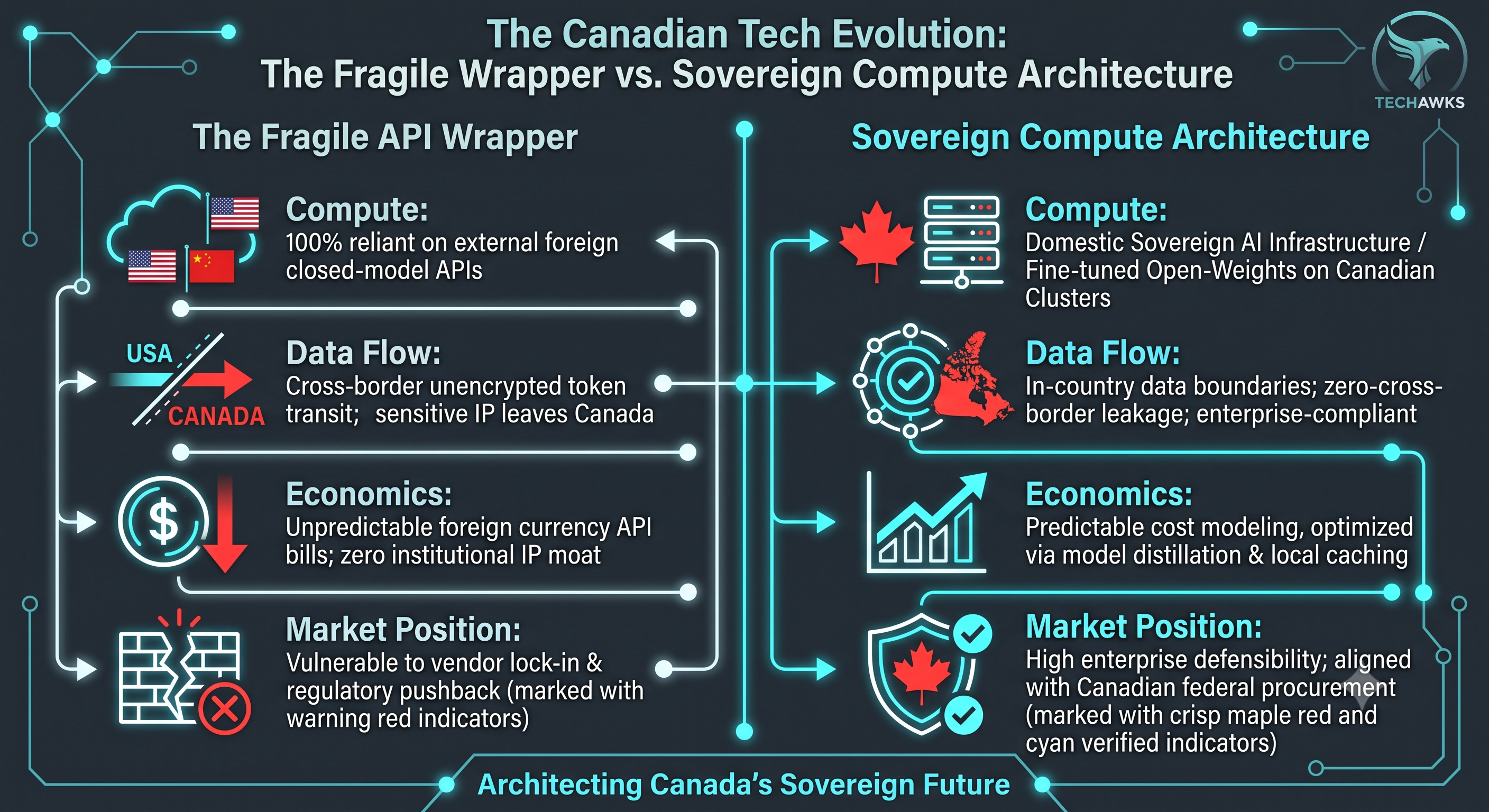
For the past three years, many Canadian startups and scale-ups relied on thin wrappers built on closed US foundation models. But between strict provincial and federal privacy legislation (PIPEDA modernization and public-sector procurement standards) and the skyrocketing cost of foreign cloud inference, Canadian enterprises—especially in banking, health networks, telecom, and natural resources—are shifting their requirements.
They aren't looking for developers who simply import external SDKs. They need engineers who understand compute efficiency, sovereign data pipelines, and on-soil infrastructure.
Here is how Canadian tech professionals can position themselves to lead this transformation:
1. Transition to "Compute-Aware" Engineering
When compute is subsidized domestically or constrained by private clusters, engineering leverage shifts to resource optimization.
Move beyond prompt engineering and master quantization (GGUF, AWQ), model distillation, and context caching.
Learn how to run and fine-tune performant open-weight models locally on Canadian infrastructure, cutting external token dependency and latency.
2. Master In-Country Data Provenance & Compliance
Canada’s regulated sectors (finance, public health, energy) will not send proprietary IP or sensitive citizen data across borders.
Design hybrid architectures that decouple orchestration from data storage, ensuring sensitive data remains on Canadian soil while maintaining high-throughput inference.
Understand the compliance parameters of federal data residency and modern privacy standards, turning regulatory constraints into an architectural moat.
3. Anchor Your Technical Work to SR&ED and Public-Private Value
In Canada's tech ecosystem, engineering leaders who understand how R&D translates to defensible innovation hold tremendous sway.
High-leverage senior engineers don't just write functional code; they architect systems that push technical boundaries—solving non-trivial algorithmic bottlenecks, memory optimization, and distributed batching.
Articulating technical uncertainty and systemic innovation makes your engineering leadership invaluable to Canadian startups navigating growth capital and R&D incentives.
Career Takeaway: Canada is determined to be more than just an exporter of top AI researchers. The builders commanding the highest compensation and long-term leverage across the country will be those who can deploy efficient, compliant, and sovereign systems right here on Canadian soil.
Discussion Question
For engineers, architects, and tech leaders in Toronto, Montreal, Vancouver, Calgary, and Ottawa: What is your team’s biggest obstacle to running AI models on domestic/sovereign compute—raw GPU availability, cost-per-token, or lack of local infrastructure tooling?
CTA
Ready to build resilient, sovereign engineering skills and advance your career across the Canadian ecosystem?
👉 Join Techawks Canada for architectural breakdowns, compensation benchmarks, and deep-dive technical discussions with leading Canadian builders.
Canada has launched its $2 Billion Canadian Sovereign AI Compute Strategy—allocating dedicated capital toward public supercomputing infrastructure, domestic commercial data center expansion, and an AI Compute Access Fund. Alongside this, federal guidelines under the "Build-Partner-Buy" framework are incentivizing domestic enterprise adoption, aiming to lift business AI adoption across Canadian industry toward 60%.
For the Canadian tech ecosystem, this marks an inflection point.
For the past three years, many Canadian startups and scale-ups relied on thin wrappers built on closed US foundation models. But between strict provincial and federal privacy legislation (PIPEDA modernization and public-sector procurement standards) and the skyrocketing cost of foreign cloud inference, Canadian enterprises—especially in banking, health networks, telecom, and natural resources—are shifting their requirements.
They aren't looking for developers who simply import external SDKs. They need engineers who understand compute efficiency, sovereign data pipelines, and on-soil infrastructure.
Here is how Canadian tech professionals can position themselves to lead this transformation:
1. Transition to "Compute-Aware" Engineering
When compute is subsidized domestically or constrained by private clusters, engineering leverage shifts to resource optimization.
Move beyond prompt engineering and master quantization (GGUF, AWQ), model distillation, and context caching.
Learn how to run and fine-tune performant open-weight models locally on Canadian infrastructure, cutting external token dependency and latency.
2. Master In-Country Data Provenance & Compliance
Canada’s regulated sectors (finance, public health, energy) will not send proprietary IP or sensitive citizen data across borders.
Design hybrid architectures that decouple orchestration from data storage, ensuring sensitive data remains on Canadian soil while maintaining high-throughput inference.
Understand the compliance parameters of federal data residency and modern privacy standards, turning regulatory constraints into an architectural moat.
3. Anchor Your Technical Work to SR&ED and Public-Private Value
In Canada's tech ecosystem, engineering leaders who understand how R&D translates to defensible innovation hold tremendous sway.
High-leverage senior engineers don't just write functional code; they architect systems that push technical boundaries—solving non-trivial algorithmic bottlenecks, memory optimization, and distributed batching.
Articulating technical uncertainty and systemic innovation makes your engineering leadership invaluable to Canadian startups navigating growth capital and R&D incentives.
Career Takeaway: Canada is determined to be more than just an exporter of top AI researchers. The builders commanding the highest compensation and long-term leverage across the country will be those who can deploy efficient, compliant, and sovereign systems right here on Canadian soil.
Discussion Question
For engineers, architects, and tech leaders in Toronto, Montreal, Vancouver, Calgary, and Ottawa: What is your team’s biggest obstacle to running AI models on domestic/sovereign compute—raw GPU availability, cost-per-token, or lack of local infrastructure tooling?
CTA
Ready to build resilient, sovereign engineering skills and advance your career across the Canadian ecosystem?
👉 Join Techawks Canada for architectural breakdowns, compensation benchmarks, and deep-dive technical discussions with leading Canadian builders.
Canada’s $2B Sovereign Compute Bet: Why Canadian Engineers Must Pivot from "API Wrappers" to Compute-Aware Systems
Canada has launched its $2 Billion Canadian Sovereign AI Compute Strategy—allocating dedicated capital toward public supercomputing infrastructure, domestic commercial data center expansion, and an AI Compute Access Fund. Alongside this, federal guidelines under the "Build-Partner-Buy" framework are incentivizing domestic enterprise adoption, aiming to lift business AI adoption across Canadian industry toward 60%.
For the Canadian tech ecosystem, this marks an inflection point.
For the past three years, many Canadian startups and scale-ups relied on thin wrappers built on closed US foundation models. But between strict provincial and federal privacy legislation (PIPEDA modernization and public-sector procurement standards) and the skyrocketing cost of foreign cloud inference, Canadian enterprises—especially in banking, health networks, telecom, and natural resources—are shifting their requirements.
They aren't looking for developers who simply import external SDKs. They need engineers who understand compute efficiency, sovereign data pipelines, and on-soil infrastructure.
Here is how Canadian tech professionals can position themselves to lead this transformation:
1. Transition to "Compute-Aware" Engineering
When compute is subsidized domestically or constrained by private clusters, engineering leverage shifts to resource optimization.
Move beyond prompt engineering and master quantization (GGUF, AWQ), model distillation, and context caching.
Learn how to run and fine-tune performant open-weight models locally on Canadian infrastructure, cutting external token dependency and latency.
2. Master In-Country Data Provenance & Compliance
Canada’s regulated sectors (finance, public health, energy) will not send proprietary IP or sensitive citizen data across borders.
Design hybrid architectures that decouple orchestration from data storage, ensuring sensitive data remains on Canadian soil while maintaining high-throughput inference.
Understand the compliance parameters of federal data residency and modern privacy standards, turning regulatory constraints into an architectural moat.
3. Anchor Your Technical Work to SR&ED and Public-Private Value
In Canada's tech ecosystem, engineering leaders who understand how R&D translates to defensible innovation hold tremendous sway.
High-leverage senior engineers don't just write functional code; they architect systems that push technical boundaries—solving non-trivial algorithmic bottlenecks, memory optimization, and distributed batching.
Articulating technical uncertainty and systemic innovation makes your engineering leadership invaluable to Canadian startups navigating growth capital and R&D incentives.
Career Takeaway: Canada is determined to be more than just an exporter of top AI researchers. The builders commanding the highest compensation and long-term leverage across the country will be those who can deploy efficient, compliant, and sovereign systems right here on Canadian soil.
Discussion Question
For engineers, architects, and tech leaders in Toronto, Montreal, Vancouver, Calgary, and Ottawa: What is your team’s biggest obstacle to running AI models on domestic/sovereign compute—raw GPU availability, cost-per-token, or lack of local infrastructure tooling?
CTA
Ready to build resilient, sovereign engineering skills and advance your career across the Canadian ecosystem?
👉 Join Techawks Canada for architectural breakdowns, compensation benchmarks, and deep-dive technical discussions with leading Canadian builders.

 English
 Arabic
 French
 Portuguese
 Deutsch
 Turkish
 Dutch
Dutch
 Italiano
 Russian
 Romaian
 Portuguese (Brazil)
 Greek
Greek