


The High-Cost Cloud Trap: What’s Bleeding Indian Tech Startups the Most?
When scaling from 10k to 1M users, infrastructure defaults will quietly crush your margins. Teams spin up managed services for speed, leave staging clusters active over weekends, and rarely audit their data egress routes.
Before diving into optimization frameworks, let’s take the pulse of the community:
Poll Question:
What is currently eating up the biggest chunk of your company’s monthly cloud bill?
🔘 Zombie/Overprovisioned Compute (Idle EC2/GCE, 24/7 staging environments)
🔘 Unmonitored Data Egress (Cross-AZ traffic, multi-region API transfers)
🔘 Managed Service Overheads (PaaS convenience markups vs. self-hosting)
🔘 Cold Storage Neglect (Unindexed S3/Cloud Storage buckets without lifecycle rules)
Practical Blueprint to Reclaim Your Budget This Week:
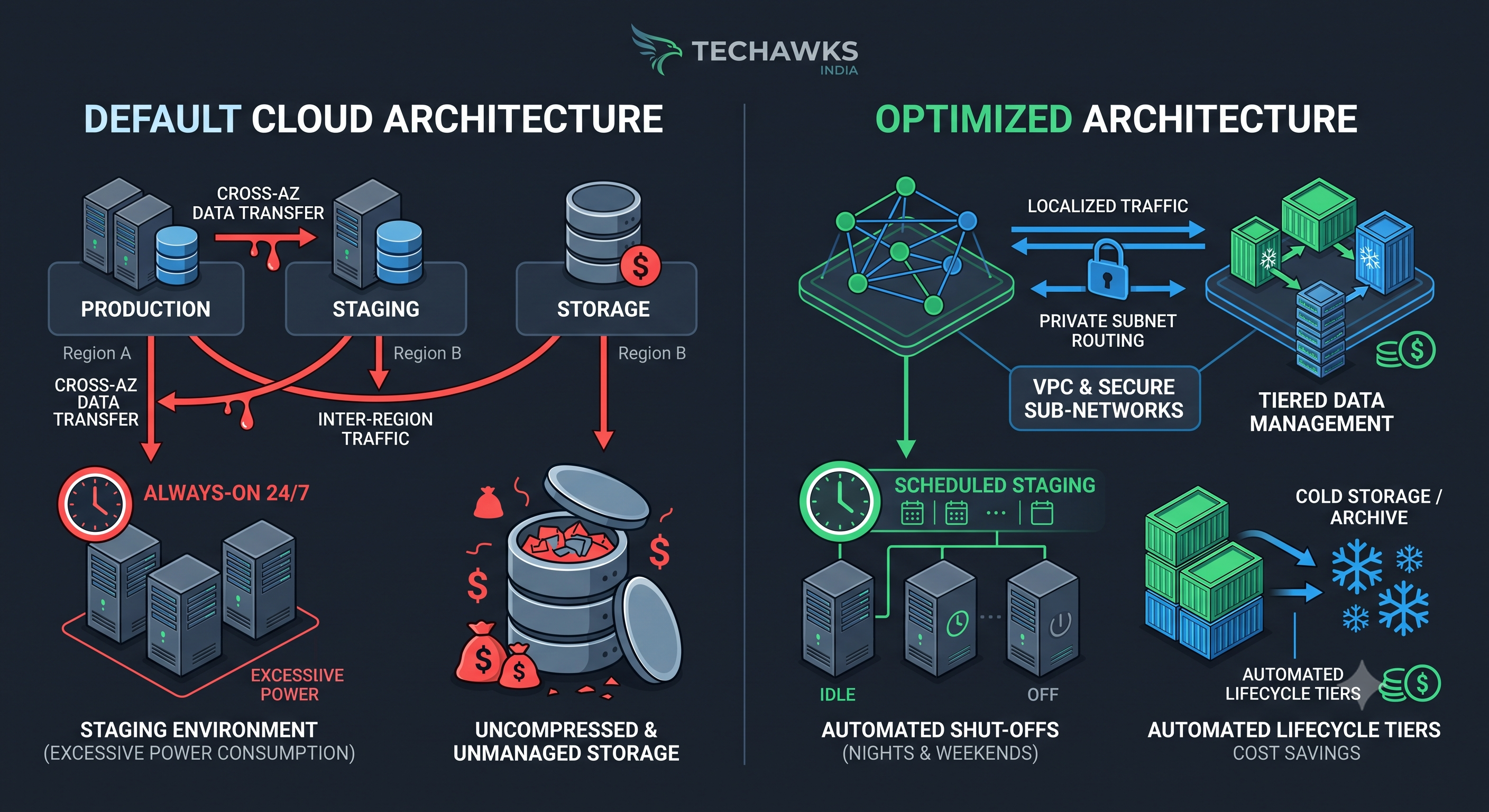
Audit Idle Non-Production Environments: Production needs high availability; staging does not. Set up automated scripts (via cron or Lambda/Cloud Functions) to shut down non-prod instances on weekday evenings and weekends. This alone cuts non-prod compute spend by roughly 60%.
Map Your Egress Paths: Transferring data between regions or out to the internet is where hidden fees compound. Route internal microservice communication within the same Availability Zone where latency permits, and place CDN endpoints in front of static media assets to minimize origin egress.
Automate Storage Lifecycle Policies: Log files, debug dumps, and old user uploads rarely need high-availability tiers after 30 days. Define bucket lifecycle rules to shift data from standard tiers to archive classes (such as Glacier or Coldline) automatically, slashing storage rates by up to 80%.
Key Takeaways
Convenience costs equity: default architecture settings prioritize quick setup over long-term cost efficiency.
Automated scheduling of staging compute yields immediate 50%+ savings on non-prod machines.
Moving archival logs to cold tiers and optimizing cross-zone traffic mitigates silent monthly bill spikes.
CTA (Join Techawks India)
Vote in the poll above and drop your favorite cost-cutting CLI tool or AWS/GCP optimization trick in the comments.
Want more real-world architecture breakdowns built for Indian engineering teams? Join Techawks India to connect with engineers, dev leads, and founders building scalable, cost-efficient tech.
When scaling from 10k to 1M users, infrastructure defaults will quietly crush your margins. Teams spin up managed services for speed, leave staging clusters active over weekends, and rarely audit their data egress routes.
Before diving into optimization frameworks, let’s take the pulse of the community:
Poll Question:
What is currently eating up the biggest chunk of your company’s monthly cloud bill?
🔘 Zombie/Overprovisioned Compute (Idle EC2/GCE, 24/7 staging environments)
🔘 Unmonitored Data Egress (Cross-AZ traffic, multi-region API transfers)
🔘 Managed Service Overheads (PaaS convenience markups vs. self-hosting)
🔘 Cold Storage Neglect (Unindexed S3/Cloud Storage buckets without lifecycle rules)
Practical Blueprint to Reclaim Your Budget This Week:
Audit Idle Non-Production Environments: Production needs high availability; staging does not. Set up automated scripts (via cron or Lambda/Cloud Functions) to shut down non-prod instances on weekday evenings and weekends. This alone cuts non-prod compute spend by roughly 60%.
Map Your Egress Paths: Transferring data between regions or out to the internet is where hidden fees compound. Route internal microservice communication within the same Availability Zone where latency permits, and place CDN endpoints in front of static media assets to minimize origin egress.
Automate Storage Lifecycle Policies: Log files, debug dumps, and old user uploads rarely need high-availability tiers after 30 days. Define bucket lifecycle rules to shift data from standard tiers to archive classes (such as Glacier or Coldline) automatically, slashing storage rates by up to 80%.
Key Takeaways
Convenience costs equity: default architecture settings prioritize quick setup over long-term cost efficiency.
Automated scheduling of staging compute yields immediate 50%+ savings on non-prod machines.
Moving archival logs to cold tiers and optimizing cross-zone traffic mitigates silent monthly bill spikes.
CTA (Join Techawks India)
Vote in the poll above and drop your favorite cost-cutting CLI tool or AWS/GCP optimization trick in the comments.
Want more real-world architecture breakdowns built for Indian engineering teams? Join Techawks India to connect with engineers, dev leads, and founders building scalable, cost-efficient tech.
The High-Cost Cloud Trap: What’s Bleeding Indian Tech Startups the Most?
When scaling from 10k to 1M users, infrastructure defaults will quietly crush your margins. Teams spin up managed services for speed, leave staging clusters active over weekends, and rarely audit their data egress routes.
Before diving into optimization frameworks, let’s take the pulse of the community:
Poll Question:
What is currently eating up the biggest chunk of your company’s monthly cloud bill?
🔘 Zombie/Overprovisioned Compute (Idle EC2/GCE, 24/7 staging environments)
🔘 Unmonitored Data Egress (Cross-AZ traffic, multi-region API transfers)
🔘 Managed Service Overheads (PaaS convenience markups vs. self-hosting)
🔘 Cold Storage Neglect (Unindexed S3/Cloud Storage buckets without lifecycle rules)
Practical Blueprint to Reclaim Your Budget This Week:
Audit Idle Non-Production Environments: Production needs high availability; staging does not. Set up automated scripts (via cron or Lambda/Cloud Functions) to shut down non-prod instances on weekday evenings and weekends. This alone cuts non-prod compute spend by roughly 60%.
Map Your Egress Paths: Transferring data between regions or out to the internet is where hidden fees compound. Route internal microservice communication within the same Availability Zone where latency permits, and place CDN endpoints in front of static media assets to minimize origin egress.
Automate Storage Lifecycle Policies: Log files, debug dumps, and old user uploads rarely need high-availability tiers after 30 days. Define bucket lifecycle rules to shift data from standard tiers to archive classes (such as Glacier or Coldline) automatically, slashing storage rates by up to 80%.
Key Takeaways
Convenience costs equity: default architecture settings prioritize quick setup over long-term cost efficiency.
Automated scheduling of staging compute yields immediate 50%+ savings on non-prod machines.
Moving archival logs to cold tiers and optimizing cross-zone traffic mitigates silent monthly bill spikes.
CTA (Join Techawks India)
Vote in the poll above and drop your favorite cost-cutting CLI tool or AWS/GCP optimization trick in the comments.
Want more real-world architecture breakdowns built for Indian engineering teams? Join Techawks India to connect with engineers, dev leads, and founders building scalable, cost-efficient tech.

 English
 Arabic
 French
 Spanish
 Portuguese
 Deutsch
 Turkish
 Dutch
Dutch
 Italiano
 Russian
 Romaian
 Greek
Greek