


The 7-Year Grid Queue: Why US Cloud Architects Are Designing for Power, Not Just Latency
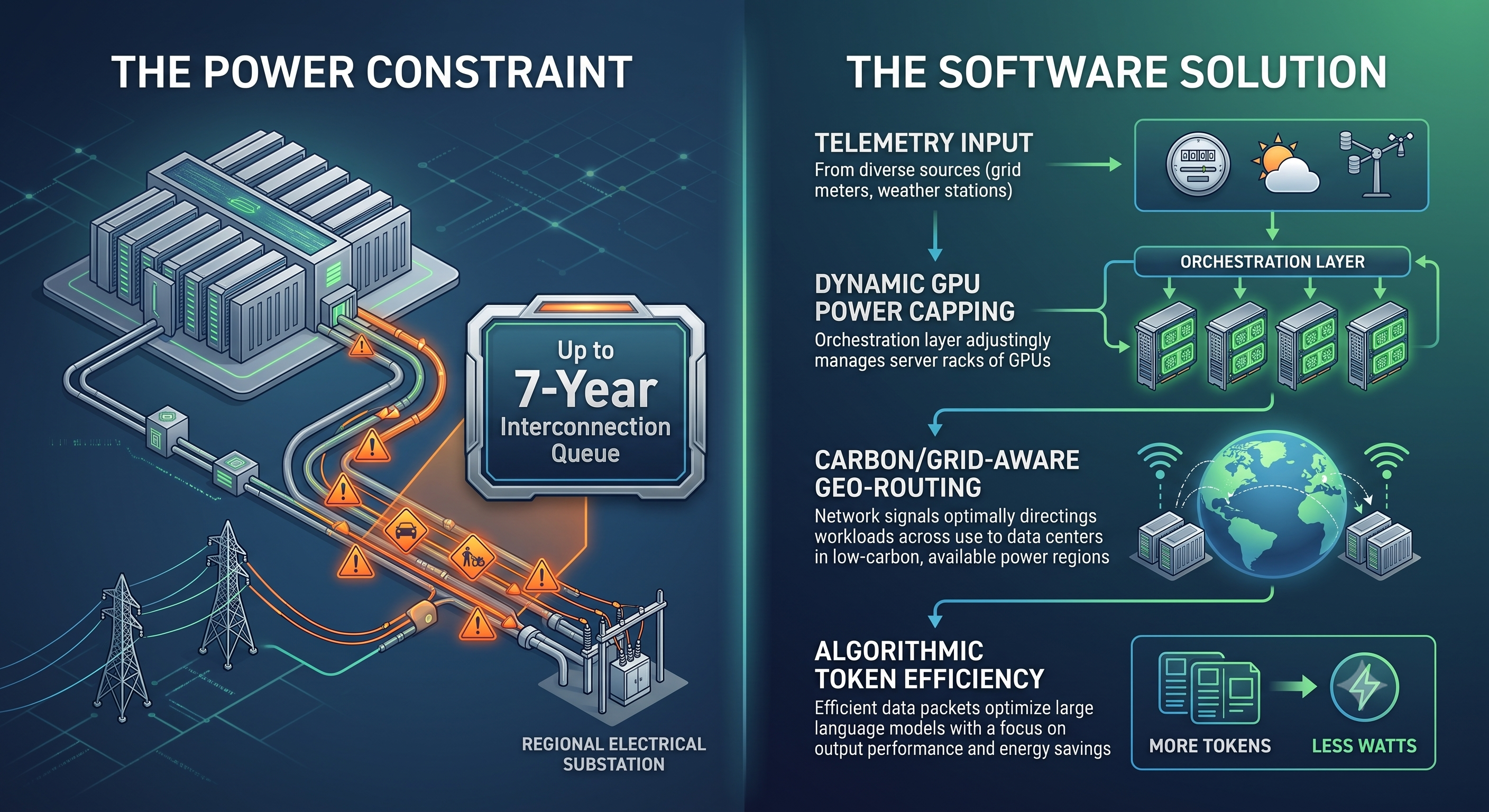
Across the primary US hyperscale corridors—from Northern Virginia’s PJM territory to Texas (ERCOT) and the Midwest—wait times to hook new high-density data centers into regional power grids have stretched up to 7 years.
US power demand from AI and high-density compute is projected to surge over 160% by 2030. Because regional utilities cannot construct high-voltage transmission lines as fast as clusters scale, hyperscalers are racing to sign behind-the-meter nuclear and microreactor power agreements.
For US software architects and platform engineers, this bottleneck changes distributed systems design. When megawatts are capped at the rack and campus level, optimization shifts from purely runtime efficiency to Power-Aware Workload Orchestration.
Here is what modern systems engineering looks like under physical energy constraints:
1. Dynamic TDP Throttling Over Naive Overprovisioning
Running high-end accelerator nodes at maximum thermal design power (TDP) yields diminishing throughput per watt.
Engineering pattern: Modern orchestrators programmatically adjust GPU power caps (e.g., dropping from 700W to 450–500W during peak tariff hours or thermal spikes). You sacrifice 5% to 8% in peak batch throughput while recovering up to 30% in power headroom, allowing higher cluster density within fixed breaker limits.
2. Follow-the-Power Geo-Distributed Scheduling
Instead of centralizing model fine-tuning and batch inference in a single region, Kubernetes schedulers are adopting time-of-day and grid-stress telemetry.
Engineering pattern: Asynchronous training checkpoints and heavy vector embedding jobs dynamically migrate to nodes in regions experiencing surplus generation or high renewable curtailment, decoupling infrastructure scaling from local utility bottlenecks.
3. Algorithmic Density (Speculative Decoding & Layer Pruning)
Every unnecessary floating-point operation is wasted energy.Engineering pattern:
Replacing brute-force dense inference with speculative decoding architectures and dynamic quantization (FP8/INT4) slashes memory bus activations—the primary driver of watt-per-token consumption.
Physical infrastructure constraints are forcing software to carry the burden of efficiency. The architects winning in this cycle aren't just measuring $P99$ latency; they are measuring tokens per kilowatt-hour.
Discussion Question (Poll)
As power availability dictates US cloud deployment strategies, what is your team's top priority for optimizing heavy compute workloads?
A) Dynamic GPU power capping & cluster TDP tuning
B) Geo-distributed batch migration (routing to green/available grid capacity)
C) Model-level optimizations (Quantization, Speculative Decoding)
D) Cloud repatriation / On-premise colocation with dedicated power
(Cast your vote above and drop your infrastructure strategies in the comments.)
CTA
Join Techawks USA — the technical forum where systems architects, platform leads, and cloud engineers dissect the infrastructure realities shaping modern enterprise architecture. Follow for zero-fluff, engineering-grade breakdowns.
Across the primary US hyperscale corridors—from Northern Virginia’s PJM territory to Texas (ERCOT) and the Midwest—wait times to hook new high-density data centers into regional power grids have stretched up to 7 years.
US power demand from AI and high-density compute is projected to surge over 160% by 2030. Because regional utilities cannot construct high-voltage transmission lines as fast as clusters scale, hyperscalers are racing to sign behind-the-meter nuclear and microreactor power agreements.
For US software architects and platform engineers, this bottleneck changes distributed systems design. When megawatts are capped at the rack and campus level, optimization shifts from purely runtime efficiency to Power-Aware Workload Orchestration.
Here is what modern systems engineering looks like under physical energy constraints:
1. Dynamic TDP Throttling Over Naive Overprovisioning
Running high-end accelerator nodes at maximum thermal design power (TDP) yields diminishing throughput per watt.
Engineering pattern: Modern orchestrators programmatically adjust GPU power caps (e.g., dropping from 700W to 450–500W during peak tariff hours or thermal spikes). You sacrifice 5% to 8% in peak batch throughput while recovering up to 30% in power headroom, allowing higher cluster density within fixed breaker limits.
2. Follow-the-Power Geo-Distributed Scheduling
Instead of centralizing model fine-tuning and batch inference in a single region, Kubernetes schedulers are adopting time-of-day and grid-stress telemetry.
Engineering pattern: Asynchronous training checkpoints and heavy vector embedding jobs dynamically migrate to nodes in regions experiencing surplus generation or high renewable curtailment, decoupling infrastructure scaling from local utility bottlenecks.
3. Algorithmic Density (Speculative Decoding & Layer Pruning)
Every unnecessary floating-point operation is wasted energy.Engineering pattern:
Replacing brute-force dense inference with speculative decoding architectures and dynamic quantization (FP8/INT4) slashes memory bus activations—the primary driver of watt-per-token consumption.
Physical infrastructure constraints are forcing software to carry the burden of efficiency. The architects winning in this cycle aren't just measuring $P99$ latency; they are measuring tokens per kilowatt-hour.
Discussion Question (Poll)
As power availability dictates US cloud deployment strategies, what is your team's top priority for optimizing heavy compute workloads?
A) Dynamic GPU power capping & cluster TDP tuning
B) Geo-distributed batch migration (routing to green/available grid capacity)
C) Model-level optimizations (Quantization, Speculative Decoding)
D) Cloud repatriation / On-premise colocation with dedicated power
(Cast your vote above and drop your infrastructure strategies in the comments.)
CTA
Join Techawks USA — the technical forum where systems architects, platform leads, and cloud engineers dissect the infrastructure realities shaping modern enterprise architecture. Follow for zero-fluff, engineering-grade breakdowns.
The 7-Year Grid Queue: Why US Cloud Architects Are Designing for Power, Not Just Latency
Across the primary US hyperscale corridors—from Northern Virginia’s PJM territory to Texas (ERCOT) and the Midwest—wait times to hook new high-density data centers into regional power grids have stretched up to 7 years.
US power demand from AI and high-density compute is projected to surge over 160% by 2030. Because regional utilities cannot construct high-voltage transmission lines as fast as clusters scale, hyperscalers are racing to sign behind-the-meter nuclear and microreactor power agreements.
For US software architects and platform engineers, this bottleneck changes distributed systems design. When megawatts are capped at the rack and campus level, optimization shifts from purely runtime efficiency to Power-Aware Workload Orchestration.
Here is what modern systems engineering looks like under physical energy constraints:
1. Dynamic TDP Throttling Over Naive Overprovisioning
Running high-end accelerator nodes at maximum thermal design power (TDP) yields diminishing throughput per watt.
Engineering pattern: Modern orchestrators programmatically adjust GPU power caps (e.g., dropping from 700W to 450–500W during peak tariff hours or thermal spikes). You sacrifice 5% to 8% in peak batch throughput while recovering up to 30% in power headroom, allowing higher cluster density within fixed breaker limits.
2. Follow-the-Power Geo-Distributed Scheduling
Instead of centralizing model fine-tuning and batch inference in a single region, Kubernetes schedulers are adopting time-of-day and grid-stress telemetry.
Engineering pattern: Asynchronous training checkpoints and heavy vector embedding jobs dynamically migrate to nodes in regions experiencing surplus generation or high renewable curtailment, decoupling infrastructure scaling from local utility bottlenecks.
3. Algorithmic Density (Speculative Decoding & Layer Pruning)
Every unnecessary floating-point operation is wasted energy.Engineering pattern:
Replacing brute-force dense inference with speculative decoding architectures and dynamic quantization (FP8/INT4) slashes memory bus activations—the primary driver of watt-per-token consumption.
Physical infrastructure constraints are forcing software to carry the burden of efficiency. The architects winning in this cycle aren't just measuring $P99$ latency; they are measuring tokens per kilowatt-hour.
Discussion Question (Poll)
As power availability dictates US cloud deployment strategies, what is your team's top priority for optimizing heavy compute workloads?
A) Dynamic GPU power capping & cluster TDP tuning
B) Geo-distributed batch migration (routing to green/available grid capacity)
C) Model-level optimizations (Quantization, Speculative Decoding)
D) Cloud repatriation / On-premise colocation with dedicated power
(Cast your vote above and drop your infrastructure strategies in the comments.)
CTA
Join Techawks USA — the technical forum where systems architects, platform leads, and cloud engineers dissect the infrastructure realities shaping modern enterprise architecture. Follow for zero-fluff, engineering-grade breakdowns.

 English
 Arabic
 French
 Spanish
 Portuguese
 Deutsch
 Dutch
Dutch
 Italiano
 Russian
 Romaian
 Portuguese (Brazil)
 Greek
Greek