


The End of Cloud Lock-in: Why the CMA’s Push Against Egress Fees Changes UK Software Architecture
The UK Competition and Markets Authority (CMA) and Digital Markets Unit (DMU) have zeroed in on the structural barriers dominating the UK’s £7.5B+ public cloud sector: data egress fees, aggressive committed-spend discounts, and software licensing markups on rival infrastructure.
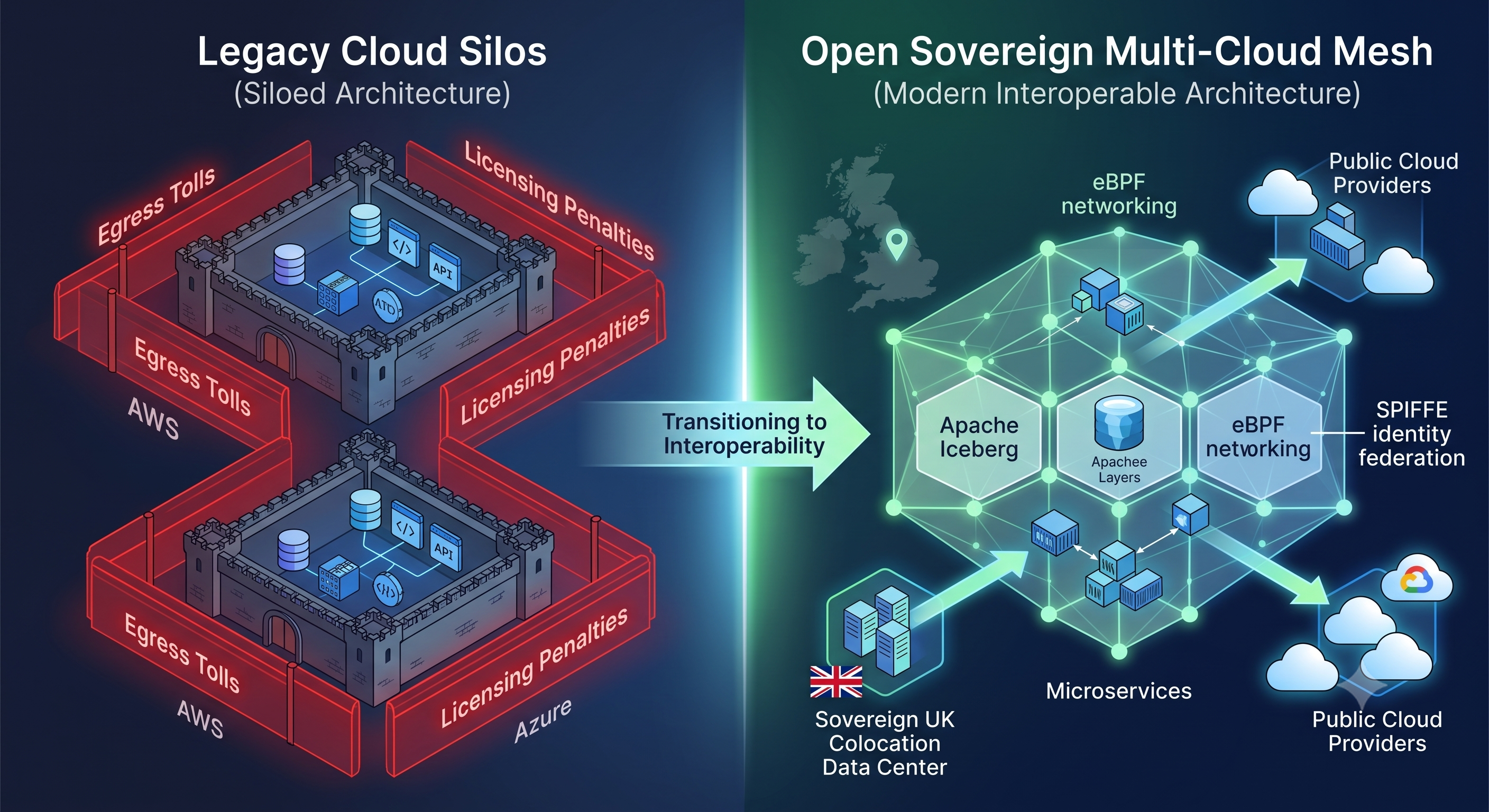
While executive suites view this as commercial leverage, for UK systems architects and platform engineers, it marks a pivotal architectural turning point. When artificial network egress tolls and proprietary licensing surcharges disappear, the engineering calculus shifts from vendor lock-in mitigation to Dynamic Multi-Cloud Interoperability.
Here is how modern UK platform teams are re-architecting their stacks:
1. S3-Compatible Storage Mesh Over Vendor-Native Blobs
Relying on proprietary cloud blob storage created massive data gravity that made migrating analytics pipelines prohibitive.
Engineering pattern: Teams are decoupling data lakes from native cloud storage APIs by standardizing on open object-storage layers (such as MinIO, Apache Iceberg, and Ceph-backed fabrics). By keeping metadata and storage formats vendor-neutral, data ingestion and compute engines (e.g., Trino, Spark) can query datasets running across sovereign UK data centers and global hyperscalers interchangeably.
2. Decoupling Identity and Secrets Management
The stickiest cloud component has never been the compute node; it is the Identity and Access Management (IAM) role graph.
Engineering pattern: Instead of writing deep cloud-provider IAM policies that bind microservices directly to AWS IAM or Azure Managed Identities, UK teams are migrating to SPIFFE/SPIRE for workload attestation and Open Policy Agent (OPA/Gatekeeper) for cloud-agnostic role enforcement. Cryptographic identity travels with the container, not the cloud provider.
3. Intent-Based WAN and Cross-Cloud Service Meshes
Without prohibitive egress tolls between availability zones and external clouds, running hybrid topologies is no longer a financial penalty.
Engineering pattern: Platform architects are replacing static cloud-interconnect tunnels with software-defined overlay networks (e.g., Cilium Cluster Mesh with WireGuard or eBPF-driven service routing). Traffic routes across the most cost-effective or lowest-latency compute cluster in real time without hardcoded transit gateways.
Regulation won't write your migration scripts. But eliminating anti-competitive cloud friction means architectural resilience and workload portability are no longer theoretical luxuries—they are baseline technical requirements.
Discussion Question (Poll)
With UK regulators dismantling hyperscaler egress and portability barriers, what is your team's biggest challenge in implementing a truly portable infrastructure?
A) Data gravity & distributed storage synchronization
B) Unifying IAM, secrets, and Zero-Trust policies across clouds
C) Observability & cross-cluster network latency (eBPF/Mesh)
D) Internal skillsets and multi-cloud Terraform/OpenTofu overhead
(Cast your vote above and drop your infrastructure stack approach in the comments.)
CTA
Join Techawks UK — the premier community for UK software engineers, solutions architects, and technical leaders breaking down modern platform engineering, regulatory shifts, and distributed cloud systems. Follow us for authoritative, engineering-first technical analysis.
The UK Competition and Markets Authority (CMA) and Digital Markets Unit (DMU) have zeroed in on the structural barriers dominating the UK’s £7.5B+ public cloud sector: data egress fees, aggressive committed-spend discounts, and software licensing markups on rival infrastructure.
While executive suites view this as commercial leverage, for UK systems architects and platform engineers, it marks a pivotal architectural turning point. When artificial network egress tolls and proprietary licensing surcharges disappear, the engineering calculus shifts from vendor lock-in mitigation to Dynamic Multi-Cloud Interoperability.
Here is how modern UK platform teams are re-architecting their stacks:
1. S3-Compatible Storage Mesh Over Vendor-Native Blobs
Relying on proprietary cloud blob storage created massive data gravity that made migrating analytics pipelines prohibitive.
Engineering pattern: Teams are decoupling data lakes from native cloud storage APIs by standardizing on open object-storage layers (such as MinIO, Apache Iceberg, and Ceph-backed fabrics). By keeping metadata and storage formats vendor-neutral, data ingestion and compute engines (e.g., Trino, Spark) can query datasets running across sovereign UK data centers and global hyperscalers interchangeably.
2. Decoupling Identity and Secrets Management
The stickiest cloud component has never been the compute node; it is the Identity and Access Management (IAM) role graph.
Engineering pattern: Instead of writing deep cloud-provider IAM policies that bind microservices directly to AWS IAM or Azure Managed Identities, UK teams are migrating to SPIFFE/SPIRE for workload attestation and Open Policy Agent (OPA/Gatekeeper) for cloud-agnostic role enforcement. Cryptographic identity travels with the container, not the cloud provider.
3. Intent-Based WAN and Cross-Cloud Service Meshes
Without prohibitive egress tolls between availability zones and external clouds, running hybrid topologies is no longer a financial penalty.
Engineering pattern: Platform architects are replacing static cloud-interconnect tunnels with software-defined overlay networks (e.g., Cilium Cluster Mesh with WireGuard or eBPF-driven service routing). Traffic routes across the most cost-effective or lowest-latency compute cluster in real time without hardcoded transit gateways.
Regulation won't write your migration scripts. But eliminating anti-competitive cloud friction means architectural resilience and workload portability are no longer theoretical luxuries—they are baseline technical requirements.
Discussion Question (Poll)
With UK regulators dismantling hyperscaler egress and portability barriers, what is your team's biggest challenge in implementing a truly portable infrastructure?
A) Data gravity & distributed storage synchronization
B) Unifying IAM, secrets, and Zero-Trust policies across clouds
C) Observability & cross-cluster network latency (eBPF/Mesh)
D) Internal skillsets and multi-cloud Terraform/OpenTofu overhead
(Cast your vote above and drop your infrastructure stack approach in the comments.)
CTA
Join Techawks UK — the premier community for UK software engineers, solutions architects, and technical leaders breaking down modern platform engineering, regulatory shifts, and distributed cloud systems. Follow us for authoritative, engineering-first technical analysis.
The End of Cloud Lock-in: Why the CMA’s Push Against Egress Fees Changes UK Software Architecture
The UK Competition and Markets Authority (CMA) and Digital Markets Unit (DMU) have zeroed in on the structural barriers dominating the UK’s £7.5B+ public cloud sector: data egress fees, aggressive committed-spend discounts, and software licensing markups on rival infrastructure.
While executive suites view this as commercial leverage, for UK systems architects and platform engineers, it marks a pivotal architectural turning point. When artificial network egress tolls and proprietary licensing surcharges disappear, the engineering calculus shifts from vendor lock-in mitigation to Dynamic Multi-Cloud Interoperability.
Here is how modern UK platform teams are re-architecting their stacks:
1. S3-Compatible Storage Mesh Over Vendor-Native Blobs
Relying on proprietary cloud blob storage created massive data gravity that made migrating analytics pipelines prohibitive.
Engineering pattern: Teams are decoupling data lakes from native cloud storage APIs by standardizing on open object-storage layers (such as MinIO, Apache Iceberg, and Ceph-backed fabrics). By keeping metadata and storage formats vendor-neutral, data ingestion and compute engines (e.g., Trino, Spark) can query datasets running across sovereign UK data centers and global hyperscalers interchangeably.
2. Decoupling Identity and Secrets Management
The stickiest cloud component has never been the compute node; it is the Identity and Access Management (IAM) role graph.
Engineering pattern: Instead of writing deep cloud-provider IAM policies that bind microservices directly to AWS IAM or Azure Managed Identities, UK teams are migrating to SPIFFE/SPIRE for workload attestation and Open Policy Agent (OPA/Gatekeeper) for cloud-agnostic role enforcement. Cryptographic identity travels with the container, not the cloud provider.
3. Intent-Based WAN and Cross-Cloud Service Meshes
Without prohibitive egress tolls between availability zones and external clouds, running hybrid topologies is no longer a financial penalty.
Engineering pattern: Platform architects are replacing static cloud-interconnect tunnels with software-defined overlay networks (e.g., Cilium Cluster Mesh with WireGuard or eBPF-driven service routing). Traffic routes across the most cost-effective or lowest-latency compute cluster in real time without hardcoded transit gateways.
Regulation won't write your migration scripts. But eliminating anti-competitive cloud friction means architectural resilience and workload portability are no longer theoretical luxuries—they are baseline technical requirements.
Discussion Question (Poll)
With UK regulators dismantling hyperscaler egress and portability barriers, what is your team's biggest challenge in implementing a truly portable infrastructure?
A) Data gravity & distributed storage synchronization
B) Unifying IAM, secrets, and Zero-Trust policies across clouds
C) Observability & cross-cluster network latency (eBPF/Mesh)
D) Internal skillsets and multi-cloud Terraform/OpenTofu overhead
(Cast your vote above and drop your infrastructure stack approach in the comments.)
CTA
Join Techawks UK — the premier community for UK software engineers, solutions architects, and technical leaders breaking down modern platform engineering, regulatory shifts, and distributed cloud systems. Follow us for authoritative, engineering-first technical analysis.

 English
 Arabic
 French
 Spanish
 Portuguese
 Deutsch
 Turkish
 Dutch
Dutch
 Italiano
 Russian
 Portuguese (Brazil)
 Greek
Greek