


Beyond 45°C: Why the UAE’s AI Ambition Is Rewriting the Thermal Engineering of Data Centers
With mega-initiatives like the 1-gigawatt Stargate UAE cluster, Khazna’s national capacity expansions, and Microsoft's multi-billion-dollar infrastructure footprint, the UAE is centralizing regional compute at an unprecedented scale.
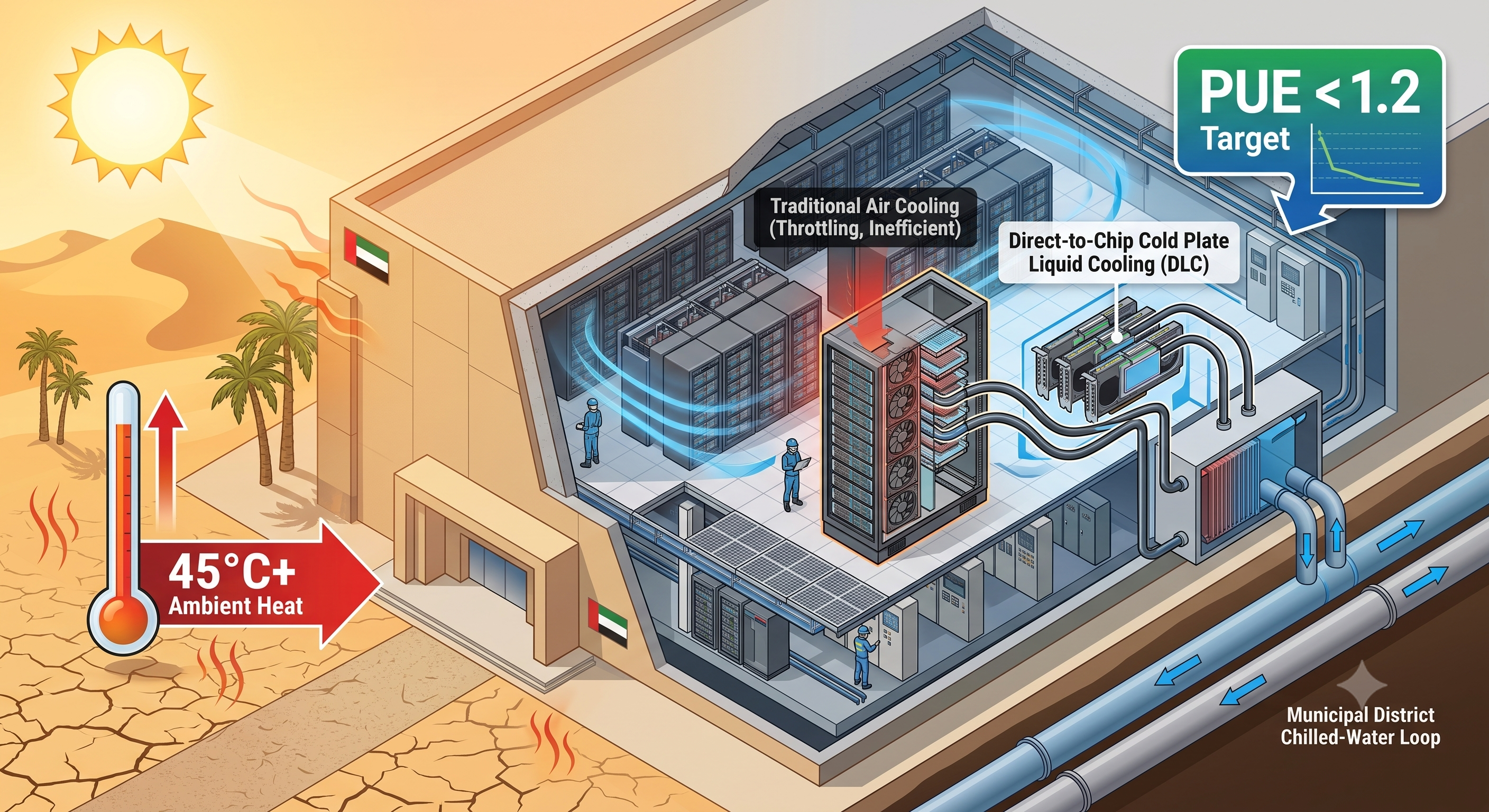
However, enterprise AI workloads running on high-density accelerator architectures (such as Nvidia Blackwell clusters) draw between 40kW and 120kW per rack—compared to 5kW to 10kW for legacy enterprise servers. In the Gulf climate, pushing that volume of heat into standard air-cooled CRAC (Computer Room Air Conditioning) units causes thermal throttling, spikes Power Usage Effectiveness (PUE) to unsustainable levels, and drains municipal power grids.
Under the Dubai Universal Blueprint for Artificial Intelligence and national efficiency mandates pushing PUE targets below 1.2, UAE systems architects and data center engineers are transitioning from air to Fluid-Dynamic Thermal Topologies.
Here are the 3 engineering transitions defining high-density compute across the Emirates:
1. Direct-to-Chip (DLC) Liquid Cooling Loops
Air cannot match the volumetric heat capacity of fluids.
Engineering shift: Chilled dielectric fluid or treated water-glycol mixtures are pumped directly through micro-channel cold plates mounted directly on GPU/CPU dies. DLC captures 70% to 80% of server heat directly at the silicon interface, allowing intake temperatures up to 32°C without requiring energy-intensive refrigeration chillers to over-cool ambient room air.
2. District Cooling Utility Integration (Empower / Tabreed Interconnects)
Instead of each facility building its own massive, standalone mechanical chiller yard—which strains local sub-stations—UAE hyperscalers are tying heat exchangers directly into municipal district cooling grids.
Engineering shift: Data center primary loops reject heat into massive centralized chilled-water networks (such as Empower's multi-million refrigeration ton infrastructure). This cuts facility-level cooling electrical loads by up to 50% and provides built-in thermal storage redundancy during grid peak hours.
3. Two-Phase Immersion Cooling for Extreme Compute Density
For specialized clusters where rack density exceeds 100kW, standard closed-loop cold plates hit plumbing and leak-risk constraints.
Engineering shift: Complete compute blades are submerged in non-conductive dielectric fluid. The fluid boils at a low temperature (around 50°C), vaporizes to remove heat from hot spots, condenses on overhead condenser coils, and returns to the bath. This completely removes server fans, reduces parasitic energy draw by 10% to 15%, and isolates sensitive silicon from airborne dust and coastal humidity.
In the UAE, software performance is directly constrained by thermodynamic efficiency. The teams building competitive regional AI platforms are optimizing the thermal envelope alongside their model weights.
Discussion Question (Poll)
As rack densities surpass 40kW–100kW across UAE facilities, which cooling and mechanical architecture will dominate local deployments by 2028?
A) Direct-to-Chip (DLC) with localized Coolant Distribution Units (CDUs)
B) Municipal District Cooling integration (bulk chilled-water off-take)
C) Full Two-Phase Immersion Cooling tanks
D) Hybrid Air/Liquid retrofits in existing Tier 3 facilities
(Cast your vote above and share your thermal optimization strategy in the comments.)
CTA
Join Techawks UAE — the technical network for systems architects, cloud engineers, and infrastructure builders shaping the Middle East’s digital backbone. Follow us for zero-fluff, deep-dive architectural insights.
With mega-initiatives like the 1-gigawatt Stargate UAE cluster, Khazna’s national capacity expansions, and Microsoft's multi-billion-dollar infrastructure footprint, the UAE is centralizing regional compute at an unprecedented scale.
However, enterprise AI workloads running on high-density accelerator architectures (such as Nvidia Blackwell clusters) draw between 40kW and 120kW per rack—compared to 5kW to 10kW for legacy enterprise servers. In the Gulf climate, pushing that volume of heat into standard air-cooled CRAC (Computer Room Air Conditioning) units causes thermal throttling, spikes Power Usage Effectiveness (PUE) to unsustainable levels, and drains municipal power grids.
Under the Dubai Universal Blueprint for Artificial Intelligence and national efficiency mandates pushing PUE targets below 1.2, UAE systems architects and data center engineers are transitioning from air to Fluid-Dynamic Thermal Topologies.
Here are the 3 engineering transitions defining high-density compute across the Emirates:
1. Direct-to-Chip (DLC) Liquid Cooling Loops
Air cannot match the volumetric heat capacity of fluids.
Engineering shift: Chilled dielectric fluid or treated water-glycol mixtures are pumped directly through micro-channel cold plates mounted directly on GPU/CPU dies. DLC captures 70% to 80% of server heat directly at the silicon interface, allowing intake temperatures up to 32°C without requiring energy-intensive refrigeration chillers to over-cool ambient room air.
2. District Cooling Utility Integration (Empower / Tabreed Interconnects)
Instead of each facility building its own massive, standalone mechanical chiller yard—which strains local sub-stations—UAE hyperscalers are tying heat exchangers directly into municipal district cooling grids.
Engineering shift: Data center primary loops reject heat into massive centralized chilled-water networks (such as Empower's multi-million refrigeration ton infrastructure). This cuts facility-level cooling electrical loads by up to 50% and provides built-in thermal storage redundancy during grid peak hours.
3. Two-Phase Immersion Cooling for Extreme Compute Density
For specialized clusters where rack density exceeds 100kW, standard closed-loop cold plates hit plumbing and leak-risk constraints.
Engineering shift: Complete compute blades are submerged in non-conductive dielectric fluid. The fluid boils at a low temperature (around 50°C), vaporizes to remove heat from hot spots, condenses on overhead condenser coils, and returns to the bath. This completely removes server fans, reduces parasitic energy draw by 10% to 15%, and isolates sensitive silicon from airborne dust and coastal humidity.
In the UAE, software performance is directly constrained by thermodynamic efficiency. The teams building competitive regional AI platforms are optimizing the thermal envelope alongside their model weights.
Discussion Question (Poll)
As rack densities surpass 40kW–100kW across UAE facilities, which cooling and mechanical architecture will dominate local deployments by 2028?
A) Direct-to-Chip (DLC) with localized Coolant Distribution Units (CDUs)
B) Municipal District Cooling integration (bulk chilled-water off-take)
C) Full Two-Phase Immersion Cooling tanks
D) Hybrid Air/Liquid retrofits in existing Tier 3 facilities
(Cast your vote above and share your thermal optimization strategy in the comments.)
CTA
Join Techawks UAE — the technical network for systems architects, cloud engineers, and infrastructure builders shaping the Middle East’s digital backbone. Follow us for zero-fluff, deep-dive architectural insights.
Beyond 45°C: Why the UAE’s AI Ambition Is Rewriting the Thermal Engineering of Data Centers
With mega-initiatives like the 1-gigawatt Stargate UAE cluster, Khazna’s national capacity expansions, and Microsoft's multi-billion-dollar infrastructure footprint, the UAE is centralizing regional compute at an unprecedented scale.
However, enterprise AI workloads running on high-density accelerator architectures (such as Nvidia Blackwell clusters) draw between 40kW and 120kW per rack—compared to 5kW to 10kW for legacy enterprise servers. In the Gulf climate, pushing that volume of heat into standard air-cooled CRAC (Computer Room Air Conditioning) units causes thermal throttling, spikes Power Usage Effectiveness (PUE) to unsustainable levels, and drains municipal power grids.
Under the Dubai Universal Blueprint for Artificial Intelligence and national efficiency mandates pushing PUE targets below 1.2, UAE systems architects and data center engineers are transitioning from air to Fluid-Dynamic Thermal Topologies.
Here are the 3 engineering transitions defining high-density compute across the Emirates:
1. Direct-to-Chip (DLC) Liquid Cooling Loops
Air cannot match the volumetric heat capacity of fluids.
Engineering shift: Chilled dielectric fluid or treated water-glycol mixtures are pumped directly through micro-channel cold plates mounted directly on GPU/CPU dies. DLC captures 70% to 80% of server heat directly at the silicon interface, allowing intake temperatures up to 32°C without requiring energy-intensive refrigeration chillers to over-cool ambient room air.
2. District Cooling Utility Integration (Empower / Tabreed Interconnects)
Instead of each facility building its own massive, standalone mechanical chiller yard—which strains local sub-stations—UAE hyperscalers are tying heat exchangers directly into municipal district cooling grids.
Engineering shift: Data center primary loops reject heat into massive centralized chilled-water networks (such as Empower's multi-million refrigeration ton infrastructure). This cuts facility-level cooling electrical loads by up to 50% and provides built-in thermal storage redundancy during grid peak hours.
3. Two-Phase Immersion Cooling for Extreme Compute Density
For specialized clusters where rack density exceeds 100kW, standard closed-loop cold plates hit plumbing and leak-risk constraints.
Engineering shift: Complete compute blades are submerged in non-conductive dielectric fluid. The fluid boils at a low temperature (around 50°C), vaporizes to remove heat from hot spots, condenses on overhead condenser coils, and returns to the bath. This completely removes server fans, reduces parasitic energy draw by 10% to 15%, and isolates sensitive silicon from airborne dust and coastal humidity.
In the UAE, software performance is directly constrained by thermodynamic efficiency. The teams building competitive regional AI platforms are optimizing the thermal envelope alongside their model weights.
Discussion Question (Poll)
As rack densities surpass 40kW–100kW across UAE facilities, which cooling and mechanical architecture will dominate local deployments by 2028?
A) Direct-to-Chip (DLC) with localized Coolant Distribution Units (CDUs)
B) Municipal District Cooling integration (bulk chilled-water off-take)
C) Full Two-Phase Immersion Cooling tanks
D) Hybrid Air/Liquid retrofits in existing Tier 3 facilities
(Cast your vote above and share your thermal optimization strategy in the comments.)
CTA
Join Techawks UAE — the technical network for systems architects, cloud engineers, and infrastructure builders shaping the Middle East’s digital backbone. Follow us for zero-fluff, deep-dive architectural insights.

 English
 Arabic
 French
 Spanish
 Portuguese
 Deutsch
 Dutch
Dutch
 Italiano
 Russian
 Romaian
 Portuguese (Brazil)
 Greek
Greek