


Canada’s Sovereign Compute Mandate: Why Provincial Grid Rules Are Reshaping Distributed AI Systems
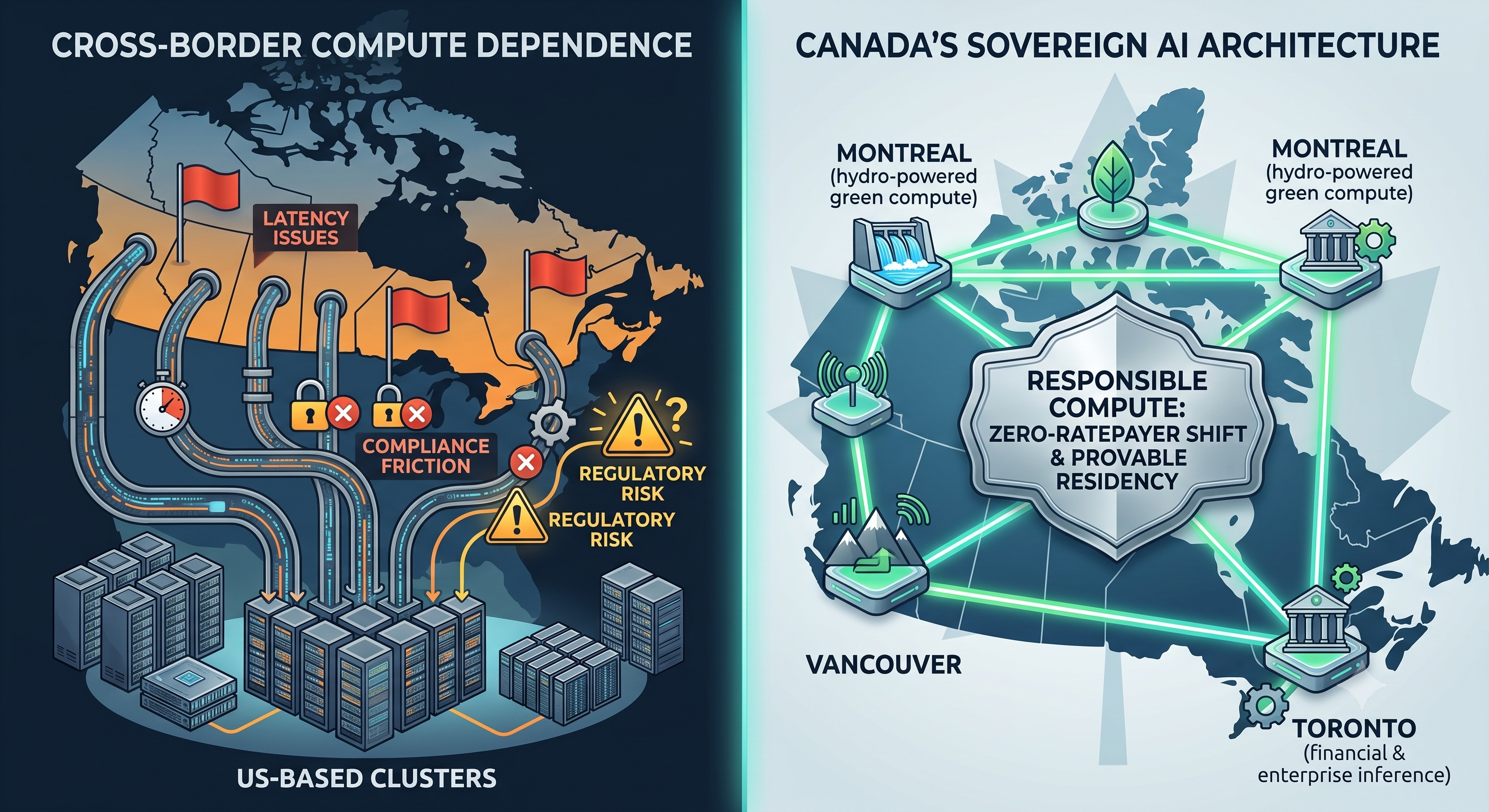
Canada currently exports immense amounts of clean hydroelectric power while importing foreign cloud and AI compute capacity.
To reverse this imbalance, the federal government launched Canada's national Responsible Data Centre Development Principles alongside the multi-billion-dollar Canadian Sovereign AI Compute Strategy. However, building high-density compute domestically comes with strict engineering constraints: facilities must preserve municipal water resources, avoid shifting energy costs onto local ratepayers, and maintain strict data residency within sovereign borders.
For Canadian software architects, platform engineers, and SREs, this changes distributed systems design. Compliance is no longer just a legal checklist; it dictates cluster topology and pipeline architecture.
Here are the 3 technical realities Canadian engineering teams must build for:
1. Provable Data Residency via Sovereign Hardware Enclaves
Operating under Canadian jurisdiction means telemetry, training checkpoints, and customer embeddings cannot transit foreign availability zones.
Engineering pattern: Teams are moving beyond software-defined VPC peering to Confidential Computing architectures (such as AMD SEV-SNP and Intel TDX). Hardware-enforced enclaves ensure data and model weights remain cryptographically isolated and physically bound to Canadian regional bare-metal clusters, preventing cross-border data exposure during distributed training iterations.
2. Carbon-Aware, Multi-Provincial Orchestration
Under the new responsible infrastructure framework, data centres cannot overload municipal grids. However, clean power across Canada is geographically fragmented—Hydro-Québec and BC Hydro offer high baseload renewables, while Ontario (IESO) and Alberta (AESO) manage dynamic grid constraints.
Engineering pattern: Systems architects are deploying carbon- and cost-aware workload schedulers. By plugging grid emission intensity APIs directly into Kubernetes orchestration layers, heavy batch-training pipelines and continuous synthetic-data generation dynamically shift between Montreal, Toronto, and Vancouver nodes based on real-time grid headroom and water-efficiency metrics.
3. Geo-Fenced Edge Model Cascading
With strict federal requirements around strategic domestic value and privacy, routing enterprise inference through foreign-hosted proprietary LLMs introduces regulatory friction.
Engineering pattern: Teams are deploying dual-layer cascaded architectures. Edge nodes run heavily quantized, local open-weight models (e.g., 8B/14B parameters) inside Canadian regional points of presence (PoPs) to resolve 85% of queries with sub-millisecond latency. Only high-complexity tasks pass to domestic sovereign supercomputing clusters, enforcing data localization by default.
Canada has never lacked algorithmic talent. The next frontier is building the resilient, sovereign systems architecture to run it.
Discussion Question (Poll)
With Canada accelerating sovereign AI infrastructure and stricter data centre mandates, what is your team's biggest challenge in localizing workloads?
A) Securing domestic high-density GPU compute availability
B) Architecting multi-provincial, grid-aware Kubernetes clusters
C) Enforcing cryptographic data residency across hybrid stacks
D) Cost parity with foreign US hyperscalers
(Cast your vote above and drop your infrastructure stack insights in the comments.)
CTA
Join Techawks Canada — the premier technical hub where Canadian systems architects, cloud engineers, and technical founders analyze infrastructure shifts, sovereign compute, and enterprise scalability. Follow us for zero-fluff, engineering-grade breakdowns.
Canada currently exports immense amounts of clean hydroelectric power while importing foreign cloud and AI compute capacity.
To reverse this imbalance, the federal government launched Canada's national Responsible Data Centre Development Principles alongside the multi-billion-dollar Canadian Sovereign AI Compute Strategy. However, building high-density compute domestically comes with strict engineering constraints: facilities must preserve municipal water resources, avoid shifting energy costs onto local ratepayers, and maintain strict data residency within sovereign borders.
For Canadian software architects, platform engineers, and SREs, this changes distributed systems design. Compliance is no longer just a legal checklist; it dictates cluster topology and pipeline architecture.
Here are the 3 technical realities Canadian engineering teams must build for:
1. Provable Data Residency via Sovereign Hardware Enclaves
Operating under Canadian jurisdiction means telemetry, training checkpoints, and customer embeddings cannot transit foreign availability zones.
Engineering pattern: Teams are moving beyond software-defined VPC peering to Confidential Computing architectures (such as AMD SEV-SNP and Intel TDX). Hardware-enforced enclaves ensure data and model weights remain cryptographically isolated and physically bound to Canadian regional bare-metal clusters, preventing cross-border data exposure during distributed training iterations.
2. Carbon-Aware, Multi-Provincial Orchestration
Under the new responsible infrastructure framework, data centres cannot overload municipal grids. However, clean power across Canada is geographically fragmented—Hydro-Québec and BC Hydro offer high baseload renewables, while Ontario (IESO) and Alberta (AESO) manage dynamic grid constraints.
Engineering pattern: Systems architects are deploying carbon- and cost-aware workload schedulers. By plugging grid emission intensity APIs directly into Kubernetes orchestration layers, heavy batch-training pipelines and continuous synthetic-data generation dynamically shift between Montreal, Toronto, and Vancouver nodes based on real-time grid headroom and water-efficiency metrics.
3. Geo-Fenced Edge Model Cascading
With strict federal requirements around strategic domestic value and privacy, routing enterprise inference through foreign-hosted proprietary LLMs introduces regulatory friction.
Engineering pattern: Teams are deploying dual-layer cascaded architectures. Edge nodes run heavily quantized, local open-weight models (e.g., 8B/14B parameters) inside Canadian regional points of presence (PoPs) to resolve 85% of queries with sub-millisecond latency. Only high-complexity tasks pass to domestic sovereign supercomputing clusters, enforcing data localization by default.
Canada has never lacked algorithmic talent. The next frontier is building the resilient, sovereign systems architecture to run it.
Discussion Question (Poll)
With Canada accelerating sovereign AI infrastructure and stricter data centre mandates, what is your team's biggest challenge in localizing workloads?
A) Securing domestic high-density GPU compute availability
B) Architecting multi-provincial, grid-aware Kubernetes clusters
C) Enforcing cryptographic data residency across hybrid stacks
D) Cost parity with foreign US hyperscalers
(Cast your vote above and drop your infrastructure stack insights in the comments.)
CTA
Join Techawks Canada — the premier technical hub where Canadian systems architects, cloud engineers, and technical founders analyze infrastructure shifts, sovereign compute, and enterprise scalability. Follow us for zero-fluff, engineering-grade breakdowns.
Canada’s Sovereign Compute Mandate: Why Provincial Grid Rules Are Reshaping Distributed AI Systems
Canada currently exports immense amounts of clean hydroelectric power while importing foreign cloud and AI compute capacity.
To reverse this imbalance, the federal government launched Canada's national Responsible Data Centre Development Principles alongside the multi-billion-dollar Canadian Sovereign AI Compute Strategy. However, building high-density compute domestically comes with strict engineering constraints: facilities must preserve municipal water resources, avoid shifting energy costs onto local ratepayers, and maintain strict data residency within sovereign borders.
For Canadian software architects, platform engineers, and SREs, this changes distributed systems design. Compliance is no longer just a legal checklist; it dictates cluster topology and pipeline architecture.
Here are the 3 technical realities Canadian engineering teams must build for:
1. Provable Data Residency via Sovereign Hardware Enclaves
Operating under Canadian jurisdiction means telemetry, training checkpoints, and customer embeddings cannot transit foreign availability zones.
Engineering pattern: Teams are moving beyond software-defined VPC peering to Confidential Computing architectures (such as AMD SEV-SNP and Intel TDX). Hardware-enforced enclaves ensure data and model weights remain cryptographically isolated and physically bound to Canadian regional bare-metal clusters, preventing cross-border data exposure during distributed training iterations.
2. Carbon-Aware, Multi-Provincial Orchestration
Under the new responsible infrastructure framework, data centres cannot overload municipal grids. However, clean power across Canada is geographically fragmented—Hydro-Québec and BC Hydro offer high baseload renewables, while Ontario (IESO) and Alberta (AESO) manage dynamic grid constraints.
Engineering pattern: Systems architects are deploying carbon- and cost-aware workload schedulers. By plugging grid emission intensity APIs directly into Kubernetes orchestration layers, heavy batch-training pipelines and continuous synthetic-data generation dynamically shift between Montreal, Toronto, and Vancouver nodes based on real-time grid headroom and water-efficiency metrics.
3. Geo-Fenced Edge Model Cascading
With strict federal requirements around strategic domestic value and privacy, routing enterprise inference through foreign-hosted proprietary LLMs introduces regulatory friction.
Engineering pattern: Teams are deploying dual-layer cascaded architectures. Edge nodes run heavily quantized, local open-weight models (e.g., 8B/14B parameters) inside Canadian regional points of presence (PoPs) to resolve 85% of queries with sub-millisecond latency. Only high-complexity tasks pass to domestic sovereign supercomputing clusters, enforcing data localization by default.
Canada has never lacked algorithmic talent. The next frontier is building the resilient, sovereign systems architecture to run it.
Discussion Question (Poll)
With Canada accelerating sovereign AI infrastructure and stricter data centre mandates, what is your team's biggest challenge in localizing workloads?
A) Securing domestic high-density GPU compute availability
B) Architecting multi-provincial, grid-aware Kubernetes clusters
C) Enforcing cryptographic data residency across hybrid stacks
D) Cost parity with foreign US hyperscalers
(Cast your vote above and drop your infrastructure stack insights in the comments.)
CTA
Join Techawks Canada — the premier technical hub where Canadian systems architects, cloud engineers, and technical founders analyze infrastructure shifts, sovereign compute, and enterprise scalability. Follow us for zero-fluff, engineering-grade breakdowns.

 English
 Arabic
 French
 Spanish
 Portuguese
 Deutsch
 Turkish
 Dutch
Dutch
 Russian
 Romaian
 Portuguese (Brazil)
 Greek
Greek