


The Infrastructure Dilemma: Managed Cloud Platforms or Self-Hosted Kubernetes?
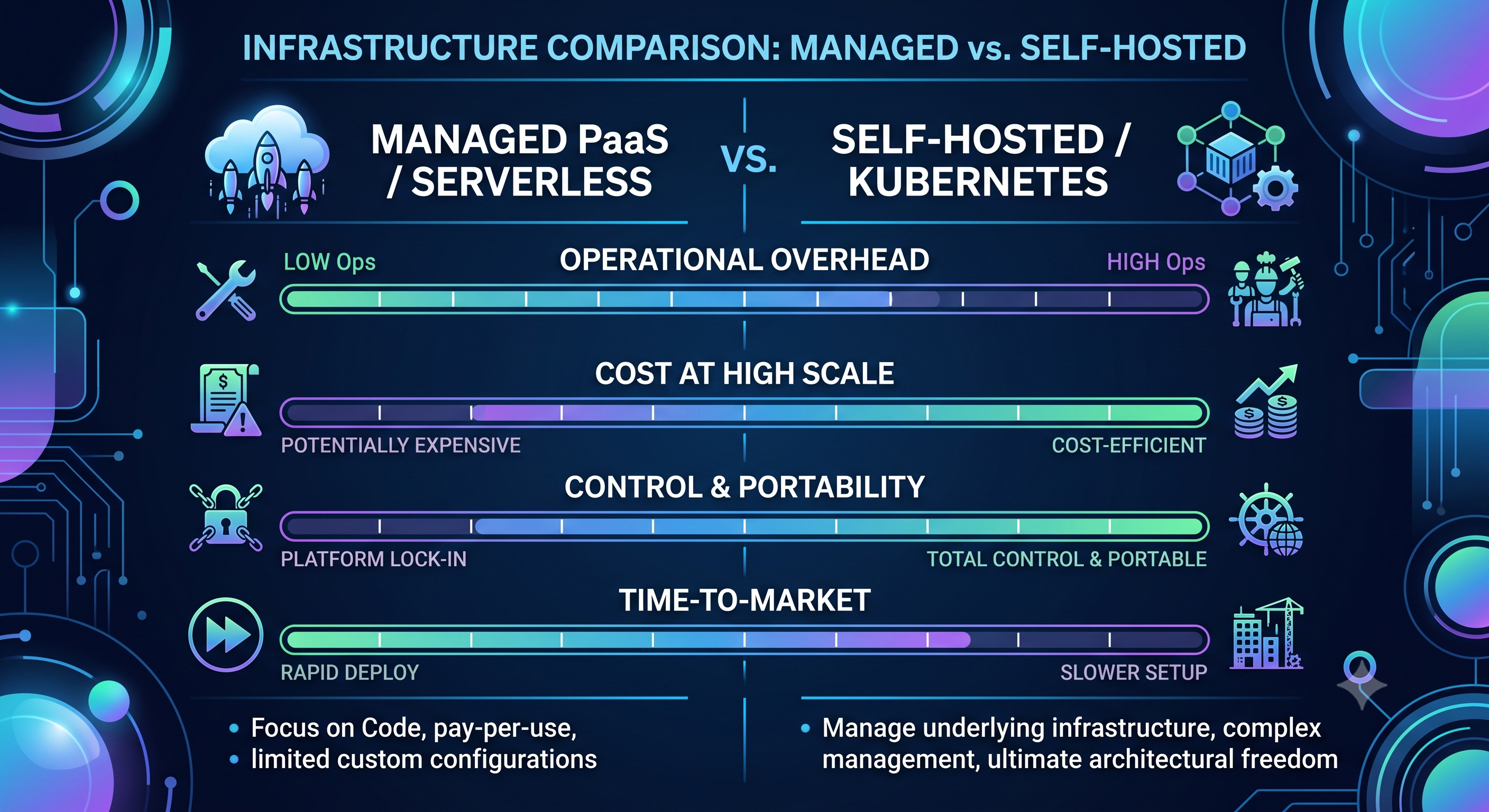
Every DevOps and platform team grapples with the operational sweet spot between developer convenience and total infrastructure control. Managed PaaS and serverless offerings let teams ship fast without worrying about node orchestration, patch cycles, or control plane health. However, as workloads scale, egress costs, platform lock-in, and unpredictable pricing often push teams to reconsider.
On the other hand, self-managed Kubernetes or custom open-source stacks offer ultimate portability and granular resource control, but they demand dedicated platform engineering bandwidth to maintain reliability and security. Finding that balance dictates both your operational overhead and cloud spend.
Poll Question:
Where does your team deploy the majority of production workloads today?
Option 1: Fully Managed PaaS / Serverless (e.g., Cloud Run, App Runner, Lambda, ECS Fargate)
Option 2: Managed Kubernetes Clusters (e.g., EKS, GKE, AKS)
Option 3: Bare-metal / Self-hosted Open Source Stack (Custom K8s, Nomad, VMs)
Option 4: Hybrid Multi-Cloud Setup
Key Takeaways
Platform-as-a-Service maximizes early developer velocity, but cost scaling curves require proactive monitoring as traffic grows.
Kubernetes trades operational simplicity for architectural portability and predictable compute density at high scale.
The true cost of self-hosting is rarely compute—it is the engineering salary hours spent maintaining the control plane and toolchain.
CTA
Have you ever migrated workloads from a managed PaaS to Kubernetes—or repatriated back to simpler services? Share your deployment war stories, unexpected cost surprises, or cluster setup lessons in the comments below!
Every DevOps and platform team grapples with the operational sweet spot between developer convenience and total infrastructure control. Managed PaaS and serverless offerings let teams ship fast without worrying about node orchestration, patch cycles, or control plane health. However, as workloads scale, egress costs, platform lock-in, and unpredictable pricing often push teams to reconsider.
On the other hand, self-managed Kubernetes or custom open-source stacks offer ultimate portability and granular resource control, but they demand dedicated platform engineering bandwidth to maintain reliability and security. Finding that balance dictates both your operational overhead and cloud spend.
Poll Question:
Where does your team deploy the majority of production workloads today?
Option 1: Fully Managed PaaS / Serverless (e.g., Cloud Run, App Runner, Lambda, ECS Fargate)
Option 2: Managed Kubernetes Clusters (e.g., EKS, GKE, AKS)
Option 3: Bare-metal / Self-hosted Open Source Stack (Custom K8s, Nomad, VMs)
Option 4: Hybrid Multi-Cloud Setup
Key Takeaways
Platform-as-a-Service maximizes early developer velocity, but cost scaling curves require proactive monitoring as traffic grows.
Kubernetes trades operational simplicity for architectural portability and predictable compute density at high scale.
The true cost of self-hosting is rarely compute—it is the engineering salary hours spent maintaining the control plane and toolchain.
CTA
Have you ever migrated workloads from a managed PaaS to Kubernetes—or repatriated back to simpler services? Share your deployment war stories, unexpected cost surprises, or cluster setup lessons in the comments below!
The Infrastructure Dilemma: Managed Cloud Platforms or Self-Hosted Kubernetes?
Every DevOps and platform team grapples with the operational sweet spot between developer convenience and total infrastructure control. Managed PaaS and serverless offerings let teams ship fast without worrying about node orchestration, patch cycles, or control plane health. However, as workloads scale, egress costs, platform lock-in, and unpredictable pricing often push teams to reconsider.
On the other hand, self-managed Kubernetes or custom open-source stacks offer ultimate portability and granular resource control, but they demand dedicated platform engineering bandwidth to maintain reliability and security. Finding that balance dictates both your operational overhead and cloud spend.
Poll Question:
Where does your team deploy the majority of production workloads today?
Option 1: Fully Managed PaaS / Serverless (e.g., Cloud Run, App Runner, Lambda, ECS Fargate)
Option 2: Managed Kubernetes Clusters (e.g., EKS, GKE, AKS)
Option 3: Bare-metal / Self-hosted Open Source Stack (Custom K8s, Nomad, VMs)
Option 4: Hybrid Multi-Cloud Setup
Key Takeaways
Platform-as-a-Service maximizes early developer velocity, but cost scaling curves require proactive monitoring as traffic grows.
Kubernetes trades operational simplicity for architectural portability and predictable compute density at high scale.
The true cost of self-hosting is rarely compute—it is the engineering salary hours spent maintaining the control plane and toolchain.
CTA
Have you ever migrated workloads from a managed PaaS to Kubernetes—or repatriated back to simpler services? Share your deployment war stories, unexpected cost surprises, or cluster setup lessons in the comments below!

 English
 Arabic
 French
 Spanish
 Portuguese
 Deutsch
 Dutch
Dutch
 Italiano
 Russian
 Romaian
 Portuguese (Brazil)
 Greek
Greek