


Stop Hardcoding Model Calls: How to Build Adaptive Test-Time Compute Routers
The state of frontier AI has shifted from pre-training scale to inference-time compute scaling. Modern reasoning engines excel at complex problem-solving by generating extended chains of thought, self-correcting intermediate logic, and interleaving tool execution before returning a token.
However, treat inference-time compute as a fixed default, and your application will face crippling latency and runaway costs.
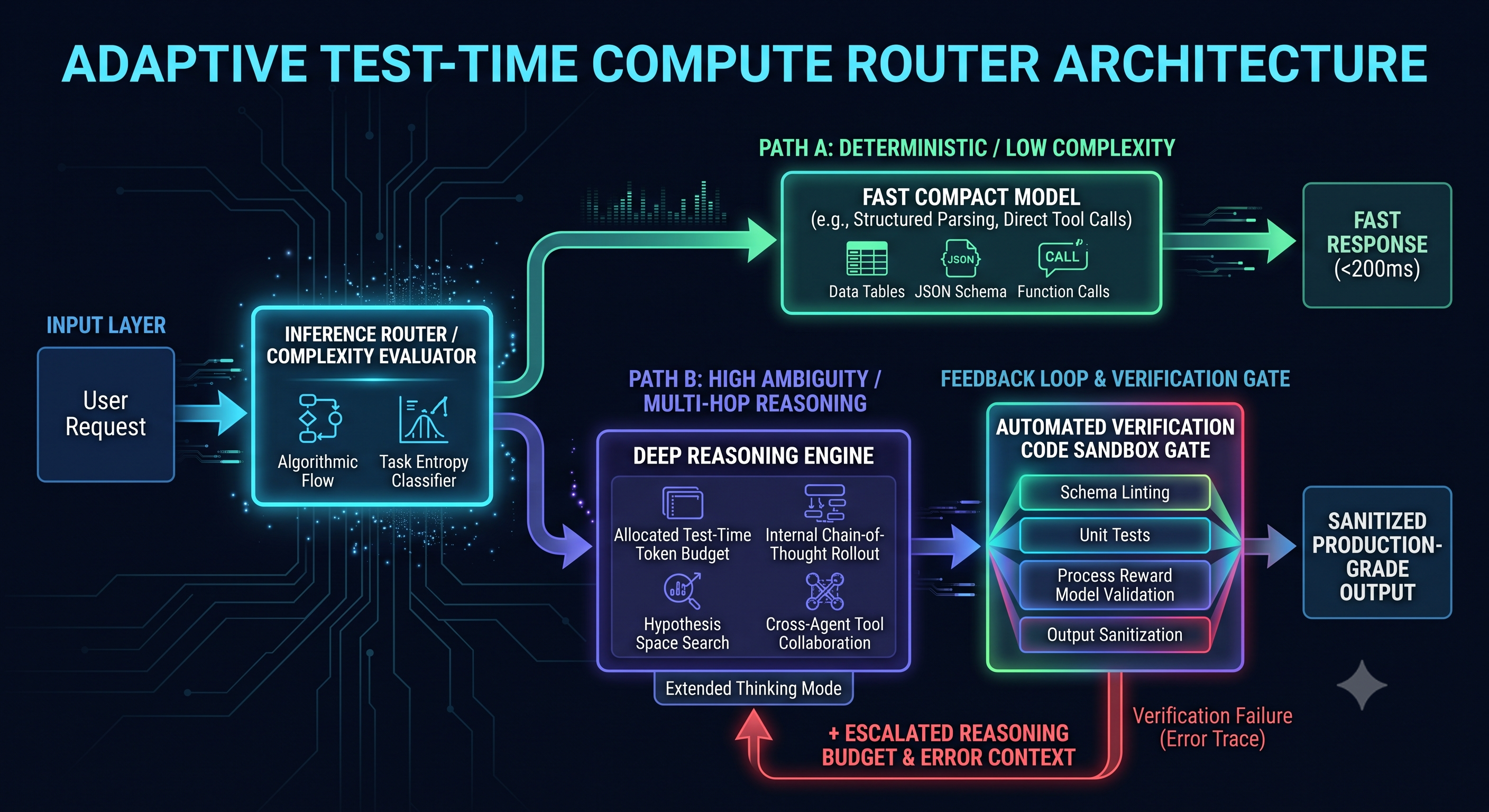
Here is why dynamic compute routing matters, and how to implement an Adaptive Test-Time Compute Router in your AI stack:
Why Dynamic Reasoning Compute Matters
Not every step in an agent workflow requires deep iterative reasoning.
Parsing a date, formatting structured JSON, or running a standard SQL lookup requires deterministic, fast execution.
Multi-hop algorithmic synthesis, codebase debugging, or policy validation demands extensive reflection and test-time rollout.
If your system treats both identically, you are wasting tokens where determinism suffices and starving problems that actually need deliberation.
The Architectural Blueprint: The 3-Tier Execution Gate
Step 1: The Heuristic Classifier (Tier 0)
Place an ultra-low-latency model or embedding-based intent classifier ahead of your workflow.
Evaluate the prompt’s algorithmic depth (e.g., token entropy, multi-step dependency flags, or explicit tool-chain requirements).
Step 2: Dynamic Budget Allocation (Tier 1)
Low-Complexity Tasks: Route directly to efficient inference models with strict system-level stop conditions and zero reasoning tokens allocated.
High-Complexity Tasks: Route to deep reasoning models while setting a explicit dynamic reasoning effort parameter (e.g., limiting token budgets for reflection steps to 1k–4k tokens based on task priority).
Step 3: Verification-Driven Fallback Loop (Tier 2)
Do not rely on open-ended retries. Implement a Process Reward or Schema Validator unit.
If the output of Tier 0 fails linting, schema parsing, or unit tests, trigger an escalated fallback: pass the failed trace and compiler error to the reasoning engine with a larger reasoning token budget.
Building real AI systems is no longer about chaining prompt templates. It is about building algorithmic pipelines that allocate compute strictly in proportion to task entropy.
Discussion Question
How does your team currently determine whether to spin up deep reasoning modes versus standard low-latency models in production workflows? Are you using deterministic heuristics or model-based routing?
CTA
Build production-grade AI systems with us.
Join the AI Builders & Enthusiasts community at Techawks to trade architectural patterns, access open-source routing templates, and connect with developers engineering scalable AI runtimes.
The state of frontier AI has shifted from pre-training scale to inference-time compute scaling. Modern reasoning engines excel at complex problem-solving by generating extended chains of thought, self-correcting intermediate logic, and interleaving tool execution before returning a token.
However, treat inference-time compute as a fixed default, and your application will face crippling latency and runaway costs.
Here is why dynamic compute routing matters, and how to implement an Adaptive Test-Time Compute Router in your AI stack:
Why Dynamic Reasoning Compute Matters
Not every step in an agent workflow requires deep iterative reasoning.
Parsing a date, formatting structured JSON, or running a standard SQL lookup requires deterministic, fast execution.
Multi-hop algorithmic synthesis, codebase debugging, or policy validation demands extensive reflection and test-time rollout.
If your system treats both identically, you are wasting tokens where determinism suffices and starving problems that actually need deliberation.
The Architectural Blueprint: The 3-Tier Execution Gate
Step 1: The Heuristic Classifier (Tier 0)
Place an ultra-low-latency model or embedding-based intent classifier ahead of your workflow.
Evaluate the prompt’s algorithmic depth (e.g., token entropy, multi-step dependency flags, or explicit tool-chain requirements).
Step 2: Dynamic Budget Allocation (Tier 1)
Low-Complexity Tasks: Route directly to efficient inference models with strict system-level stop conditions and zero reasoning tokens allocated.
High-Complexity Tasks: Route to deep reasoning models while setting a explicit dynamic reasoning effort parameter (e.g., limiting token budgets for reflection steps to 1k–4k tokens based on task priority).
Step 3: Verification-Driven Fallback Loop (Tier 2)
Do not rely on open-ended retries. Implement a Process Reward or Schema Validator unit.
If the output of Tier 0 fails linting, schema parsing, or unit tests, trigger an escalated fallback: pass the failed trace and compiler error to the reasoning engine with a larger reasoning token budget.
Building real AI systems is no longer about chaining prompt templates. It is about building algorithmic pipelines that allocate compute strictly in proportion to task entropy.
Discussion Question
How does your team currently determine whether to spin up deep reasoning modes versus standard low-latency models in production workflows? Are you using deterministic heuristics or model-based routing?
CTA
Build production-grade AI systems with us.
Join the AI Builders & Enthusiasts community at Techawks to trade architectural patterns, access open-source routing templates, and connect with developers engineering scalable AI runtimes.
Stop Hardcoding Model Calls: How to Build Adaptive Test-Time Compute Routers
The state of frontier AI has shifted from pre-training scale to inference-time compute scaling. Modern reasoning engines excel at complex problem-solving by generating extended chains of thought, self-correcting intermediate logic, and interleaving tool execution before returning a token.
However, treat inference-time compute as a fixed default, and your application will face crippling latency and runaway costs.
Here is why dynamic compute routing matters, and how to implement an Adaptive Test-Time Compute Router in your AI stack:
Why Dynamic Reasoning Compute Matters
Not every step in an agent workflow requires deep iterative reasoning.
Parsing a date, formatting structured JSON, or running a standard SQL lookup requires deterministic, fast execution.
Multi-hop algorithmic synthesis, codebase debugging, or policy validation demands extensive reflection and test-time rollout.
If your system treats both identically, you are wasting tokens where determinism suffices and starving problems that actually need deliberation.
The Architectural Blueprint: The 3-Tier Execution Gate
Step 1: The Heuristic Classifier (Tier 0)
Place an ultra-low-latency model or embedding-based intent classifier ahead of your workflow.
Evaluate the prompt’s algorithmic depth (e.g., token entropy, multi-step dependency flags, or explicit tool-chain requirements).
Step 2: Dynamic Budget Allocation (Tier 1)
Low-Complexity Tasks: Route directly to efficient inference models with strict system-level stop conditions and zero reasoning tokens allocated.
High-Complexity Tasks: Route to deep reasoning models while setting a explicit dynamic reasoning effort parameter (e.g., limiting token budgets for reflection steps to 1k–4k tokens based on task priority).
Step 3: Verification-Driven Fallback Loop (Tier 2)
Do not rely on open-ended retries. Implement a Process Reward or Schema Validator unit.
If the output of Tier 0 fails linting, schema parsing, or unit tests, trigger an escalated fallback: pass the failed trace and compiler error to the reasoning engine with a larger reasoning token budget.
Building real AI systems is no longer about chaining prompt templates. It is about building algorithmic pipelines that allocate compute strictly in proportion to task entropy.
Discussion Question
How does your team currently determine whether to spin up deep reasoning modes versus standard low-latency models in production workflows? Are you using deterministic heuristics or model-based routing?
CTA
Build production-grade AI systems with us.
Join the AI Builders & Enthusiasts community at Techawks to trade architectural patterns, access open-source routing templates, and connect with developers engineering scalable AI runtimes.

 English
 Arabic
 French
 Spanish
 Portuguese
 Deutsch
 Turkish
 Dutch
Dutch
 Italiano
 Russian
 Romaian
 Portuguese (Brazil)