


Stop Bypassing the Type System: Enforcing Parse, Don’t Validate with Zod & TypeScript
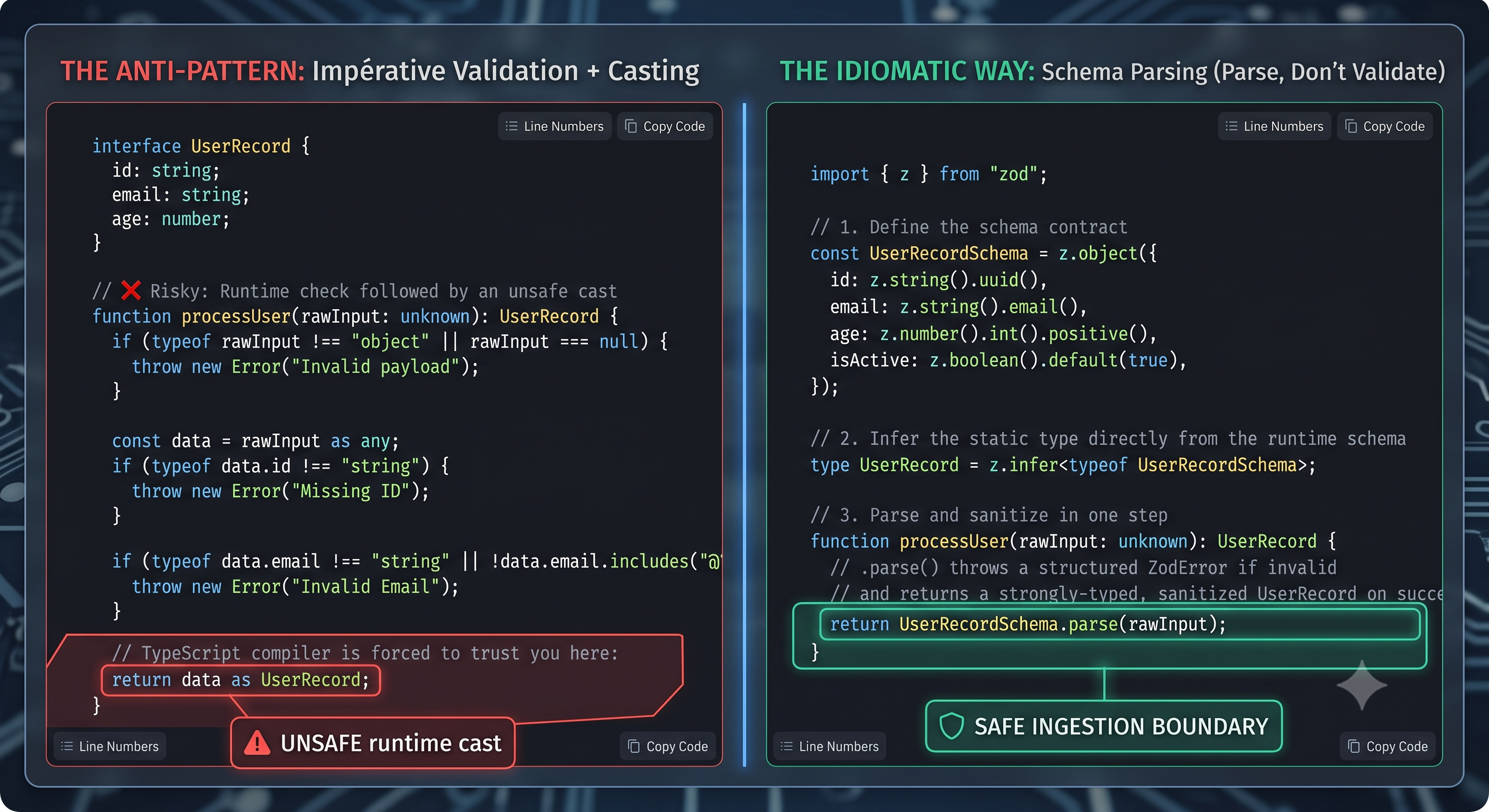
In modern software engineering, TypeScript guarantees static type safety at compile time, but it disappears completely at runtime. When untrusted data arrives from an external API, a database query, or user input, developers frequently write imperative if (!data.id) validations and then use type assertions (as User) to silence the compiler.
This pattern breaks the fundamental design principle: Parse, Don't Validate.
When you merely validate data, you verify its shape and throw an error if it is invalid, but you return nothing structural to the type system. When you parse data, you take unstructured input, verify it against a contract, and produce a guaranteed typed domain object in a single execution step.
The Anti-Pattern: Validate and Force-Cast
TypeScript
interface UserProfile {
id: string;
email: string;
age: number;
}
// ❌ Risky: Runtime check followed by an unsafe cast
function handleProfile(rawInput: unknown): UserProfile {
if (typeof rawInput !== "object" || rawInput === null) {
throw new Error("Invalid payload");
}
// TypeScript compiler is forced to trust you here:
return rawInput as UserProfile;
}
The Production Pattern: Parse into Guaranteed Types
Instead of manual assertion, define your schema as the single source of truth using a parser like Zod, Valibot, or ArkType:
TypeScript
import { z } from "zod";
// 1. Define the schema contract
const UserProfileSchema = z.object({
id: z.string().uuid(),
email: z.string().email(),
age: z.number().int().positive(),
isActive: z.boolean().default(true),
});
// 2. Infer the static type directly from the runtime schema
type UserProfile = z.infer<typeof UserProfileSchema>;
// 3. Parse and sanitize in one step
function handleProfile(rawInput: unknown): UserProfile {
// .parse() throws a structured ZodError if invalid
// and returns a strongly-typed, sanitized UserProfile on success
return UserProfileSchema.parse(rawInput);
}
Why This Matters in Production:
Elimination of Shotgun Parsing: Data verification happens strictly at the application boundary (controllers, event listeners, API fetch layers). The interior layers of your application receive strictly parsed, valid entities.
Zero Drift Between Types & Runtime Rules: Inferred types dynamically update whenever validation requirements change, eliminating out-of-sync types and dead code.
Data Transformation & Coercion: Parsers allow you to normalize inputs (e.g., stripping unknown keys, trimming strings, parsing date strings into Date objects) safely during the ingestion phase.
Discussion Question
Do you define your database/API schemas in TypeScript interfaces first, or do you infer your domain types directly from runtime validation schemas like Zod or TypeBox?
CTA
Sharpen your engineering craft.
Join the Developers & Coding community at Techawks to explore production code patterns, clean system design, and advanced TypeScript techniques with fellow developers.
In modern software engineering, TypeScript guarantees static type safety at compile time, but it disappears completely at runtime. When untrusted data arrives from an external API, a database query, or user input, developers frequently write imperative if (!data.id) validations and then use type assertions (as User) to silence the compiler.
This pattern breaks the fundamental design principle: Parse, Don't Validate.
When you merely validate data, you verify its shape and throw an error if it is invalid, but you return nothing structural to the type system. When you parse data, you take unstructured input, verify it against a contract, and produce a guaranteed typed domain object in a single execution step.
The Anti-Pattern: Validate and Force-Cast
TypeScript
interface UserProfile {
id: string;
email: string;
age: number;
}
// ❌ Risky: Runtime check followed by an unsafe cast
function handleProfile(rawInput: unknown): UserProfile {
if (typeof rawInput !== "object" || rawInput === null) {
throw new Error("Invalid payload");
}
// TypeScript compiler is forced to trust you here:
return rawInput as UserProfile;
}
The Production Pattern: Parse into Guaranteed Types
Instead of manual assertion, define your schema as the single source of truth using a parser like Zod, Valibot, or ArkType:
TypeScript
import { z } from "zod";
// 1. Define the schema contract
const UserProfileSchema = z.object({
id: z.string().uuid(),
email: z.string().email(),
age: z.number().int().positive(),
isActive: z.boolean().default(true),
});
// 2. Infer the static type directly from the runtime schema
type UserProfile = z.infer<typeof UserProfileSchema>;
// 3. Parse and sanitize in one step
function handleProfile(rawInput: unknown): UserProfile {
// .parse() throws a structured ZodError if invalid
// and returns a strongly-typed, sanitized UserProfile on success
return UserProfileSchema.parse(rawInput);
}
Why This Matters in Production:
Elimination of Shotgun Parsing: Data verification happens strictly at the application boundary (controllers, event listeners, API fetch layers). The interior layers of your application receive strictly parsed, valid entities.
Zero Drift Between Types & Runtime Rules: Inferred types dynamically update whenever validation requirements change, eliminating out-of-sync types and dead code.
Data Transformation & Coercion: Parsers allow you to normalize inputs (e.g., stripping unknown keys, trimming strings, parsing date strings into Date objects) safely during the ingestion phase.
Discussion Question
Do you define your database/API schemas in TypeScript interfaces first, or do you infer your domain types directly from runtime validation schemas like Zod or TypeBox?
CTA
Sharpen your engineering craft.
Join the Developers & Coding community at Techawks to explore production code patterns, clean system design, and advanced TypeScript techniques with fellow developers.
Stop Bypassing the Type System: Enforcing Parse, Don’t Validate with Zod & TypeScript
In modern software engineering, TypeScript guarantees static type safety at compile time, but it disappears completely at runtime. When untrusted data arrives from an external API, a database query, or user input, developers frequently write imperative if (!data.id) validations and then use type assertions (as User) to silence the compiler.
This pattern breaks the fundamental design principle: Parse, Don't Validate.
When you merely validate data, you verify its shape and throw an error if it is invalid, but you return nothing structural to the type system. When you parse data, you take unstructured input, verify it against a contract, and produce a guaranteed typed domain object in a single execution step.
The Anti-Pattern: Validate and Force-Cast
TypeScript
interface UserProfile {
id: string;
email: string;
age: number;
}
// ❌ Risky: Runtime check followed by an unsafe cast
function handleProfile(rawInput: unknown): UserProfile {
if (typeof rawInput !== "object" || rawInput === null) {
throw new Error("Invalid payload");
}
// TypeScript compiler is forced to trust you here:
return rawInput as UserProfile;
}
The Production Pattern: Parse into Guaranteed Types
Instead of manual assertion, define your schema as the single source of truth using a parser like Zod, Valibot, or ArkType:
TypeScript
import { z } from "zod";
// 1. Define the schema contract
const UserProfileSchema = z.object({
id: z.string().uuid(),
email: z.string().email(),
age: z.number().int().positive(),
isActive: z.boolean().default(true),
});
// 2. Infer the static type directly from the runtime schema
type UserProfile = z.infer<typeof UserProfileSchema>;
// 3. Parse and sanitize in one step
function handleProfile(rawInput: unknown): UserProfile {
// .parse() throws a structured ZodError if invalid
// and returns a strongly-typed, sanitized UserProfile on success
return UserProfileSchema.parse(rawInput);
}
Why This Matters in Production:
Elimination of Shotgun Parsing: Data verification happens strictly at the application boundary (controllers, event listeners, API fetch layers). The interior layers of your application receive strictly parsed, valid entities.
Zero Drift Between Types & Runtime Rules: Inferred types dynamically update whenever validation requirements change, eliminating out-of-sync types and dead code.
Data Transformation & Coercion: Parsers allow you to normalize inputs (e.g., stripping unknown keys, trimming strings, parsing date strings into Date objects) safely during the ingestion phase.
Discussion Question
Do you define your database/API schemas in TypeScript interfaces first, or do you infer your domain types directly from runtime validation schemas like Zod or TypeBox?
CTA
Sharpen your engineering craft.
Join the Developers & Coding community at Techawks to explore production code patterns, clean system design, and advanced TypeScript techniques with fellow developers.

 English
 Arabic
 Spanish
 Portuguese
 Deutsch
 Turkish
 Dutch
Dutch
 Italiano
 Russian
 Romaian
 Portuguese (Brazil)
 Greek
Greek