


Beyond the Wrapper: Why India’s Push into Compute and Silicon Redefines the Developer Stack
India’s tech conversation is undergoing a seismic pivot. For the past decade, the Indian developer ecosystem scaled rapidly on the application and services layer—building world-class consumer apps, SaaS interfaces, and digital public infrastructure like UPI.
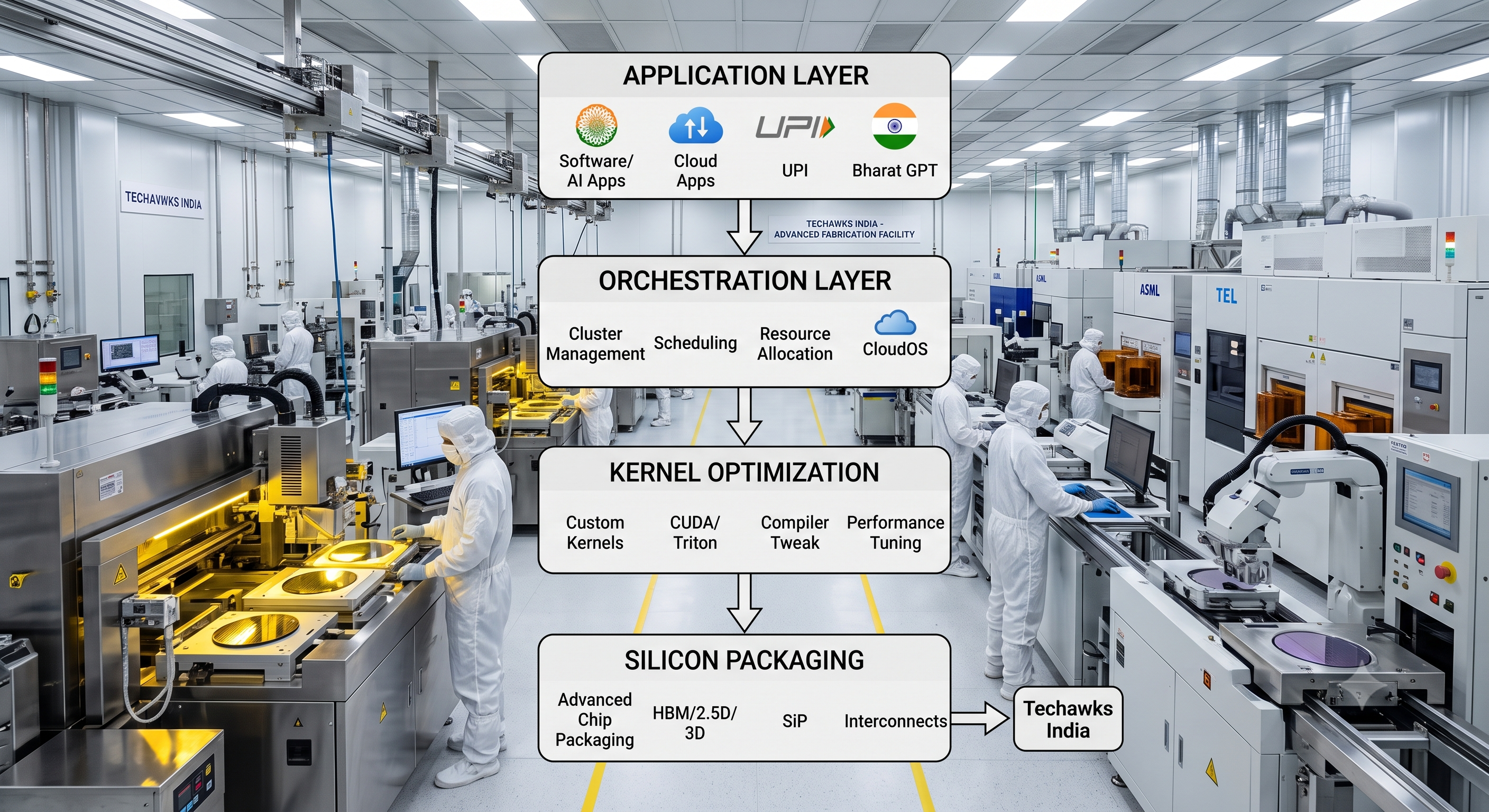
However, with global hardware bottlenecks and the ongoing rollout of Semicon 2.0 and the India AI Mission compute clusters, the real leverage has moved down the stack: from the API layer directly into silicon, custom architectures, and hardware-software co-design. Why This Matters to You Global GPU shortages and localized compliance requirements mean software engineering can no longer remain hardware-agnostic. Whether you build enterprise microservices or sovereign generative models, software that isn't optimized for specific hardware constraints is becoming financially unviable to run at scale.
What You Need to Know (The Tech Breakdown):The Fall of Generic Compute: Running pure FP32 workloads on general-purpose cloud instances is burning capital. Modern high-throughput engineering demands deep familiarity with quantization techniques (INT4/FP8), mixed-precision execution, and kernel optimization (Triton, CUDA, ROCm).
Hardware-Software Co-Design: As domestic packaging, ATMP (Assembly, Testing, Marking, and Packaging), and edge-ASIC design ramp up, software engineers who understand cache hierarchies, high-bandwidth memory (HBM) bandwidth limits, and device-level orchestration will out-earn pure interface developers.
Sovereign Infrastructure Protocols: India's push towards subsidized public GPU pools and specialized domestic LLMs requires teams to build architectures resilient to hardware diversity, rather than relying exclusively on proprietary, single-vendor APIs.
The Bottom Line: Don't just consume abstractions. Learn what happens when your code hits the bare metal.
Discussion Question
As infrastructure costs overtake standard cloud hosting budgets, has your team started profiling down to the hardware level (quantization, memory footprints, custom kernels), or are you still relying primarily on standard managed API wrappers?
CTA (Join Techawks India)
Join Techawks India—the community where high-conviction Indian engineers, architects, and founders break down deep-tech systems, hardware-software co-design, and real-world infrastructure.
👉 [Join Techawks India on Discord/LinkedIn – Link in Bio]
India’s tech conversation is undergoing a seismic pivot. For the past decade, the Indian developer ecosystem scaled rapidly on the application and services layer—building world-class consumer apps, SaaS interfaces, and digital public infrastructure like UPI.
However, with global hardware bottlenecks and the ongoing rollout of Semicon 2.0 and the India AI Mission compute clusters, the real leverage has moved down the stack: from the API layer directly into silicon, custom architectures, and hardware-software co-design. Why This Matters to You Global GPU shortages and localized compliance requirements mean software engineering can no longer remain hardware-agnostic. Whether you build enterprise microservices or sovereign generative models, software that isn't optimized for specific hardware constraints is becoming financially unviable to run at scale.
What You Need to Know (The Tech Breakdown):The Fall of Generic Compute: Running pure FP32 workloads on general-purpose cloud instances is burning capital. Modern high-throughput engineering demands deep familiarity with quantization techniques (INT4/FP8), mixed-precision execution, and kernel optimization (Triton, CUDA, ROCm).
Hardware-Software Co-Design: As domestic packaging, ATMP (Assembly, Testing, Marking, and Packaging), and edge-ASIC design ramp up, software engineers who understand cache hierarchies, high-bandwidth memory (HBM) bandwidth limits, and device-level orchestration will out-earn pure interface developers.
Sovereign Infrastructure Protocols: India's push towards subsidized public GPU pools and specialized domestic LLMs requires teams to build architectures resilient to hardware diversity, rather than relying exclusively on proprietary, single-vendor APIs.
The Bottom Line: Don't just consume abstractions. Learn what happens when your code hits the bare metal.
Discussion Question
As infrastructure costs overtake standard cloud hosting budgets, has your team started profiling down to the hardware level (quantization, memory footprints, custom kernels), or are you still relying primarily on standard managed API wrappers?
CTA (Join Techawks India)
Join Techawks India—the community where high-conviction Indian engineers, architects, and founders break down deep-tech systems, hardware-software co-design, and real-world infrastructure.
👉 [Join Techawks India on Discord/LinkedIn – Link in Bio]
Beyond the Wrapper: Why India’s Push into Compute and Silicon Redefines the Developer Stack
India’s tech conversation is undergoing a seismic pivot. For the past decade, the Indian developer ecosystem scaled rapidly on the application and services layer—building world-class consumer apps, SaaS interfaces, and digital public infrastructure like UPI.
However, with global hardware bottlenecks and the ongoing rollout of Semicon 2.0 and the India AI Mission compute clusters, the real leverage has moved down the stack: from the API layer directly into silicon, custom architectures, and hardware-software co-design. Why This Matters to You Global GPU shortages and localized compliance requirements mean software engineering can no longer remain hardware-agnostic. Whether you build enterprise microservices or sovereign generative models, software that isn't optimized for specific hardware constraints is becoming financially unviable to run at scale.
What You Need to Know (The Tech Breakdown):The Fall of Generic Compute: Running pure FP32 workloads on general-purpose cloud instances is burning capital. Modern high-throughput engineering demands deep familiarity with quantization techniques (INT4/FP8), mixed-precision execution, and kernel optimization (Triton, CUDA, ROCm).
Hardware-Software Co-Design: As domestic packaging, ATMP (Assembly, Testing, Marking, and Packaging), and edge-ASIC design ramp up, software engineers who understand cache hierarchies, high-bandwidth memory (HBM) bandwidth limits, and device-level orchestration will out-earn pure interface developers.
Sovereign Infrastructure Protocols: India's push towards subsidized public GPU pools and specialized domestic LLMs requires teams to build architectures resilient to hardware diversity, rather than relying exclusively on proprietary, single-vendor APIs.
The Bottom Line: Don't just consume abstractions. Learn what happens when your code hits the bare metal.
Discussion Question
As infrastructure costs overtake standard cloud hosting budgets, has your team started profiling down to the hardware level (quantization, memory footprints, custom kernels), or are you still relying primarily on standard managed API wrappers?
CTA (Join Techawks India)
Join Techawks India—the community where high-conviction Indian engineers, architects, and founders break down deep-tech systems, hardware-software co-design, and real-world infrastructure.
👉 [Join Techawks India on Discord/LinkedIn – Link in Bio]

 English
 Arabic
 French
 Spanish
 Portuguese
 Deutsch
 Dutch
Dutch
 Italiano
 Russian
 Romaian
 Portuguese (Brazil)
 Greek
Greek