


Why "Data Residency" Is No Longer Enough for AI in the UAE
Across Dubai and Abu Dhabi, AI infrastructure spending has doubled over the past year. Yet, enterprise teams are hitting a quiet wall: The Residency Trap.
Many engineering and product leaders assume that selecting a UAE-based hyper scaler region (like me-central-1 or uae-central) checks every regulatory box. It doesn’t.
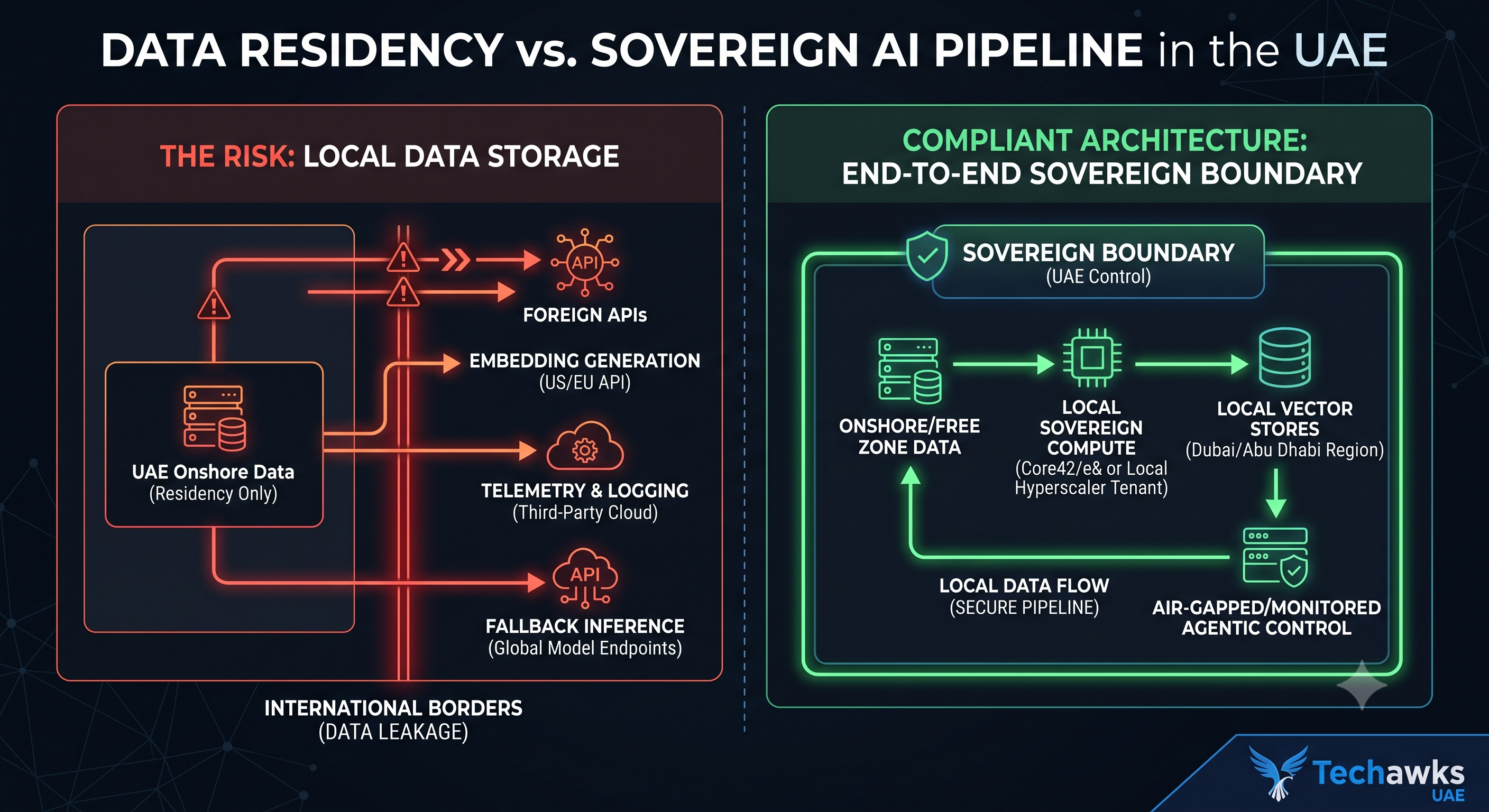
Why This Matters Locally The UAE's regulatory reality is a multi-layered framework: Federal Level: Federal Decree-Law No. 45 of 2021 (PDPL) on personal data protection. Financial Free Zones: DIFC’s enforceable Regulation 10 governing autonomous and semi-autonomous systems, and ADGM’s Data Protection Regulations. National Directives: The UAE Sovereign AI initiatives led by the UAE Cyber Security Council and local infrastructure providers (e.g., e& and Core42). The critical distinction is between Data Residency (physical location of servers) and Data Sovereignty (which legal jurisdiction and foreign access mandates apply to the entire pipeline). If your vector embeddings, system metadata, or fallback inference routes leak across borders during pipeline orchestration, you breach local standards. 🛠️ What to Implement: The 4-Tier Sovereign AI Audit Before pushing your next AI agent or RAG pipeline into staging, verify these four layers:
Inference Isolation: Ensure API tokens and prompt payloads execute inside local boundary clusters (e.g., localized sovereign instances or dedicated regional inference nodes) rather than defaulting to US/EU server failovers.
Embeddings & Vector Store Co-location: Keep embedding generation and vector databases in the same geographic tenant as your primary data to prevent silent cross-border telemetry.
Dual-Zone Mapping: If your organization operates in both mainland UAE and free zones (like DIFC or ADGM), confirm your model risk assessment aligns with DIFC Regulation 10 transparency criteria while maintaining federal PDPL consent logs. Metadata & Agent Action Boundaries: Autonomous agents that query internal enterprise systems must have deterministic guardrails that prevent log scraping and telemetry ingestion by third-party model providers.
Discussion Question
For tech leads and architects in the UAE: When deploying AI systems locally, what has been your biggest hurdle—managing cross-zone compliance (DIFC/ADGM vs. Mainland) or securing cost-effective in-country GPU compute?
CTA
Join Techawks UAE — Connect with local founders, CTOs, and developers shaping the Middle East’s digital frontier. Get access to exclusive playbooks, architecture tear-downs, and peer discussions. Link in bio / comments.
Across Dubai and Abu Dhabi, AI infrastructure spending has doubled over the past year. Yet, enterprise teams are hitting a quiet wall: The Residency Trap.
Many engineering and product leaders assume that selecting a UAE-based hyper scaler region (like me-central-1 or uae-central) checks every regulatory box. It doesn’t.
Why This Matters Locally The UAE's regulatory reality is a multi-layered framework: Federal Level: Federal Decree-Law No. 45 of 2021 (PDPL) on personal data protection. Financial Free Zones: DIFC’s enforceable Regulation 10 governing autonomous and semi-autonomous systems, and ADGM’s Data Protection Regulations. National Directives: The UAE Sovereign AI initiatives led by the UAE Cyber Security Council and local infrastructure providers (e.g., e& and Core42). The critical distinction is between Data Residency (physical location of servers) and Data Sovereignty (which legal jurisdiction and foreign access mandates apply to the entire pipeline). If your vector embeddings, system metadata, or fallback inference routes leak across borders during pipeline orchestration, you breach local standards. 🛠️ What to Implement: The 4-Tier Sovereign AI Audit Before pushing your next AI agent or RAG pipeline into staging, verify these four layers:
Inference Isolation: Ensure API tokens and prompt payloads execute inside local boundary clusters (e.g., localized sovereign instances or dedicated regional inference nodes) rather than defaulting to US/EU server failovers.
Embeddings & Vector Store Co-location: Keep embedding generation and vector databases in the same geographic tenant as your primary data to prevent silent cross-border telemetry.
Dual-Zone Mapping: If your organization operates in both mainland UAE and free zones (like DIFC or ADGM), confirm your model risk assessment aligns with DIFC Regulation 10 transparency criteria while maintaining federal PDPL consent logs. Metadata & Agent Action Boundaries: Autonomous agents that query internal enterprise systems must have deterministic guardrails that prevent log scraping and telemetry ingestion by third-party model providers.
Discussion Question
For tech leads and architects in the UAE: When deploying AI systems locally, what has been your biggest hurdle—managing cross-zone compliance (DIFC/ADGM vs. Mainland) or securing cost-effective in-country GPU compute?
CTA
Join Techawks UAE — Connect with local founders, CTOs, and developers shaping the Middle East’s digital frontier. Get access to exclusive playbooks, architecture tear-downs, and peer discussions. Link in bio / comments.
Why "Data Residency" Is No Longer Enough for AI in the UAE
Across Dubai and Abu Dhabi, AI infrastructure spending has doubled over the past year. Yet, enterprise teams are hitting a quiet wall: The Residency Trap.
Many engineering and product leaders assume that selecting a UAE-based hyper scaler region (like me-central-1 or uae-central) checks every regulatory box. It doesn’t.
Why This Matters Locally The UAE's regulatory reality is a multi-layered framework: Federal Level: Federal Decree-Law No. 45 of 2021 (PDPL) on personal data protection. Financial Free Zones: DIFC’s enforceable Regulation 10 governing autonomous and semi-autonomous systems, and ADGM’s Data Protection Regulations. National Directives: The UAE Sovereign AI initiatives led by the UAE Cyber Security Council and local infrastructure providers (e.g., e& and Core42). The critical distinction is between Data Residency (physical location of servers) and Data Sovereignty (which legal jurisdiction and foreign access mandates apply to the entire pipeline). If your vector embeddings, system metadata, or fallback inference routes leak across borders during pipeline orchestration, you breach local standards. 🛠️ What to Implement: The 4-Tier Sovereign AI Audit Before pushing your next AI agent or RAG pipeline into staging, verify these four layers:
Inference Isolation: Ensure API tokens and prompt payloads execute inside local boundary clusters (e.g., localized sovereign instances or dedicated regional inference nodes) rather than defaulting to US/EU server failovers.
Embeddings & Vector Store Co-location: Keep embedding generation and vector databases in the same geographic tenant as your primary data to prevent silent cross-border telemetry.
Dual-Zone Mapping: If your organization operates in both mainland UAE and free zones (like DIFC or ADGM), confirm your model risk assessment aligns with DIFC Regulation 10 transparency criteria while maintaining federal PDPL consent logs. Metadata & Agent Action Boundaries: Autonomous agents that query internal enterprise systems must have deterministic guardrails that prevent log scraping and telemetry ingestion by third-party model providers.
Discussion Question
For tech leads and architects in the UAE: When deploying AI systems locally, what has been your biggest hurdle—managing cross-zone compliance (DIFC/ADGM vs. Mainland) or securing cost-effective in-country GPU compute?
CTA
Join Techawks UAE — Connect with local founders, CTOs, and developers shaping the Middle East’s digital frontier. Get access to exclusive playbooks, architecture tear-downs, and peer discussions. Link in bio / comments.

 English
 Arabic
 French
 Spanish
 Portuguese
 Deutsch
 Turkish
 Dutch
Dutch
 Russian
 Romaian
 Portuguese (Brazil)
 Greek
Greek