


Canada’s New Responsible Data Centre Principles: The Engineering Impact for AI Builders
Enterprise data centre and AI compute deployment in Canada just hit a regulatory turning point.
Between the multi-billion-dollar Sovereign AI Compute Strategy and federal efforts to anchor compute at home, the constraint is no longer just securing GPUs—it is passing local power, environmental, and sovereignty checks.
The new federal principles require data centres to protect local electricity ratepayers, restrict water consumption, and demonstrate tangible domestic economic returns before breaking ground or expanding capacity. For Canadian engineering leaders, platform architects, and DevOps teams, this fundamentally changes infrastructure roadmaps.
Architectural Takeaways for Canadian Tech Teams:
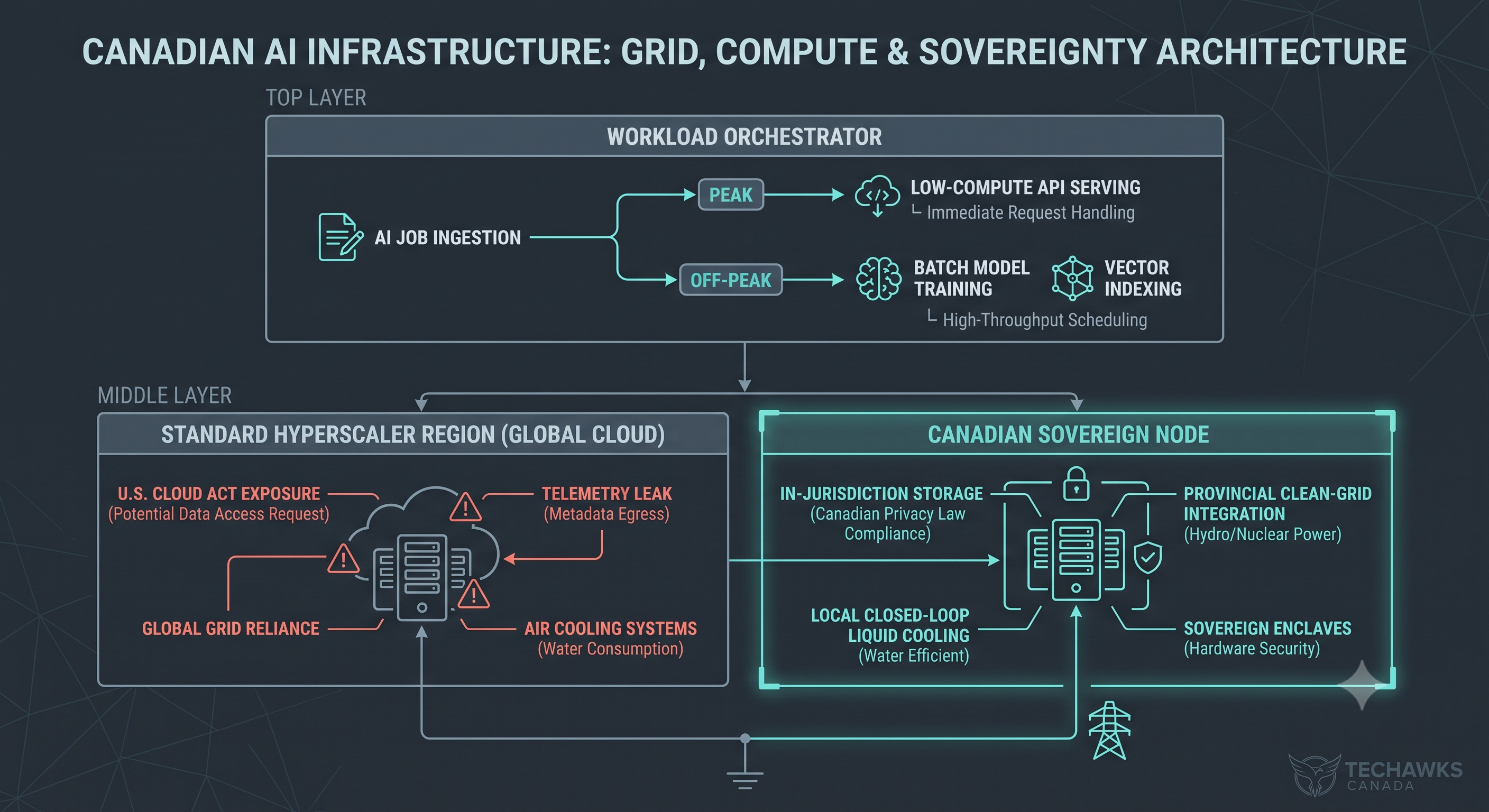
Grid-Aware Workload Orchestration: Data centres must prove they won’t drive up municipal ratepayer costs. AI teams should implement dynamic compute scheduling that shifts non-urgent, high-throughput batch training and fine-tuning jobs to off-peak grid hours (leveraging provincial clean energy peaks in Quebec, Ontario, or BC).
Cooling and PUE/WUE Metric Auditing: Water-use minimization is now explicit. When selecting local colocation or private cloud providers, prioritize facilities with closed-loop direct-to-chip liquid cooling or rear-door heat exchangers over open evaporative cooling towers.
True Domestic Data Sovereignty (Avoiding the CLOUD Act Loophole): Keeping data in a Canadian hyperscaler region does not automatically shield enterprise workloads from extraterritorial reach under foreign legislation like the U.S. CLOUD Act. Teams handling sensitive data (healthcare, fintech, and public sector) must evaluate bare-metal sovereign clusters or Canadian-controlled cloud environments for enterprise deployments.
Decoupled Fallback Pipelines: If your primary pipeline relies on local sovereign compute nodes, audit your API orchestration layers. Ensure agentic loops and vector retrieval processes do not trigger cross-border failovers that violate domestic privacy frameworks (PIPEDA / Law 25).
Discussion Question
For Canadian CTOs and cloud architects: Does your team factor local grid carbon-intensity and municipal data residency into your model training pipelines, or are you still relying primarily on generic North American hyperscaler regions?
CTA
Join Techawks Canada — Connect with founders, engineering leads, and tech innovators across Toronto, Montreal, Vancouver, and beyond. Access local architecture playbooks, sovereign compute insights, and peer discussions shaping the future of Canadian tech. Link in bio / comments.
Enterprise data centre and AI compute deployment in Canada just hit a regulatory turning point.
Between the multi-billion-dollar Sovereign AI Compute Strategy and federal efforts to anchor compute at home, the constraint is no longer just securing GPUs—it is passing local power, environmental, and sovereignty checks.
The new federal principles require data centres to protect local electricity ratepayers, restrict water consumption, and demonstrate tangible domestic economic returns before breaking ground or expanding capacity. For Canadian engineering leaders, platform architects, and DevOps teams, this fundamentally changes infrastructure roadmaps.
Architectural Takeaways for Canadian Tech Teams:
Grid-Aware Workload Orchestration: Data centres must prove they won’t drive up municipal ratepayer costs. AI teams should implement dynamic compute scheduling that shifts non-urgent, high-throughput batch training and fine-tuning jobs to off-peak grid hours (leveraging provincial clean energy peaks in Quebec, Ontario, or BC).
Cooling and PUE/WUE Metric Auditing: Water-use minimization is now explicit. When selecting local colocation or private cloud providers, prioritize facilities with closed-loop direct-to-chip liquid cooling or rear-door heat exchangers over open evaporative cooling towers.
True Domestic Data Sovereignty (Avoiding the CLOUD Act Loophole): Keeping data in a Canadian hyperscaler region does not automatically shield enterprise workloads from extraterritorial reach under foreign legislation like the U.S. CLOUD Act. Teams handling sensitive data (healthcare, fintech, and public sector) must evaluate bare-metal sovereign clusters or Canadian-controlled cloud environments for enterprise deployments.
Decoupled Fallback Pipelines: If your primary pipeline relies on local sovereign compute nodes, audit your API orchestration layers. Ensure agentic loops and vector retrieval processes do not trigger cross-border failovers that violate domestic privacy frameworks (PIPEDA / Law 25).
Discussion Question
For Canadian CTOs and cloud architects: Does your team factor local grid carbon-intensity and municipal data residency into your model training pipelines, or are you still relying primarily on generic North American hyperscaler regions?
CTA
Join Techawks Canada — Connect with founders, engineering leads, and tech innovators across Toronto, Montreal, Vancouver, and beyond. Access local architecture playbooks, sovereign compute insights, and peer discussions shaping the future of Canadian tech. Link in bio / comments.
Canada’s New Responsible Data Centre Principles: The Engineering Impact for AI Builders
Enterprise data centre and AI compute deployment in Canada just hit a regulatory turning point.
Between the multi-billion-dollar Sovereign AI Compute Strategy and federal efforts to anchor compute at home, the constraint is no longer just securing GPUs—it is passing local power, environmental, and sovereignty checks.
The new federal principles require data centres to protect local electricity ratepayers, restrict water consumption, and demonstrate tangible domestic economic returns before breaking ground or expanding capacity. For Canadian engineering leaders, platform architects, and DevOps teams, this fundamentally changes infrastructure roadmaps.
Architectural Takeaways for Canadian Tech Teams:
Grid-Aware Workload Orchestration: Data centres must prove they won’t drive up municipal ratepayer costs. AI teams should implement dynamic compute scheduling that shifts non-urgent, high-throughput batch training and fine-tuning jobs to off-peak grid hours (leveraging provincial clean energy peaks in Quebec, Ontario, or BC).
Cooling and PUE/WUE Metric Auditing: Water-use minimization is now explicit. When selecting local colocation or private cloud providers, prioritize facilities with closed-loop direct-to-chip liquid cooling or rear-door heat exchangers over open evaporative cooling towers.
True Domestic Data Sovereignty (Avoiding the CLOUD Act Loophole): Keeping data in a Canadian hyperscaler region does not automatically shield enterprise workloads from extraterritorial reach under foreign legislation like the U.S. CLOUD Act. Teams handling sensitive data (healthcare, fintech, and public sector) must evaluate bare-metal sovereign clusters or Canadian-controlled cloud environments for enterprise deployments.
Decoupled Fallback Pipelines: If your primary pipeline relies on local sovereign compute nodes, audit your API orchestration layers. Ensure agentic loops and vector retrieval processes do not trigger cross-border failovers that violate domestic privacy frameworks (PIPEDA / Law 25).
Discussion Question
For Canadian CTOs and cloud architects: Does your team factor local grid carbon-intensity and municipal data residency into your model training pipelines, or are you still relying primarily on generic North American hyperscaler regions?
CTA
Join Techawks Canada — Connect with founders, engineering leads, and tech innovators across Toronto, Montreal, Vancouver, and beyond. Access local architecture playbooks, sovereign compute insights, and peer discussions shaping the future of Canadian tech. Link in bio / comments.

 English
 Arabic
 French
 Spanish
 Portuguese
 Deutsch
 Turkish
 Dutch
Dutch
 Italiano
 Russian
 Portuguese (Brazil)
 Greek
Greek