


The Platform Engineering Paradox: Why Your Internal Developer Platform (IDP) Is Leaking Kubernetes Complexity
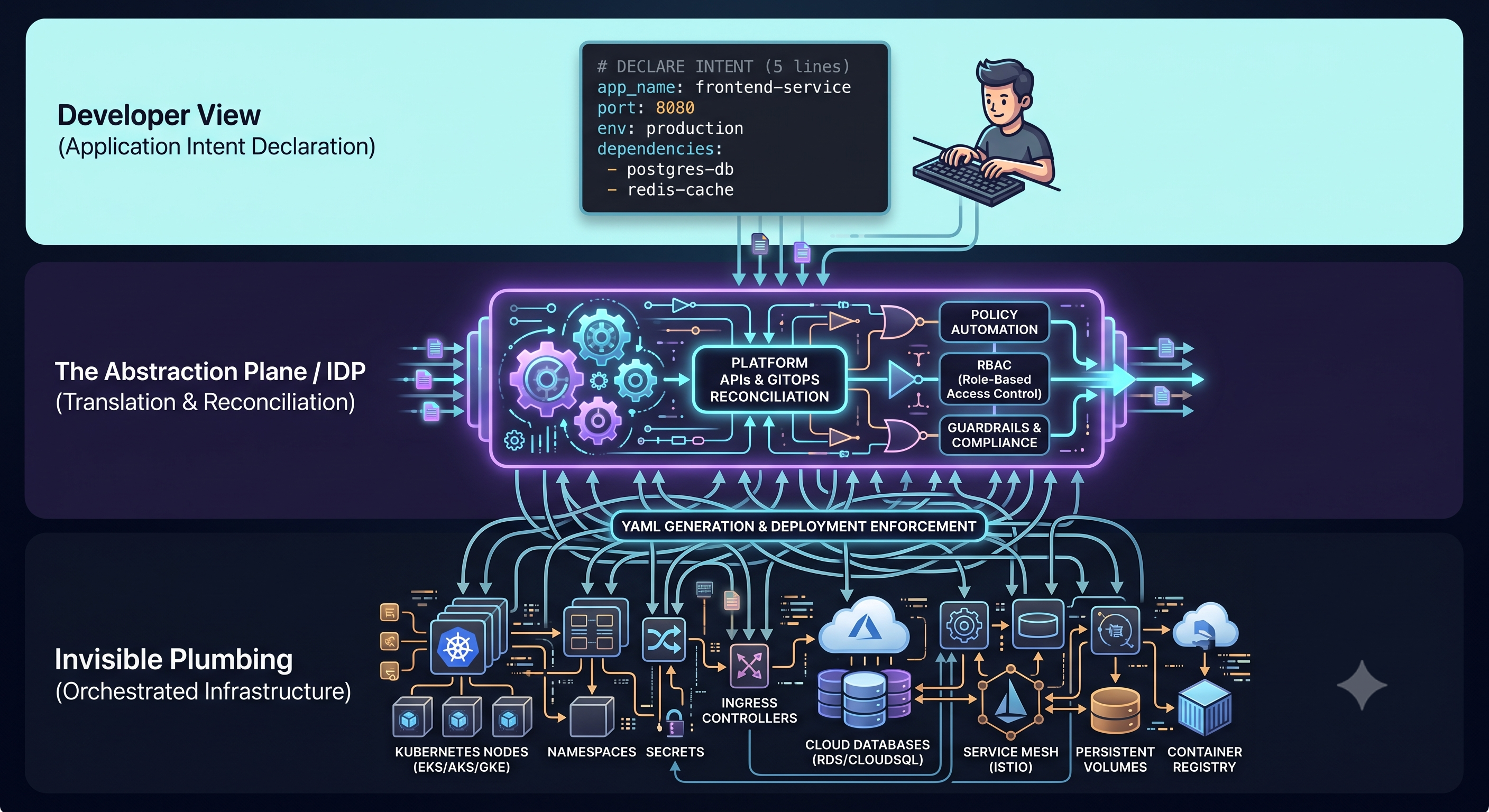
The core promise of Platform Engineering was clear: reduce cognitive load and turn Kubernetes into invisible plumbing. Yet across the industry, IDP adoption frequently stalls at "Day 2." Teams build elaborate platform layers using tools like Crossplane, Backstage, or Argo CD, only for developers to bypass them because the abstractions either leak cluster complexity or become rigid bottlenecks.
The failure point rarely stems from the tooling; it’s an abstraction boundary problem.
When platform teams treat Kubernetes resources as the base unit exposed to application developers, developers are still forced to think in infrastructure primitives (Pods, ConfigMaps, Persistent Volume Claims) rather than application intent (Compute, Storage, Secret, Route).
Architectural Takeaway: Move from "Infrastructure Exposer" to "Intent-Based Golden Paths"
Decouple App Intent from Infrastructure Control Planes: Developers should declare what their application requires (e.g., type: web-service, database: postgres, traffic: public), not how Kubernetes orchestrates it. Use composite resource definitions (XRDs) or open standards like Open Application Model (OAM) to map intent to infrastructure under the hood.
Shift-Left Guardrails, Shift-Down Mechanics: Instead of forcing developers to configure security policies, Pod Disruption Budgets, or network policies in GitOps repos, bake these into the platform's control loop via admission controllers and mutation webhooks automatically.
Treat the Platform as a Product, Not a Mandate: Measure platform success by time-to-first-PR and self-service recovery rates, not cluster count. If an abstraction leaks raw kubectl debugging back onto product teams during a deployment failure, the abstraction has failed.
Discussion Question
Where do you draw the abstraction boundary in your organization? Do you allow application teams direct access to Kubernetes manifests and Helm values, or do they deploy strictly via high-level self-service APIs and service catalogs? What broke when you tried to enforce it?
CTA
Share your real-world deployment experiences in the comments below. Let’s compare notes on what works—from golden path setups to the messy edge cases of developer adoption.
The core promise of Platform Engineering was clear: reduce cognitive load and turn Kubernetes into invisible plumbing. Yet across the industry, IDP adoption frequently stalls at "Day 2." Teams build elaborate platform layers using tools like Crossplane, Backstage, or Argo CD, only for developers to bypass them because the abstractions either leak cluster complexity or become rigid bottlenecks.
The failure point rarely stems from the tooling; it’s an abstraction boundary problem.
When platform teams treat Kubernetes resources as the base unit exposed to application developers, developers are still forced to think in infrastructure primitives (Pods, ConfigMaps, Persistent Volume Claims) rather than application intent (Compute, Storage, Secret, Route).
Architectural Takeaway: Move from "Infrastructure Exposer" to "Intent-Based Golden Paths"
Decouple App Intent from Infrastructure Control Planes: Developers should declare what their application requires (e.g., type: web-service, database: postgres, traffic: public), not how Kubernetes orchestrates it. Use composite resource definitions (XRDs) or open standards like Open Application Model (OAM) to map intent to infrastructure under the hood.
Shift-Left Guardrails, Shift-Down Mechanics: Instead of forcing developers to configure security policies, Pod Disruption Budgets, or network policies in GitOps repos, bake these into the platform's control loop via admission controllers and mutation webhooks automatically.
Treat the Platform as a Product, Not a Mandate: Measure platform success by time-to-first-PR and self-service recovery rates, not cluster count. If an abstraction leaks raw kubectl debugging back onto product teams during a deployment failure, the abstraction has failed.
Discussion Question
Where do you draw the abstraction boundary in your organization? Do you allow application teams direct access to Kubernetes manifests and Helm values, or do they deploy strictly via high-level self-service APIs and service catalogs? What broke when you tried to enforce it?
CTA
Share your real-world deployment experiences in the comments below. Let’s compare notes on what works—from golden path setups to the messy edge cases of developer adoption.
The Platform Engineering Paradox: Why Your Internal Developer Platform (IDP) Is Leaking Kubernetes Complexity
The core promise of Platform Engineering was clear: reduce cognitive load and turn Kubernetes into invisible plumbing. Yet across the industry, IDP adoption frequently stalls at "Day 2." Teams build elaborate platform layers using tools like Crossplane, Backstage, or Argo CD, only for developers to bypass them because the abstractions either leak cluster complexity or become rigid bottlenecks.
The failure point rarely stems from the tooling; it’s an abstraction boundary problem.
When platform teams treat Kubernetes resources as the base unit exposed to application developers, developers are still forced to think in infrastructure primitives (Pods, ConfigMaps, Persistent Volume Claims) rather than application intent (Compute, Storage, Secret, Route).
Architectural Takeaway: Move from "Infrastructure Exposer" to "Intent-Based Golden Paths"
Decouple App Intent from Infrastructure Control Planes: Developers should declare what their application requires (e.g., type: web-service, database: postgres, traffic: public), not how Kubernetes orchestrates it. Use composite resource definitions (XRDs) or open standards like Open Application Model (OAM) to map intent to infrastructure under the hood.
Shift-Left Guardrails, Shift-Down Mechanics: Instead of forcing developers to configure security policies, Pod Disruption Budgets, or network policies in GitOps repos, bake these into the platform's control loop via admission controllers and mutation webhooks automatically.
Treat the Platform as a Product, Not a Mandate: Measure platform success by time-to-first-PR and self-service recovery rates, not cluster count. If an abstraction leaks raw kubectl debugging back onto product teams during a deployment failure, the abstraction has failed.
Discussion Question
Where do you draw the abstraction boundary in your organization? Do you allow application teams direct access to Kubernetes manifests and Helm values, or do they deploy strictly via high-level self-service APIs and service catalogs? What broke when you tried to enforce it?
CTA
Share your real-world deployment experiences in the comments below. Let’s compare notes on what works—from golden path setups to the messy edge cases of developer adoption.

 Arabic
 French
 Spanish
 Portuguese
 Deutsch
 Turkish
 Dutch
Dutch
 Italiano
 Russian
 Romaian
 Portuguese (Brazil)
 Greek
Greek