


The 2026 Technical Interview Pivot: Why "Code Generation" Is Dead and "Code Audit & Verification" Gets You Hired
A major bifurcation has taken over tech hiring: pure implementation questions are being replaced by System Architecture, Live Code Auditing, and Verification-First assessments.
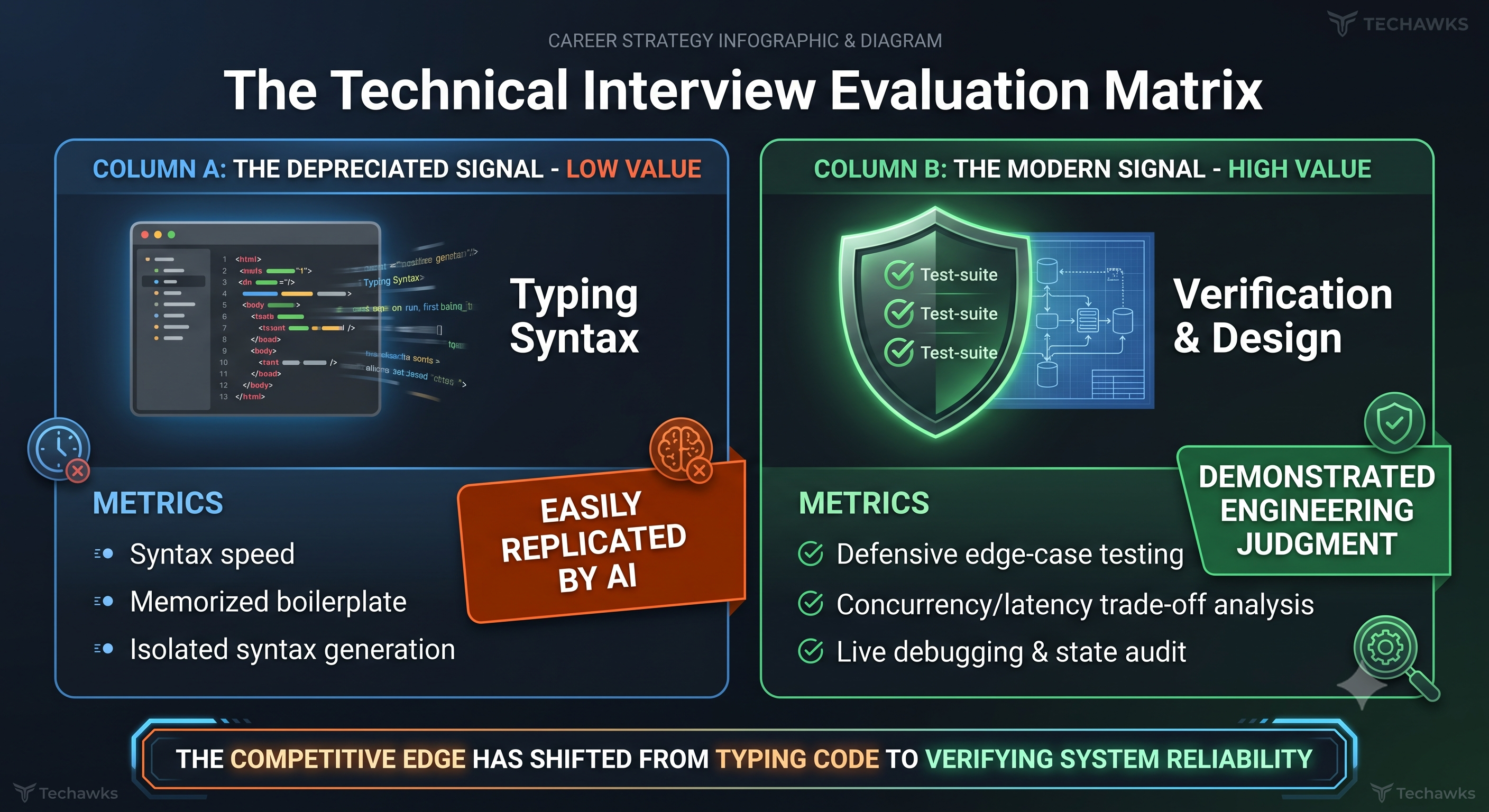
Hiring managers now operate in an environment where AI assistants can output 50 lines of boilerplate syntax in two seconds. As a result, the value of an engineer is no longer measured by how fast they generate code, but by their ability to audit, secure, and stress-test automated outputs.
If you want to clear engineering interviews today, your preparation framework needs to evolve across three critical areas:
1. Shift from "Code Author" to "System Auditor"
In live rounds, interviewers increasingly provide functional or AI-scaffolded snippets with subtle concurrency flaws, edge-case memory leaks, or missing rollback safety.
The winning move: Before writing or accepting code, verbally identify the boundary conditions: How does this handle non-idempotent network drops? What happens during cache staleness? Where are the unhandled exceptions?
2. Master "Verification-First" Design
Candidates who pass today do not jump directly into problem implementation.
Start by defining strict schema interfaces and writing failing integration/unit tests before a single line of business logic is touched.
Showing an interviewer that you design the test harness first demonstrates that you understand production guardrails—a quality distinguishing reliable hires from mere prompt copy-pasters.
3. Anchor Every Decision in Trade-Offs
When asked to evaluate two architectural approaches, steer clear of generic answers like "it depends." Quantify trade-offs explicitly:
Network hops vs. compute latency
Eventual consistency vs. transactional lock overhead
Read-heavy cache invalidation costs vs. cold-start database queries
In the modern hiring market, the code itself is a commodity. Your architectural discernment and defensive testing mindset are the proprietary assets companies are competing to hire.
Discussion Question
For those interviewing or conducting technical screens recently: has your interview format shifted toward live debugging/auditing of pre-written code, or are teams still relying heavily on classical algorithmic challenges?
CTA
Navigate your tech career with clarity.
Join the Tech Jobs & Opportunities community at Techawks for verified job openings, resume teardowns, and modern technical interview playbooks shared by senior engineering leads.
A major bifurcation has taken over tech hiring: pure implementation questions are being replaced by System Architecture, Live Code Auditing, and Verification-First assessments.
Hiring managers now operate in an environment where AI assistants can output 50 lines of boilerplate syntax in two seconds. As a result, the value of an engineer is no longer measured by how fast they generate code, but by their ability to audit, secure, and stress-test automated outputs.
If you want to clear engineering interviews today, your preparation framework needs to evolve across three critical areas:
1. Shift from "Code Author" to "System Auditor"
In live rounds, interviewers increasingly provide functional or AI-scaffolded snippets with subtle concurrency flaws, edge-case memory leaks, or missing rollback safety.
The winning move: Before writing or accepting code, verbally identify the boundary conditions: How does this handle non-idempotent network drops? What happens during cache staleness? Where are the unhandled exceptions?
2. Master "Verification-First" Design
Candidates who pass today do not jump directly into problem implementation.
Start by defining strict schema interfaces and writing failing integration/unit tests before a single line of business logic is touched.
Showing an interviewer that you design the test harness first demonstrates that you understand production guardrails—a quality distinguishing reliable hires from mere prompt copy-pasters.
3. Anchor Every Decision in Trade-Offs
When asked to evaluate two architectural approaches, steer clear of generic answers like "it depends." Quantify trade-offs explicitly:
Network hops vs. compute latency
Eventual consistency vs. transactional lock overhead
Read-heavy cache invalidation costs vs. cold-start database queries
In the modern hiring market, the code itself is a commodity. Your architectural discernment and defensive testing mindset are the proprietary assets companies are competing to hire.
Discussion Question
For those interviewing or conducting technical screens recently: has your interview format shifted toward live debugging/auditing of pre-written code, or are teams still relying heavily on classical algorithmic challenges?
CTA
Navigate your tech career with clarity.
Join the Tech Jobs & Opportunities community at Techawks for verified job openings, resume teardowns, and modern technical interview playbooks shared by senior engineering leads.
The 2026 Technical Interview Pivot: Why "Code Generation" Is Dead and "Code Audit & Verification" Gets You Hired
A major bifurcation has taken over tech hiring: pure implementation questions are being replaced by System Architecture, Live Code Auditing, and Verification-First assessments.
Hiring managers now operate in an environment where AI assistants can output 50 lines of boilerplate syntax in two seconds. As a result, the value of an engineer is no longer measured by how fast they generate code, but by their ability to audit, secure, and stress-test automated outputs.
If you want to clear engineering interviews today, your preparation framework needs to evolve across three critical areas:
1. Shift from "Code Author" to "System Auditor"
In live rounds, interviewers increasingly provide functional or AI-scaffolded snippets with subtle concurrency flaws, edge-case memory leaks, or missing rollback safety.
The winning move: Before writing or accepting code, verbally identify the boundary conditions: How does this handle non-idempotent network drops? What happens during cache staleness? Where are the unhandled exceptions?
2. Master "Verification-First" Design
Candidates who pass today do not jump directly into problem implementation.
Start by defining strict schema interfaces and writing failing integration/unit tests before a single line of business logic is touched.
Showing an interviewer that you design the test harness first demonstrates that you understand production guardrails—a quality distinguishing reliable hires from mere prompt copy-pasters.
3. Anchor Every Decision in Trade-Offs
When asked to evaluate two architectural approaches, steer clear of generic answers like "it depends." Quantify trade-offs explicitly:
Network hops vs. compute latency
Eventual consistency vs. transactional lock overhead
Read-heavy cache invalidation costs vs. cold-start database queries
In the modern hiring market, the code itself is a commodity. Your architectural discernment and defensive testing mindset are the proprietary assets companies are competing to hire.
Discussion Question
For those interviewing or conducting technical screens recently: has your interview format shifted toward live debugging/auditing of pre-written code, or are teams still relying heavily on classical algorithmic challenges?
CTA
Navigate your tech career with clarity.
Join the Tech Jobs & Opportunities community at Techawks for verified job openings, resume teardowns, and modern technical interview playbooks shared by senior engineering leads.

 English
 Arabic
 French
 Portuguese
 Deutsch
 Turkish
 Dutch
Dutch
 Italiano
 Russian
 Romaian
 Portuguese (Brazil)
 Greek
Greek